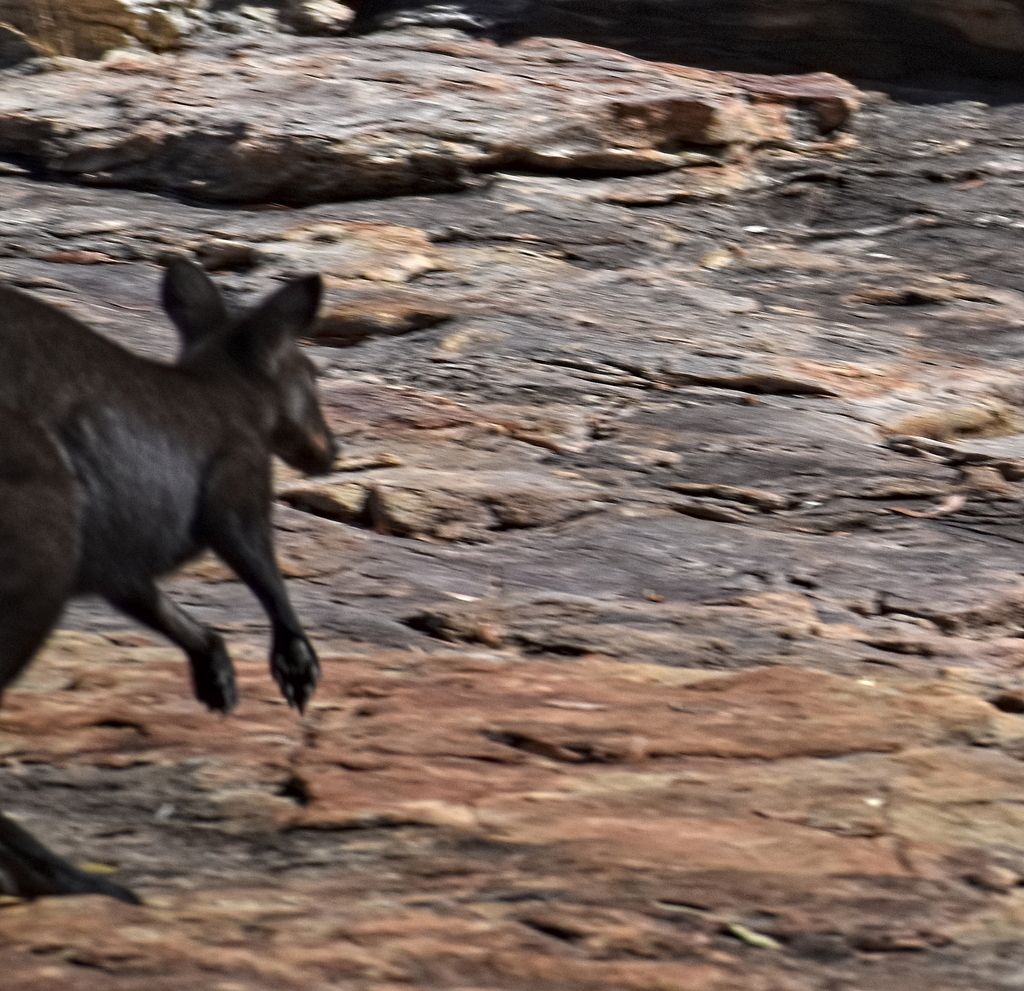
Black Wallaroo
Photo © Wairambar Rainforest
Photo © Wairambar Rainforest — CC BY 4.0 — Source: iNaturalist #120441883The black wallaroo (Osphranter bernardus), also known as Woodward's wallaroo, is a species of macropod restricted to a small, mountainous area in Arnhem Land, Northern Territory, Australia, between South Alligator River and Nabarlek. It classified as near threatened, mostly due to its limited distribution. A large proportion of the range is protected by Kakadu National Park. == Taxonomy == The description of the species was published by Walter Rothschild in 1904. The author initially assigned the species to a new genus as Dendrodorcopsis woodwardi, but revision of new material forwarded to England by the collector John Tunney persuaded the mammalogist Oldfield Thomas that the characteristics of the taxon were assignable to Macropus. The specific epithet woodwardi was preoccupied by another subspecies of the genus (Macropus robustus woodwardi), prompting Rothschild to assign the new epithet bernardus. In 2019, a reassessment of macropod taxonomy determined that the species should be moved from the genus Macropus to the genus Osphranter. This change was accepted by the Australian Faunal Directory in 2020. Other common names of O. bernardus also include black kangaroo, northern black wallaroo, Bernard's kangaroo, and Bernard's wallaroo. == Description == The black wallaroo is a smaller member of the kangaroos and…
Kakadu National Park
Kakadu, Australia
+273 birds+46 mammals
Kakadu National Park is Australia’s largest national park and one of the world’s most remarkable protected areas, covering nearly 20,000 square kilometres in the tropical north…
VIEW NATIONAL PARKNitmiluk National Park
Australia
+186 birds+27 mammals
Dramatic sandstone gorges carved by the Katherine River slice through the tropical savanna of Australia's Top End, creating a landscape where escarpments tower above crystalline pools…
VIEW NATIONAL PARKNo community photos yet. Log in to add the first one.
No community observations of this species yet.