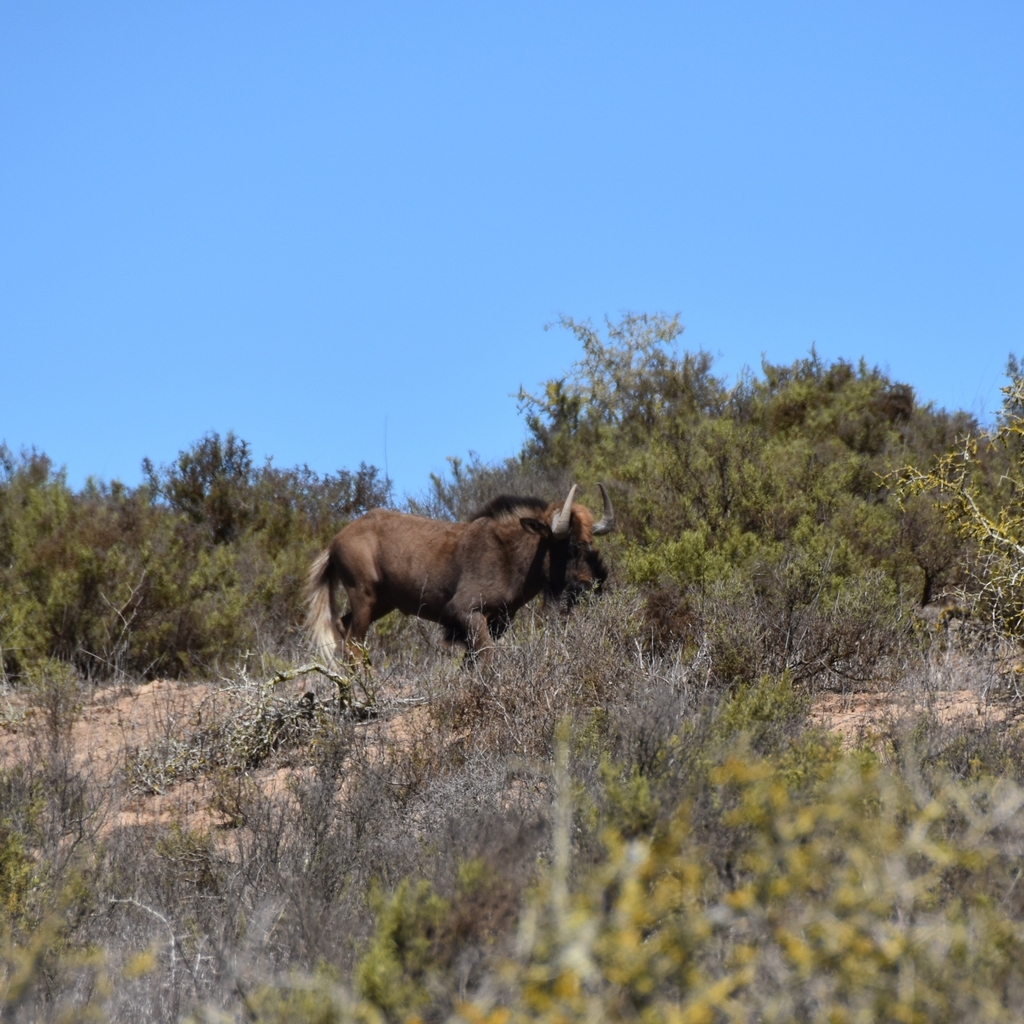
Black Wildebeest
Photo © Nathan Van Cooten
Photo © Nathan Van Cooten — CC BY 4.0 — Source: iNaturalist #267079644Identification
The black wildebeest is a stocky bovine with a distinctly dark appearance, measuring 1.7–2.2 m in head-and-body length and weighing 110–180 kg, with bulls notably larger and darker than cows. The most striking feature is its long, horse-like tail—bright white and measuring 80–100 cm—which immediately distinguishes it from its close relative, the blue wildebeest, and gives rise to the alternative name "white-tailed gnu." The coat is dark brown to black, coarser and shaggier in winter and slightly paler in summer. Males possess a distinctive bushy mane of white or cream-coloured hairs with dark tips running up the back of the neck, while both sexes display long, dark hair between the forelegs and under the belly, plus prominent forward-curving horns that resemble hooks.
Range & Habitat
Endemic to southern Africa, the black wildebeest historically occupied a wide range but was nearly exterminated during the 19th century. Today, it has been reintroduced extensively across Lesotho, Eswatini, and South Africa through private reserves and protected areas, with additional introductions to Namibia and Kenya. The species favours open plains, grasslands, and karoo shrublands—habitats that provide the grasses essential to its diet and access to water, which is a critical requirement for survival.
Behaviour & Diet
Black wildebeest are strict herbivores, feeding almost exclusively on grasses. They are fast runners and live in three distinct social groups: female herds, bachelor herds, and territorial bulls. Communication occurs through a rich repertoire of visual and vocal signals. The breeding season peaks from February to April, with a single calf born after approximately 8.5 months of gestation. Calves remain with their mothers for about a year until the next calf is born. Interestingly, black wildebeest can hybridise with blue wildebeest when confined together, though their differing social behaviours and habitat preferences have historically prevented this in the wild.
Best Time & Places to See It
For the best viewing opportunities, visit South African nature reserves and private game areas, particularly in Lesotho and Eswatini where reintroduction efforts have been most successful. The February to April breeding season offers chances to observe territorial behaviour and bulls engaged in social interactions. Early morning and late afternoon provide optimal viewing conditions, when animals are most active and grass cover is less obscured by midday heat haze.
Photography Tips
The white tail is the signature feature—capture it in profile or rear views to showcase this distinctive characteristic. Photograph bulls during the breeding season to capture their darker colouration and prominent manes. The open grassland habitats offer clear sightlines; use telephoto lenses to isolate individuals against the landscape. Backlighting during golden hour beautifully highlights the mane's texture and the long body hair. For action shots, anticipate the fast running behaviour and use continuous autofocus to track movement across the plains.
Addo Elephant National Park
Camdeboo National Park
Mokala National Park
Mountain Zebra National Park
Nothing matches these filters.
No community photos yet. Log in to add the first one.
No community observations of this species yet.