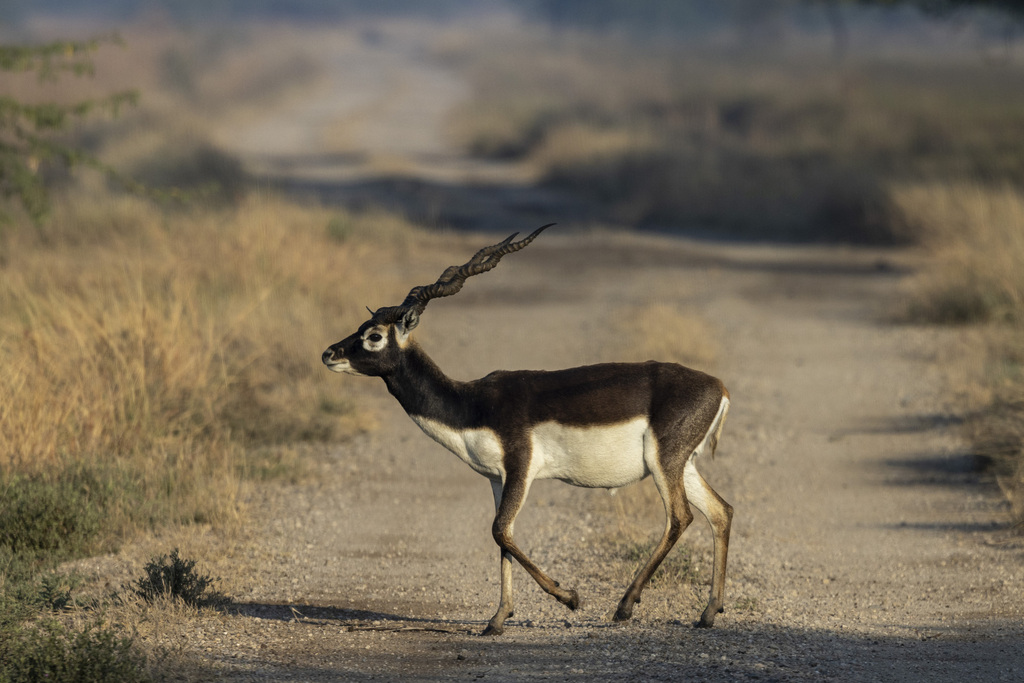
Blackbuck
Photo © Ramesh Shenai Jr.
Photo © Ramesh Shenai Jr. — CC BY 4.0 — Source: iNaturalist photo #602266760Identification
The blackbuck is a medium-sized antelope standing 74 to 84 cm high at the shoulder. Males are distinctly darker than females, with coats ranging from dark brown to black on the dorsal surface, contrasted sharply by white circles around the eyes, white ears, white tail, and white underparts including the belly, lower jaw, and inner legs. The face displays distinctive black stripes, and the white fur on the chin and around the eyes creates a striking pattern. Females and juveniles are considerably lighter, displaying yellowish-fawn to tan colouration with the same white markings rendered in beige tones. Females are also characterized by a pronounced horizontal white side-stripe running from the shoulder to the rump.
Males are considerably heavier than females, weighing an average of 38 kg compared to females' average of 27 kg. The most prominent male feature is their impressive corkscrew horns, measuring 35 to 75 cm in length. Females occasionally develop horns as well, though less prominently. The blackbuck is the sole living member of the genus Antilope, first formally described by Carl Linnaeus in 1758.
Range & Habitat
The blackbuck is native to India and Nepal, with the species occurring mainly throughout India. It historically ranged more widely, but today small and scattered herds are largely confined to protected areas due to twentieth-century declines caused by excessive hunting, deforestation, and habitat destruction. The species is now locally extinct in Pakistan and Bangladesh.
This antelope inhabits grassy plains and lightly forested areas that provide perennial water sources. The species has been introduced to Argentina, Australia, and the United States, primarily on hunting ranches, with populations surviving particularly well in Argentina. In India, hunting of blackbuck is prohibited under Schedule I of the Wildlife Protection Act of 1972, and the species holds cultural significance in Hinduism, with Indian and Nepali villagers traditionally not harming the animal.
Behaviour & Diet
The blackbuck is primarily diurnal, remaining active mainly during daylight hours. The species exhibits a distinctive social structure, forming three types of small groups: female herds, male herds, and young bachelor groups. Males employ a lekking strategy to attract females for mating, establishing territories that exclude other males while permitting females to visit for foraging and mating opportunities.
As herbivores, blackbucks graze on low grasses and occasionally browse on other vegetation. Females achieve sexual maturity at eight months but do not mate before two years of age, while males mature later at 1.5 years. Mating occurs throughout the year, followed by a typical gestation period of six months, after which a single calf is born. The species typically lives 10 to 15 years in lifespan.
Best Time & Places to See It
Travellers seeking blackbuck should focus on protected areas within India, where small and scattered herds are largely concentrated today. The species' native range spans India and Nepal, though populations are now fragmented across these countries. Given the animal's diurnal activity patterns, daytime visits to suitable habitats offer the best viewing opportunities.
Since mating occurs year-round and the species is active during the day, visiting protected areas during the dry season may concentrate animals around perennial water sources, potentially improving viewing chances. Local guides at protected areas can direct visitors to known herds and explain the seasonal movements and behavioural patterns of resident populations.
Photography Tips
The blackbuck's striking sexual dimorphism offers excellent photographic subjects. Males' dramatic dark colouration contrasts beautifully with their white facial markings and eye rings, particularly in strong daylight. Capture the distinctive corkscrew horns in profile to showcase their impressive length and spiral structure, and focus on the sharp facial patterns with their black stripes and white chin markings.
Females and juveniles present softer colour palettes in yellowish-fawn and tan tones, with the horizontal white side-stripe providing a compositional element. The animals' gregarious nature, particularly their formation of single-sex herds and the males' territorial lekking behaviour, offers opportunities for group shots. Since blackbucks are primarily diurnal, plan photography during morning and late afternoon when light is most favourable, and approach quietly to avoid startling the alert, wary herds.
Kanha Tiger Reserve
Kanha Kisli F.V., India
+321 birds+23 mammals
Where sal forests give way to emerald meadows and crystalline streams carve through ancient valleys, one of India's finest wilderness reserves unfolds across the Maikal Range.…
VIEW NATIONAL PARKKeoladeo National Park
Shreenagar Rural, India
+326 birds+14 mammals
Where shallow wetlands shimmer beneath vast Rajasthani skies, one of Asia's finest bird sanctuaries pulses with extraordinary life. This former maharaja's hunting reserve, now spanning 29…
VIEW NATIONAL PARKGir National Park
Asundrali, India
+258 birds+13 mammals
Dry deciduous forests cloak the rolling hills of western Gujarat where the Gir landscape rises as a final sanctuary for one of the world's rarest felids:…
VIEW NATIONAL PARKSanta Ana National Wildlife Refuge
Hidalgo County, United States
+349 birds+12 mammals
Where the Rio Grande delta meets the semi-arid scrublands of South Texas, Santa Ana National Wildlife Sanctuary preserves a rare mosaic of wetland and thornforest habitat…
VIEW WILDLIFE SANCTUARYNo community photos yet. Log in to add the first one.
No community observations of this species yet.