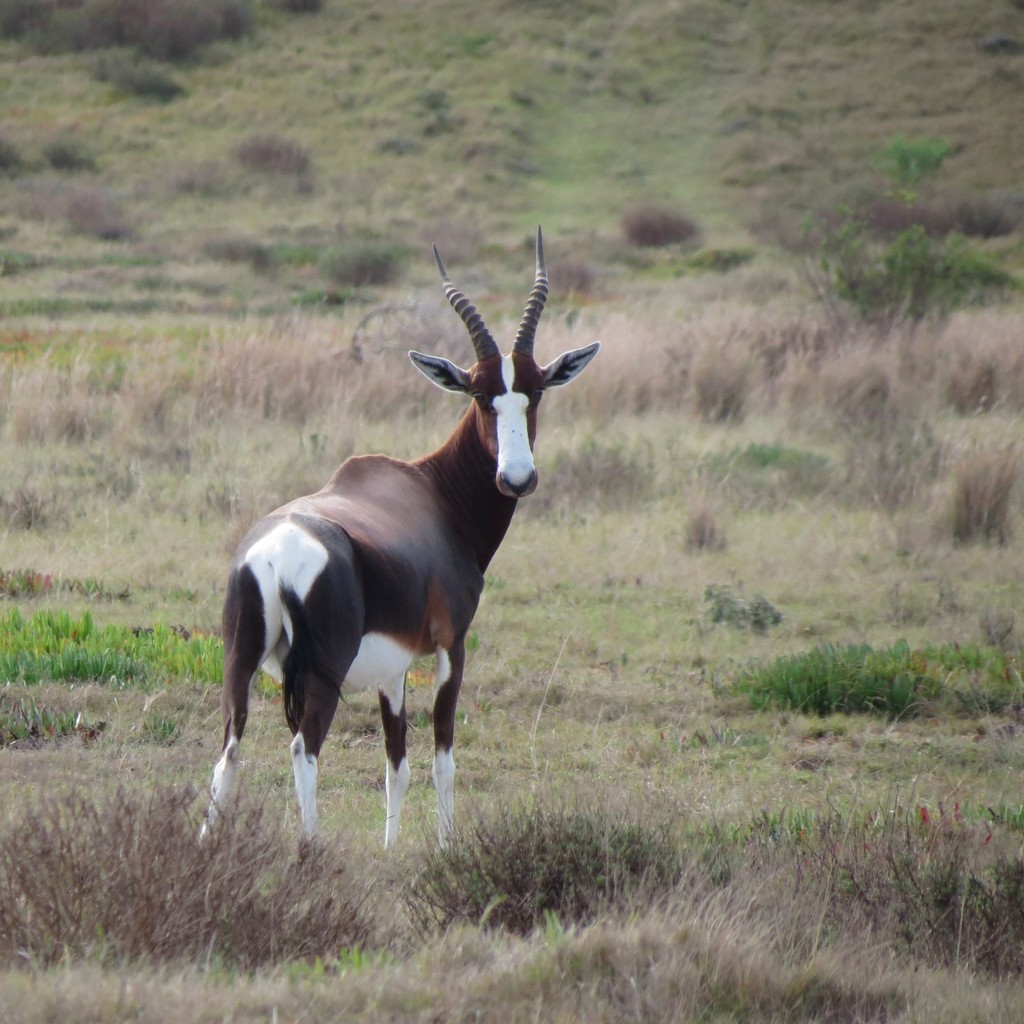
Bontebok
Photo © Christiaan Viljoen
Photo © Christiaan Viljoen — CC BY 4.0 — Source: iNaturalist #54922374Identification
The bontebok is a tall, medium-sized antelope standing 0.8 to 1 m high at the shoulder, with a body length of 1.2 to 1.6 m and a distinctive tail measuring 30 to 60 cm. Males are noticeably larger and heavier than females, typically weighing 50 to 68 kg. The species is instantly recognizable by its chocolate-brown coat contrasting sharply with white undersides and a striking white stripe running from the forehead to the tip of the nose. A distinctive white patch surrounds the tail, giving the bontebok its Latin name. Both sexes possess elegant, lyre-shaped horns reaching up to half a metre in length, clearly ringed along their entire length. The blesbok subspecies differs subtly, featuring a brown stripe across the white facial blaze and a light brown or tan patch around the tail rather than pure white.
Range & Habitat
The bontebok is found in South Africa, Lesotho, and Namibia, with two distinct subspecies occupying different regions. The nominate subspecies occurs naturally in the coastal Fynbos and Renosterveld areas of the Western Cape, while the blesbok subspecies inhabits the Highveld grasslands. These antelope are diurnal animals, remaining active during cooler parts of the day but resting during the intense midday heat. They prefer short-grass habitats and are particularly adapted to their respective ecosystems.
Behaviour & Diet
Bontebok are grazers that feed on short grasses in their specialized habitats. They are not accomplished jumpers, but possess a remarkable ability to crawl under obstacles—an adaptation that proved crucial to their survival during conservation efforts. They live in herds that vary in composition, containing males only, females only, or mixed groups, though bontebok herds typically do not exceed 40 animals. Mature males are territorial and engage in displays and occasional fights to maintain and defend their ranges.
Best Time & Places to See It
Today, bontebok are very abundant and can be reliably seen on farms and reserves throughout their range in South Africa. Bontebok National Park, established in 1931 and relocated in 1961 to better suit the species' needs, remains an excellent destination for observing these antelope. The current population is estimated at 2,500 to 3,000 individuals, making encounters relatively straightforward for dedicated wildlife visitors.
Photography Tips
The bontebok's striking contrast between rich chocolate-brown and crisp white markings makes it highly photogenic, particularly in clear light that emphasizes these color divisions. The distinctive white facial blaze and white tail patch are key identifying features worth capturing. Photograph territorial males during cooler morning and late afternoon hours when they are most active and engaged in displays. The animals' preference for short grasslands often provides clean, uncluttered backgrounds ideal for wildlife photography. Their moderate size and relatively approachable behavior on reserves make them excellent subjects for both telephoto and wider landscape compositions.
Agulhas National Park
Bontebok National Park
Camdeboo National Park
Garden Route National Park
Mokala National Park
Mountain Zebra National Park
Pilanesberg National Park
Nothing matches these filters.
No community photos yet. Log in to add the first one.
No community observations of this species yet.