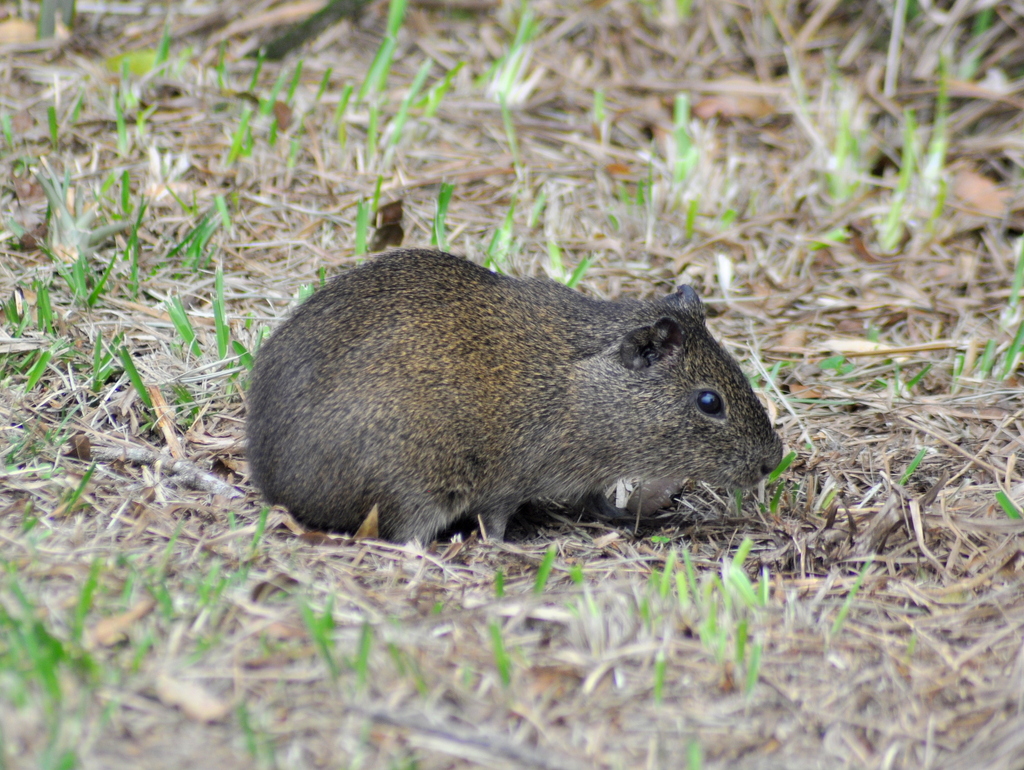
Brazilian Guinea Pig
Photo © vinicius_s_domingues
Photo © vinicius_s_domingues — CC BY 4.0 — Source: iNaturalist photo #475695740The Brazilian guinea pig (Cavia aperea) (preá in Portuguese) is a wild guinea pig species found in Argentina, Brazil, Bolivia, Colombia, Ecuador, Guyana, Paraguay, Uruguay and Venezuela. Cavia aperea has been successfully mated to the domestic guinea pig, Cavia porcellus, though many females become infertile in successive generations. Brazilian guinea pigs are mainly diurnal animals and are narrower and longer than domesticated guinea pigs. == Description == This is a medium-sized guinea pig with an adult length of about 272 mm (11 in) and a weight of 637 grams (22.5 oz). The tail, at around 2.4 mm, is almost non-existent. The dorsal fur is dark olive-brown mixed with brown and black, and the underparts are a pale grey or yellowish-grey. Its karyotype has 2n = 64 and a reportedly variable FN of 116 or 128 for C. a. aperea and 128 for C. a. pamparum. == Distribution == The Brazilian guinea pig has a wide distribution in South America at altitudes between 400 and 3,000 metres (1,300 and 9,800 ft) above sea level. Its range extends from Colombia, Ecuador and Venezuela to areas in the north of Argentina. Its typical habitat is open grassland and savannah. == Behaviour == Cavia…
Natural Chingaza National Park
Junín, Colombia
+285 birds+6 mammals
Where the Andes rise above three thousand metres in the Cundinamarca region, high-altitude grasslands and cloud forests converge in a landscape shaped by both geology and…
VIEW NATIONAL PARKNatural Sumapaz National Park
Cubarral, Colombia
+368 birds+1 mammals
Where the Andes descend toward the Amazon basin, the high páramo grasslands of Sumapaz National Park sprawl across more than five thousand square kilometers of Meta…
VIEW NATIONAL PARKIguaçu National Park
Brazil
+387 birds+17 mammals
Where the Paraná Plateau plunges toward the Atlantic watershed, six thousand square kilometers of subtropical rainforest cling to steep gorges and river valleys in this corner…
VIEW NATIONAL PARKRío Pilcomayo National Park
Argentina
+271 birds+13 mammals
Where the Río Pilcomayo cuts through northeastern Argentina's subtropical lowlands, a sprawling mosaic of wetlands, grasslands, and seasonally flooded forests creates one of South America's most…
VIEW NATIONAL PARKNo community photos yet. Log in to add the first one.
No community observations of this species yet.