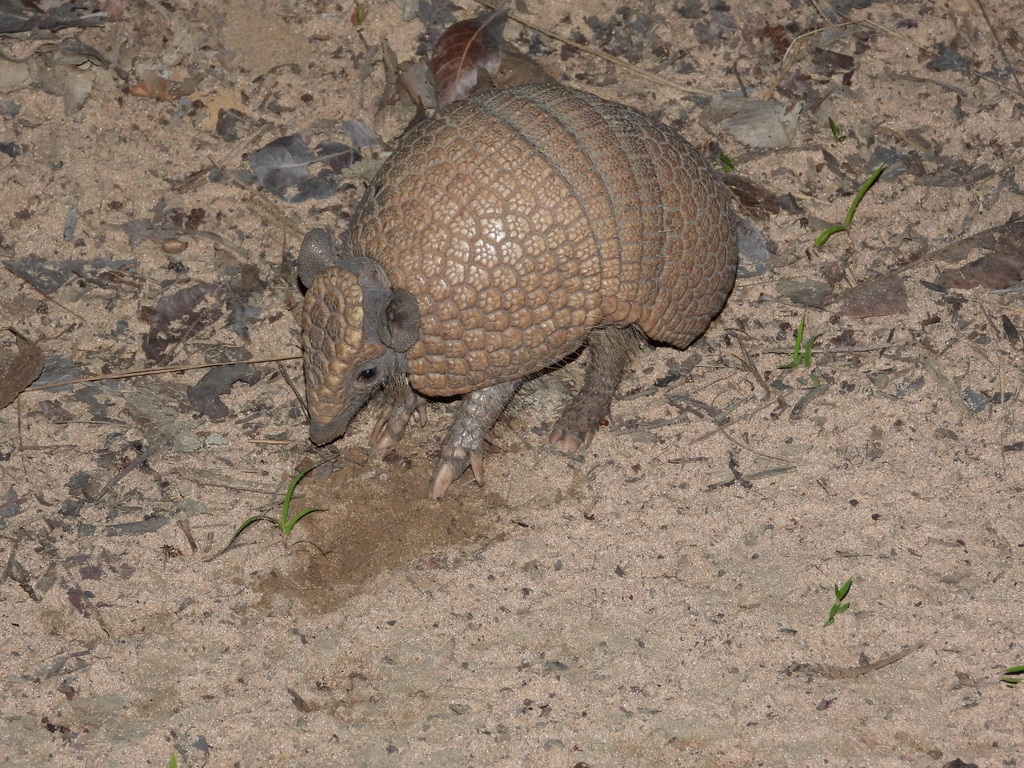
Brazilian Three-banded Armadillo
Photo © Reuber Brandão
Photo © Reuber Brandão — CC BY 4.0 — Source: iNaturalist #259637571The Brazilian three-banded armadillo (Tolypeutes tricinctus) is an armadillo species endemic to eastern Brazil, where it is known as tatu-bola (Portuguese pronunciation: [tɐˈtu ˈbɔlɐ], lit. ball armadillo). It is one of only two species of armadillo that can roll into a ball (the other is the southern three-banded armadillo). == Names == It was known as kwaráu in the extinct Huamoé language of the Serra Negra in Pernambuco State, Brazil, and as ˈkʌ̨́ñíkį̀ in the extinct Kambiwá language of Barreira, Petrolândia, Pernambuco. == Anatomy == Brazilian three-banded armadillos have a head-and-body length of about 22 to 27 cm (8.7 to 10.6 in) and the tail is between 6 and 8 cm (2.4 and 3.1 in) long. They weigh 1–1.6 kg (2.2–3.5 lb). The armor is composed of ossified dermal scutes covered by nonoverlapping, keratinized epidermal scales, which are connected by flexible bands of skin. This armor covers the back, sides, head, tail, ears, and outside surfaces of the legs. The underside of the body and the inner surfaces of the legs have no armored protection, and are covered instead by long, coarse hair. The genus Tolypeutes, which includes both the Brazilian and southern species of three-banded armadillos, is unique in…
No community photos yet. Log in to add the first one.
No community observations of this species yet.