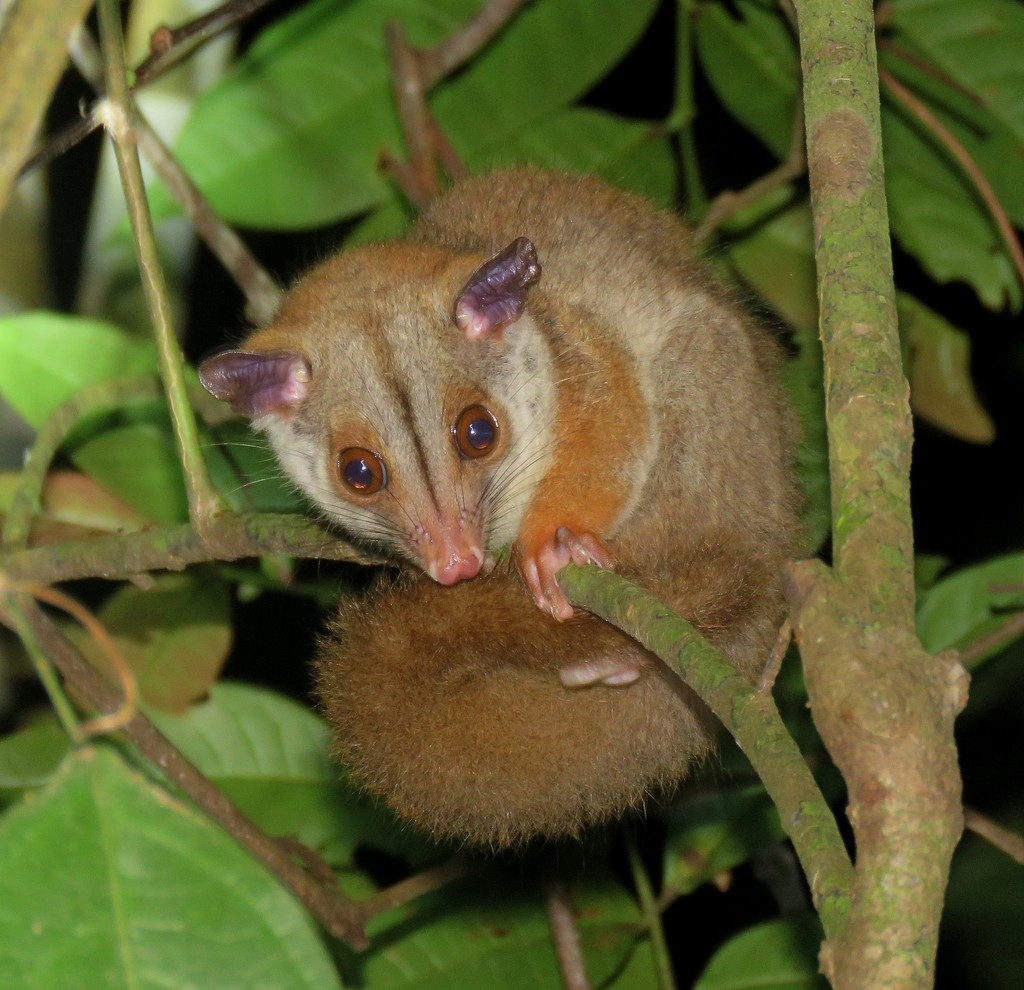
Brown-eared Woolly Opossum
Photo © Sidnei Dantas
Photo © Sidnei Dantas — CC BY-SA 4.0 — Source: iNaturalist #71397018Identification
The brown-eared woolly opossum is a small, distinctive marsupial characterized by a brown to reddish-brown coat with similarly colored limbs and a striking yellow to orange underbelly. Its most recognizable features include hairless, brown ears with a hint of pink, and faint orange rings circling the eyes on a grayish-white face. A dark stripe runs from the nose between the eyes up to the back of the ears. The coat is fairly long, soft and thick, and may be tinged with gray or develop orange shading on the shoulders, limbs and crown.
The tail is particularly distinctive: furred on the back for up to half its length and increasingly bare towards the tip, with the last 30 percent naked and typically white with a yellowish tinge spotted with brown. This semi-naked tail is a key identifying feature that distinguishes it from related species. Head-and-body length ranges from 20 to 32 centimetres, with a tail measuring 33 to 45 centimetres, and the animal weighs only 31–52 grams—making it a genuinely tiny arboreal mammal.
Range & Habitat
The brown-eared woolly opossum inhabits humid tropical forests across much of northern and central South America, with a range east of the Andes. Its distribution spans from Bolivia and central Colombia through eastern Ecuador and Peru, to western and southern Venezuela, and extends into Brazil (western, central and southern regions), eastern and southern Paraguay, and northeastern Argentina. Four recognized subspecies occupy slightly different portions of this broad range, with variations in coloration across populations.
These opossums prefer humid tropical forests—including primary, secondary and gallery forests—as well as plantations, mangrove swamps and xerophytic forests. They also inhabit the more densely wooded parts of the cerrado and pantanal. Typically occurring up to 500 metres above sea level, individuals have been recorded as high as 2,600 metres. The species is currently listed as least concern by the IUCN due to its wide distribution and presumably large populations, though deforestation threatens it in some parts of its range.
Behaviour & Diet
The brown-eared woolly opossum is strictly nocturnal, active only at night, and generally solitary—though individuals have occasionally been observed foraging in pairs. The species is omnivorous, feeding on a varied diet that reflects its role in tropical forest ecosystems. Fruits from plants such as Cecropia, Piper and Solanaceae species form a major part of its diet, supplemented by nectar, small invertebrates and vertebrates. Research suggests it is a typical frugivore with a well-developed cecum adapted for digesting plant material.
Beyond its dietary importance, the brown-eared woolly opossum likely plays a role in pollination, particularly of Pseudobombax tomentosum and Quararibea cordata flowers, as it feeds on their nectar. These opossums are generally silent animals. The estrus cycle lasts 27–29 days, and females develop a pouch before carrying young. Litter size ranges from one to four offspring, which is considerably smaller than that of some related species.
Best Time & Places to See It
Since the brown-eared woolly opossum is strictly nocturnal and solitary, observing it requires night-time searching in appropriate habitat. The best opportunities lie in humid tropical forests throughout its range, particularly in primary and secondary forests, gallery forests, and well-wooded plantations in Bolivia, Peru, Ecuador, Colombia, Venezuela and Brazil. The species' preference for forests up to 500 metres elevation (though sometimes higher) makes lowland tropical reserves particularly promising.
Patience and luck are essential, as these small, solitary animals are not commonly encountered. Night walks through suitable forest habitat offer the best chance, particularly in areas where fruiting trees are abundant and nectar-producing flowers are in bloom. The animal's generally silent nature means visual detection is far more likely than auditory detection.
Photography Tips
Photographing the brown-eared woolly opossum presents real challenges due to its nocturnal habits, small size and solitary, elusive behavior. Successful photographers will need quality night-vision equipment or high-powered headlamps combined with a camera capable of low-light performance. A macro or telephoto lens is advisable to capture details of this diminutive animal while maintaining a respectful distance and avoiding disturbance.
Focus on the distinctive features: the characteristic facial markings including the dark nasal stripe and orange eye-rings, the brown ears, and especially the unique semi-naked tail with its spotted, pale terminal section. Given the animal's small size (31–52 grams), patience and slow, deliberate movement through forest at night will maximize your chances of an encounter that allows for photography.
No community photos yet. Log in to add the first one.
No community observations of this species yet.