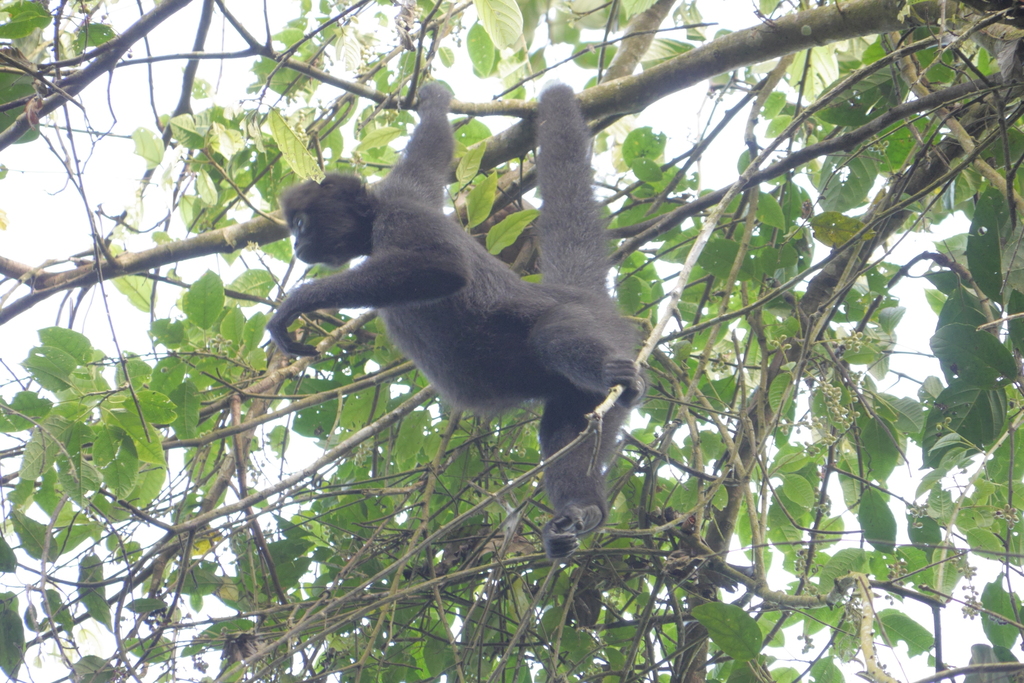
Brown-headed Spider Monkey
Photo © Nico
Photo © Nico — CC0 1.0 — Source: iNaturalist photo #244044205Identification
The brown-headed spider monkey is one of the largest New World primates, with a head and body length typically ranging from 39 to 54 centimetres, complemented by an impressively long prehensile tail measuring 71 to 86 centimetres. The two subspecies show distinct markings: the northwestern Ecuadorian form (A. f. fusciceps) displays a brown head contrasting with a black or brown body, while the Colombian and Panamanian subspecies (A. f. rufiventris) is entirely black with distinctive white markings on the chin. Both sexes are similarly sized, with males averaging 8.89 kilograms and females slightly lighter at 8.8 kilograms.
Range & Habitat
This species inhabits the rainforests of Central and South America, with populations occurring in Colombia, Ecuador, and Panama. The northwestern Ecuadorian subspecies occupies tropical and subtropical humid forests between 100 and 1,700 metres elevation, while the Colombian and Panamanian populations are more adaptable, thriving in dry forests, humid forests, and cloud forests at elevations reaching up to 2,500 metres. Population densities remain modest, typically around 1.2 individuals per square kilometre in the Ecuadorian range.
Behaviour & Diet
Brown-headed spider monkeys are highly arboreal and active during daylight hours, moving through the forest canopy primarily by brachiation and climbing. They are highly sociable animals, living in groups of up to 20 individuals, though they typically travel and forage in smaller subgroups. Their diet is predominantly frugivorous, with fruit comprising approximately 80 percent of their food intake, supplemented by leaves, nuts, seeds, bark, insects, and flowers. Females give birth every three years, with infants remaining dependent on their mothers' backs for 16 weeks and nursing until 20 months of age.
Best Time & Places to See It
Your best chances of observing this species occur in protected forest reserves and national parks throughout Colombia, Ecuador, and Panama. Early morning hours offer the greatest likelihood of sightings, as the monkeys are most active at dawn. The Ecuadorian subspecies, restricted to the northwestern forests, may be more accessible in certain protected areas, while the Colombian and Panamanian populations occupy a broader range of forest habitats. However, be aware that this species is classified as endangered, with populations having declined by more than 50 percent over recent decades due to hunting and habitat loss.
Photography Tips
The brown-headed spider monkey's acrobatic movements through the canopy and distinctive silhouette make for compelling wildlife photography. Fast shutter speeds are essential to capture their dynamic brachiating behaviour, and a telephoto lens will help you maintain distance while obtaining detailed facial portraits. The contrasting coloration of the northwestern subspecies, particularly the brown head against darker fur, provides excellent compositional opportunities. Early morning light filtering through the forest canopy will best reveal the subtle colour variations between the subspecies. Patience is crucial, as these monkeys can be difficult to locate and track, but their social nature means that photographing groups yields dynamic multi-subject compositions.
No community photos yet. Log in to add the first one.
No community observations of this species yet.