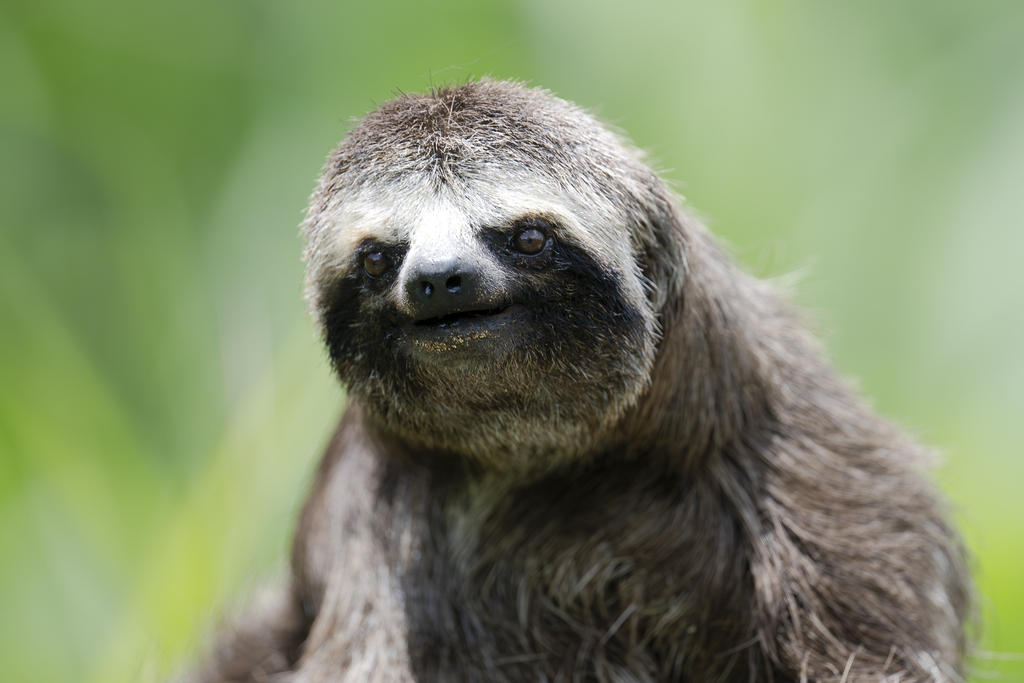
Brown-throated Three-toed Sloth
Photo © Charlotte Kirchner
Photo © Charlotte Kirchner — CC BY 4.0 — Source: iNaturalist photo #612370704Identification
The brown-throated three-toed sloth is a compact, slow-moving mammal measuring 42 to 80 cm in body length, with a short tail of only 2.5 to 9 cm. Adults weigh between 2.25 and 6.3 kg, with no significant size difference between males and females. Each foot bears three curved claws—7 to 8 cm long on the front feet and 5 to 5.5 cm on the hind feet—perfectly adapted for life in the trees. The head is rounded with a blunt nose and inconspicuous ears, and the animal's most distinctive feature is its dark brown throat and face markings, including a stripe of very dark fur running beneath the eyes. The fur is grayish-brown to beige across the body, with a soft inner layer beneath a coarser, woolly outer coat that often hosts algae growth, sometimes lending the animal a greenish tint.
One of the sloth's most remarkable anatomical features is its exceptional neck flexibility—approximately 10 cervical vertebrae allow the head to rotate up to 270 degrees. Their teeth are unusual, lacking enamel and including no incisors or canines, only simple, peg-like cheek teeth. The sloth's hair structure is itself fascinating: the strands lack a central medulla and are covered with microscopic cracks that harbor commensal algae species and fungi, some of which possess anti-parasitic, anti-cancer, and anti-bacterial properties.
Range & Habitat
The brown-throated three-toed sloth is the most widespread and common of the five three-toed sloth species. Its range extends from Honduras in the north through Central America and into South America, including Nicaragua, Costa Rica, Panama, Venezuela, Colombia, Ecuador, Bolivia, Brazil, and eastern Peru. Although they once inhabited Argentina, they are now believed to be extinct there.
These sloths are highly adaptable and thrive in a variety of tropical environments, including rainforests, semi-deciduous forests, subtropical lowlands, and swamps. They are generally found from sea level to 1,200 meters in elevation, though some individuals have been recorded at higher elevations. Brown-throated sloths inhabit the forest canopy and are strong swimmers, though they rarely descend to the ground. They often favor trees with sun-exposed crowns, likely to help regulate their body temperature, but do not show preference for specific tree species.
Behaviour & Diet
Brown-throated sloths are extraordinarily sedentary, sleeping 15 to 18 hours each day and remaining active only during brief periods with no preference for day or night activity—they are cathemeral. They are most active between 12:00 and 18:00, typically sleeping between 06:00 and 12:00. While capable of walking on the ground and swimming, they spend virtually their entire lives suspended in the high branches of trees, descending approximately once every eight days to defecate on the forest floor.
The brown-throated sloth is entirely herbivorous, feeding on young leaves from a wide range of trees—particularly those of the genus Cecropia—as well as flowers and fruits. They maintain remarkably small home ranges of 0.5 to 9 hectares and may visit only around 40 trees within a typical 5-hectare range. Adult animals are solitary except when caring for young, and males have been observed fighting one another using their powerful forelimbs. Their multi-chambered stomachs contain specialized microorganisms essential for digesting cellulose from their plant-based diet.
Best Time & Places to See It
The brown-throated three-toed sloth's broad range across Central and South America offers multiple opportunities for wildlife travelers to encounter this species. Look for them throughout their range in Honduras, Nicaragua, Panama, Colombia, Ecuador, Peru, Brazil, Bolivia, and Venezuela, where they are the most common three-toed sloth species. They inhabit rainforests and other tropical forest habitats from sea level to 1,200 meters elevation.
Since brown-throated sloths are cathemeral with no strict day-night rhythm, they can potentially be seen at any hour, though they are most active between midday and early evening. Patience is essential; scan the high canopy for motionless forms hanging among the branches, particularly in trees with exposed crowns. Your best chance of spotting one is to observe the forest canopy slowly and carefully, as their cryptic nature and sedentary lifestyle make them easy to overlook.
Photography Tips
Photographing brown-throated sloths requires patience and preparation. These animals spend most of their time perfectly still in the high canopy, so successful photography demands a telephoto lens to reach distant subjects among the treetops. Early morning or midday light works best for illuminating the canopy, and the sloth's dark facial markings and distinctive brown throat provide good contrast for exposure metering.
Look for individuals in trees with sun-exposed crowns, where they position themselves to regulate body temperature and where lighting conditions are most favorable. Since sloths move minimally and predictably through a limited home range of trees, spending time in one productive forest location increases your chances of repeated encounters. Respect the animal's slowness and maintain distance to avoid disturbing it; the reward is capturing intimate images of one of nature's most remarkable and unhurried creatures.
Tijuca National Park
Brazil
+317 birds+13 mammals
Where the Atlantic forest rises steeply from Rio de Janeiro's urban edge, Tijuca National Park encompasses a landscape of dramatic granite peaks, cascading waterfalls, and closed-canopy…
VIEW NATIONAL PARKCorcovado National Park
Puerto Jiménez, Costa Rica
+444 birds+48 mammals
Where the Osa Peninsula juts into the Pacific, rainforest descends almost to the tide line, and Corcovado National Park protects one of Central America's most intact…
VIEW NATIONAL PARKManuel Antonio National Park
Quepos, Costa Rica
+426 birds+22 mammals
Where tropical rainforest descends steeply to a rocky Pacific coastline, Manuel Antonio National Park distills Central American biodiversity into one of Costa Rica's most compressed and…
VIEW NATIONAL PARKArenal Volcano National Park
Peñas Blancas, Costa Rica
+551 birds+21 mammals
Straddling the border between Alajuela and Guanacaste in northwestern Costa Rica, this national park rises dramatically around one of Central America's most active volcanic systems. The…
VIEW NATIONAL PARKTortuguero National Park
Roxana, Costa Rica
+420 birds+23 mammals
Canals and lagoons thread through a labyrinth of lowland rainforest where the Caribbean coast of Costa Rica meets the wetland frontier. This is terrain shaped by…
VIEW NATIONAL PARKBraulio Carrillo National Park
Las Horquetas, Costa Rica
+547 birds+18 mammals
Where the Caribbean slope descends from the central volcanic cordillera toward the humid lowlands of Heredia, Braulio Carrillo National Park preserves one of Costa Rica's most…
VIEW NATIONAL PARKPiedras Blancas National Park
Golfito, Costa Rica
+386 birds+24 mammals
Where the Golfo Dulce meets the southwestern Pacific coast of Costa Rica, Piedras Blancas National Park protects a dramatic transition zone where lowland rainforest descends toward…
VIEW NATIONAL PARKGuanacaste National Park
Santa Elena, Costa Rica
+461 birds+17 mammals
Where the Pacific slopes of northwestern Costa Rica rise toward the Continental Divide, dry tropical forest gives way to cloud-laden peaks and misty ridges—a landscape that…
VIEW NATIONAL PARKYasuní National Park
Aguarico, Ecuador
+601 birds+43 mammals
Where the western Amazon basin converges with Ecuador's Orellana Province, lowland rainforest reaches toward the horizon in an unbroken canopy of staggering botanical density. Yasuní National…
VIEW NATIONAL PARKNatural Utría National Park
Alto Baudó (Pie de Pató), Colombia
+372 birds+11 mammals
Where the Chocó's coastal mountains plunge toward the Pacific, Utría National Park preserves one of Colombia's most biodiverse and least-visited wilderness expanses. Sprawling across 1,287 square…
VIEW NATIONAL PARKNatural Uramba Bahía Málaga National Park
Buenaventura, Colombia
+308 birds+15 mammals
Where the Pacific coastal rainforest descends to mangrove estuaries and rocky headlands, Uramba Bahía Málaga National Park unfolds across nearly 1,000 square kilometres of Colombia's Valle…
VIEW NATIONAL PARKAmacayacu National Park
Leticia, Colombia
+567 birds+25 mammals
Where the Rio Amazonas curves through the tri-border region where Colombia, Peru, and Brazil converge, Amacayacu National Park sprawls across more than 5,250 square kilometres of…
VIEW NATIONAL PARKSerra da Bocaina National Park
Brazil
+441 birds+5 mammals
Where the escarpment of the Serra da Bocaina rises sharply from the Atlantic coastal plain, tropical rainforest cloaks steep mountainsides that climb toward peaks exceeding 2,000…
VIEW NATIONAL PARKSerra dos Órgãos National Park
Brazil
+446 birds+13 mammals
Granite peaks thrust skyward through the Atlantic Forest canopy in the mountains immediately north of Rio de Janeiro, their bare rock faces rising above a landscape…
VIEW NATIONAL PARKAnavilhanas National Park
Brazil
+468 birds+8 mammals
Across the Rio Negro in central Amazonas, an archipelago of over a thousand islands rises from the world's largest rainforest river system, creating a labyrinth of…
VIEW NATIONAL PARKSerra do Divisor National Park
Brazil
+448 birds+10 mammals
Where the western Amazon meets the Andes foothills, Serra do Divisor National Park sprawls across one of South America's most biodiverse and least accessible frontiers. Spanning…
VIEW NATIONAL PARKManu National Park
Manu, Peru
+892 birds+26 mammals
Across the eastern slopes of the Peruvian Andes, tropical rainforest descends into the Amazon basin with a complexity that few terrestrial ecosystems match. Manu National Park…
VIEW NATIONAL PARKSoberanía National Park
Cristóbal, Panama
+495 birds+34 mammals
Rainforest and riverine woodland blanket the rolling terrain of this 714-square-kilometre national park in Colón Province, where the Caribbean watershed feeds a maze of streams and…
VIEW NATIONAL PARKChagres National Park
Caimitillo, Panama
+486 birds+19 mammals
Where the Chagres River carves through the humid tropics of central Panama, a vast montane and lowland forest sprawls across more than 2,300 square kilometers, anchoring…
VIEW NATIONAL PARKDarién National Park
Tucutí, Panama
+534 birds+13 mammals
Where the spine of Central America crumbles into wetland and rainforest, Darién National Park sprawls across more than 20,000 square kilometres of some of the tropics'…
VIEW NATIONAL PARKPortobelo National Park
Portobelo, Panama
+366 birds+9 mammals
Where the Caribbean's turquoise waters meet the Darién's verdant shore, Portobelo National Park sprawls across 570 square kilometers of coastal forest, mangrove wetland, and coral-fringed islands…
VIEW NATIONAL PARKParque Internacional la Amistad
Teribe, Panama
+325 birds+11 mammals
Where the continental divide rises between the Caribbean and Pacific watersheds, a wilderness of extraordinary biological richness unfolds across the Talamanca Range and into lowland rainforest—a…
VIEW NATIONAL PARKCarara National Park
Tárcoles, Costa Rica
+397 birds+19 mammals
Where the Pacific coastal plain meets transitional forest, Carara National Park straddles one of Central America's most dynamic ecological boundaries. The park's landscape encompasses lowland deciduous…
VIEW NATIONAL PARKCahuita National Park
Talamanca, Costa Rica
+359 birds+15 mammals
Where the Caribbean shoreline dissolves into mangrove creeks and coral gardens, Cahuita's mosaic of habitats unfolds across the Limón coast. The park's signature feature—a living coral…
VIEW NATIONAL PARKRincón de la Vieja National Park
Liberia, Costa Rica
+451 birds+30 mammals
Where volcanic slopes rise abruptly from the Guanacaste lowlands, Rincón de la Vieja National Park sprawls across a landscape shaped by geothermal drama and seasonal extremes.…
VIEW NATIONAL PARKTapantí Macizo de la Muerte National Park
Orosi, Costa Rica
+503 birds+18 mammals
Where montane cloud forest rises steeply from the Orosi Valley, Tapantí Macizo de la Muerte National Park enfolds a landscape of perpetual moisture and emerald complexity.…
VIEW NATIONAL PARKLa Amistad International Park
Crorina, Costa Rica
+532 birds+20 mammals
Where the Caribbean slopes of Costa Rica's Talamanca Mountains rise steeply inland from Limón, the boundary between two nations dissolves into an unbroken expanse of rainforest.…
VIEW NATIONAL PARKVolcán Tenorio National Park
Guatuso, Costa Rica
+480 birds+12 mammals
Where volcanic slopes rise through Costa Rica's northwestern borderlands, Volcán Tenorio National Park sprawls across terrain shaped by ancient lava flows and mineral-rich springs. The park's…
VIEW NATIONAL PARKCaño Negro National Wildlife Refuge
Caño Negro District, Costa Rica
+486 birds+16 mammals
Where the San Juan River's seasonal floodplain opens into expansive wetlands, Caño Negro Wildlife Sanctuary sprawls across one of Central America's most productive freshwater ecosystems. This…
VIEW WILDLIFE SANCTUARYGandoca-Manzanillo National Wildlife Refuge
Manzanillo, Costa Rica
+394 birds+18 mammals
Where the Caribbean coastal plain surrenders to water-logged forest and mangrove tangles, Gandoca-Manzanillo Wildlife Sanctuary shelters one of Costa Rica's most biodiverse lowland wetland ecosystems. The…
VIEW WILDLIFE SANCTUARYBarra del Colorado National Wildlife Refuge
Tortuguero, Costa Rica
+462 birds+36 mammals
Where the Caribbean's restless waters meet the Limón Province coastline, Barra del Colorado National Wildlife Sanctuary unfolds across a landscape of extraordinary ecological complexity. This equatorial…
VIEW WILDLIFE SANCTUARYNo community photos yet. Log in to add the first one.
No community observations of this species yet.