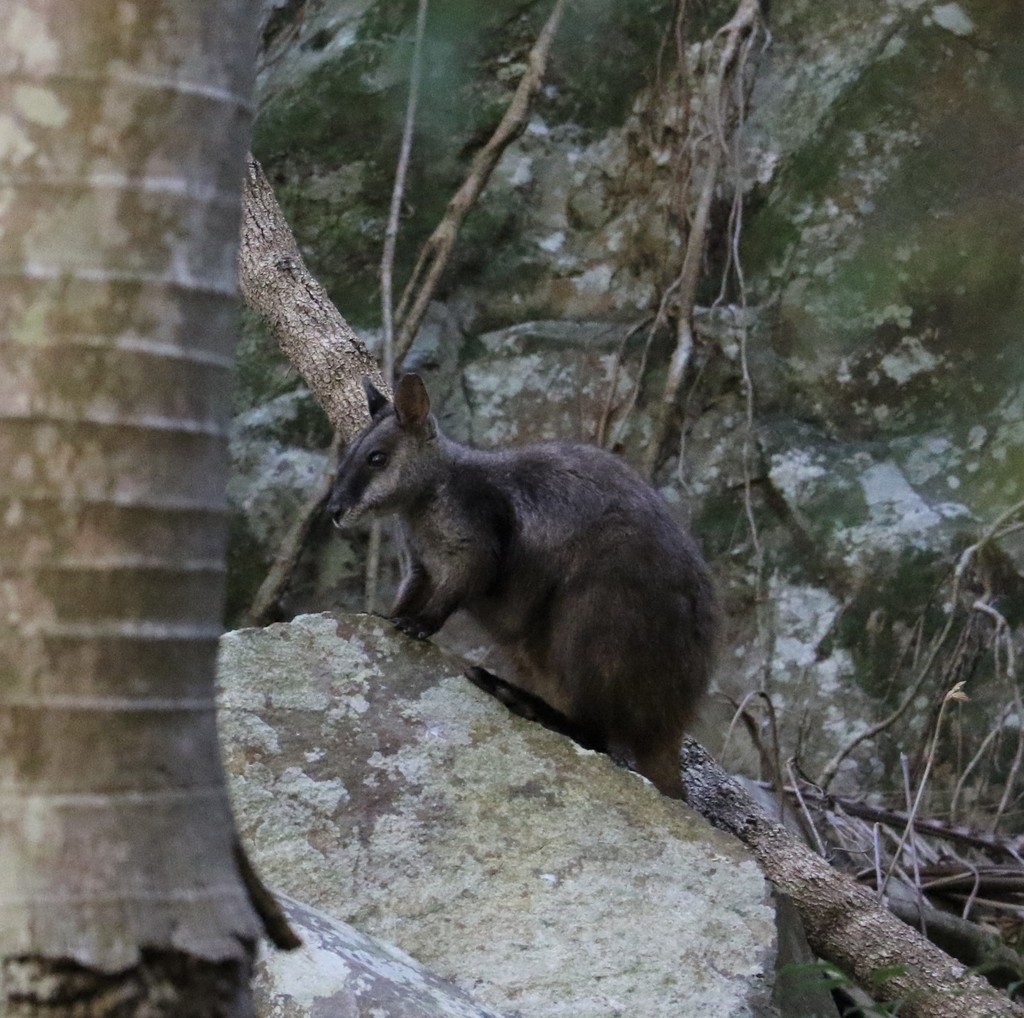
Brush-tailed Rock Wallaby
Photo © Greg Tasney
Photo © Greg Tasney — CC BY-SA 4.0 — Source: iNaturalist #98473692Identification
The brush-tailed rock-wallaby is a compact marsupial weighing 5 to 8 kilograms, with a distinctively long tail measuring 500 to 700 millimetres—longer than its combined head and body length of 510 to 580 millimetres. The tail is dark brown or black, becoming progressively bushier toward its shaggy, brush-like tip, which gives the species its common name. The pelage is dense and shaggy, typically rufous or grey-brown on the upper parts, with paler underparts that may display a white chest blazon. Dark fur covers the lower limbs, paws, and feet, and a whitish stripe often runs along the body's side. Northern populations tend to be paler with shorter fur. The feet possess well-developed pads with coarse texture, providing excellent traction on rocky surfaces.
This species is distinguished from the similar black-footed rock-wallaby by its smaller size and the distinctive bushy, blackish tail tip. Herbert's rock-wallaby, which overlaps in the northern range, is greyer in overall coloration with lighter limbs and lacks the brush-tailed species' characteristic dark tail features.
Range & Habitat
The brush-tailed rock-wallaby inhabits fragmented populations along the Great Dividing Range from approximately 100 kilometres north-west of Brisbane in Queensland to northern Victoria, with the southern edge reaching the Grampians and the western limit near the Warrumbungles range in New South Wales. The species favours vegetation ranging from rainforest to dry sclerophyll forests across its range. It remains locally common in northern New South Wales and southern Queensland, though populations have declined significantly in the south and west of its historical range, particularly following large bushfire events that destroyed approximately 70% of its habitat by January 2020.
The species shelters during daylight hours within rocky habitat, utilizing complex terrain including ledges, cliff-faces, overhangs, caves, and crevices that provide cool refuges and protection from predators. Individual foraging territories average around 15 hectares, potentially larger for males.
Behaviour & Diet
The brush-tailed rock-wallaby is supremely adapted to negotiating difficult rocky terrain, with a compact yet powerful build, counter-balanced by its long tail, and feet specially suited to maintaining purchase on inclined surfaces and precarious ledges. The species is largely nocturnal in its foraging habits, though it will emerge to bask in winter sunlight for short periods. It favours north-facing refuges, where temperature regulation and predator avoidance are optimized.
Breeding occurs throughout the year in many populations, though groups in cooler latitudes or higher altitudes tend to concentrate reproduction between February and May. Breeding females form monogamous partnerships with single males. Females maintain cohesive maternal groups, while male offspring typically disperse to other colonies or relocate to different locations.
Best Time & Places to See It
The brush-tailed rock-wallaby is best observed in its stronghold populations of northern New South Wales and southern Queensland, where it remains locally common. The rugged terrain along the Great Dividing Range provides ideal habitat. Since the species is largely nocturnal and favours complex rocky refuges, early morning or dusk visits to cliff lines and rocky outcrops offer the best viewing opportunities. Winter months may provide additional chances to observe basking individuals in daylight hours.
Access to suitable habitat varies; national parks and protected areas along the Great Dividing Range offer the most reliable opportunities. The species' preference for north-facing refuges within complex rocky terrain should guide site selection.
Photography Tips
The brush-tailed rock-wallaby's agility and preference for rocky, complex terrain present both challenges and opportunities for photographers. Wide-angle lenses can capture the dramatic cliff-face and rocky habitat alongside the animal, emphasizing its remarkable locomotor abilities. Early morning light illuminates north-facing refuges where the species favours shelter, creating favorable lighting conditions. The distinctive brushy tail is a key identifying feature—ensure adequate resolution to capture the characteristic dark, bushy tail tip.
Patience is essential given the species' largely nocturnal behaviour; positioning yourself near rocky outcrops during dawn or dusk increases encounter likelihood. The animal's small size (5–8 kg) requires appropriate focal lengths, and the complex rocky habitat demands careful composition to isolate subjects against busy backgrounds. In winter, when basking occurs, a longer focal length allows distant photography without disturbing these rare individuals.
Bald Rock National Park
Australia
+122 birds+15 mammals
Granite peaks and weathered stone dominate the landscape of this 202-square-kilometre national park in inland New South Wales, where rugged tors and rocky outcrops rise dramatically…
VIEW NATIONAL PARKGirraween National Park
Australia
+193 birds+21 mammals
Granite boulders rise like the bones of the earth across these 278 square kilometres of southeastern Queensland, where the Great Dividing Range descends towards the coastal…
VIEW NATIONAL PARKMorton National Park
Australia
+253 birds+57 mammals
Across nearly 4,800 square kilometers of New South Wales's Southern Tablelands, rugged sandstone plateaus rise above sheltered valleys where cool-climate eucalypt woodland meets grassy heath and…
VIEW NATIONAL PARKOxley Wild Rivers National Park
Australia
+202 birds+45 mammals
Where the New England Tablelands descend toward the coast, river gorges carve through temperate forests in a landscape of dramatic geological contrast. Oxley Wild Rivers National…
VIEW NATIONAL PARKNo community photos yet. Log in to add the first one.
No community observations of this species yet.