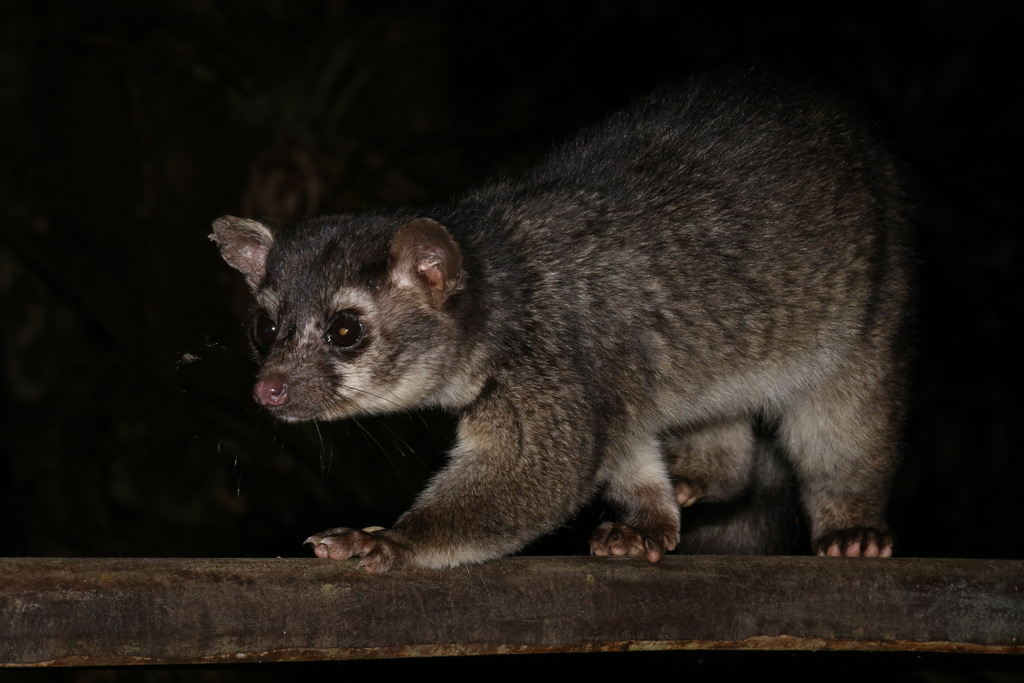
Cacomistle
Photo © Laura Gaudette
Photo © Laura Gaudette — CC BY 4.0 — Source: iNaturalist photo #168312445The cacomistle (; Bassariscus sumichrasti), also spelled cacomixtle, is a primarily nocturnal, arboreal, omnivorous member of the carnivoran family Procyonidae (coatis, kinkajous and raccoons). Depending on the location, its preferred habitats are humid and tropical evergreen jungle and montane cloud forests; seasonally, it may venture into drier, deciduous forests. Although its total population is listed as being of "least concern" (i.e., stable), the cacomistle is still a highly cryptic, secretive animal, and generally an uncommon sight throughout much of its range (from southern México to western Panamá); this fact is especially true in Costa Rica, where it inhabits only a very small area. Additionally, the species is completely dependent on trees and dense vegetation for habitat, making it particularly susceptible to deforestation. The name cacomistle comes from the Nahuatl language (tlahcomiztli) and means "half-cat" or "half-puma"; the same name is also given, by some, to the North American Bassariscus astutus, more commonly known as the ringtail (or, semi-inaccurately, ringtail 'cat'). This "sister species" of the cacomistle inhabits a much more northerly and less tropical range, from arid Northern Mexico into the Southwestern United States. == Taxonomy == The cacomistle is one of two extant species in the genus Bassariscus, along…
Braulio Carrillo National Park
Las Horquetas, Costa Rica
+547 birds+18 mammals
Where the Caribbean slope descends from the central volcanic cordillera toward the humid lowlands of Heredia, Braulio Carrillo National Park preserves one of Costa Rica's most…
VIEW NATIONAL PARKBaru Volcano National Park
Cerro Punta, Panama
+402 birds+6 mammals
Where the land rises sharply toward the Caribbean's western spine, Baru Volcano National Park sprawls across roughly 220 square kilometres of southwestern Panama, anchored by the…
VIEW NATIONAL PARKParque Internacional la Amistad
Teribe, Panama
+325 birds+11 mammals
Where the continental divide rises between the Caribbean and Pacific watersheds, a wilderness of extraordinary biological richness unfolds across the Talamanca Range and into lowland rainforest—a…
VIEW NATIONAL PARKNo community photos yet. Log in to add the first one.
No community observations of this species yet.