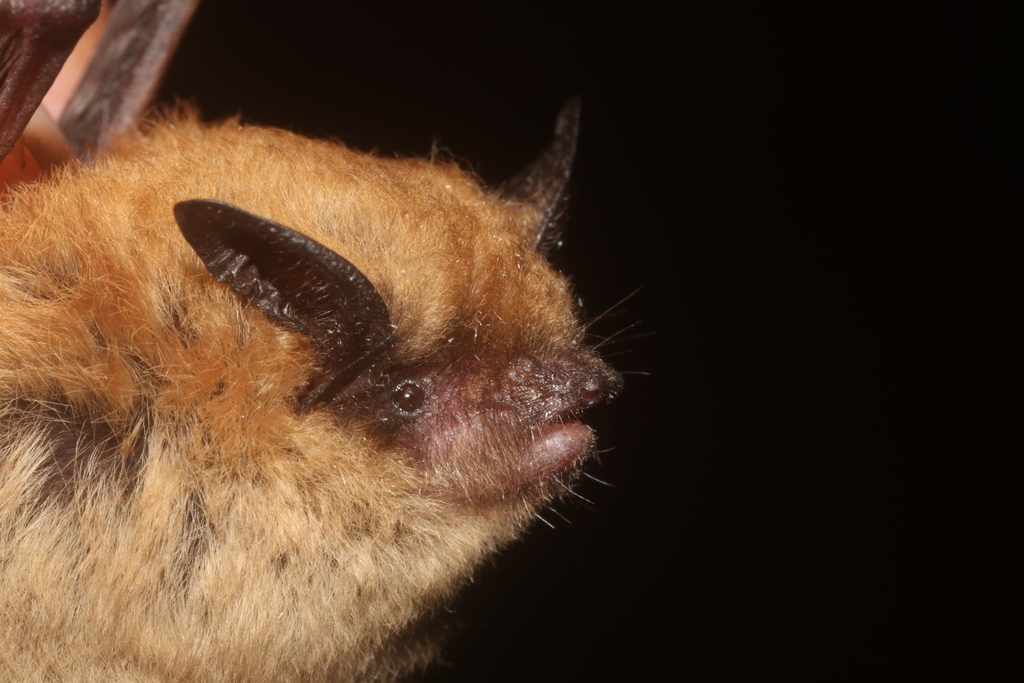
California Myotis
Photo © Juan Cruzado Cortés
Photo © Juan Cruzado Cortés — CC BY-SA 4.0 — Source: iNaturalist photo #191141818Identification
The California myotis is one of North America's smallest bats, measuring just 70–94 millimetres in length and weighing a mere 3.3–5.4 grams. Its pale, dull fur and diminutive size make it easily overlooked, though several distinctive features aid identification. The bat has medium-sized ears (12–15 millimetres) with a narrow, pointed tragus, and an obviously keeled calcar. Most notably, its feet are exceptionally small—among the tiniest of any bat species—and its tail appears noticeably shorter than that of the superficially similar western small-footed myotis, with which it is frequently confused. The California myotis also displays a slightly lighter face mask. With a wing span averaging 220 millimetres, this is a delicate, agile flyer adapted for precision hunting.
An interesting biological note: the California myotis is largely free of the ectoparasites—fleas, ticks, flies, and lice—that commonly burden other bat species, though mites have occasionally been found on their wings.
Range & Habitat
The California myotis is found across a broad geographic range stretching from British Columbia in Canada through the western United States (including California), Mexico, and into Guatemala. Within California, the species demonstrates remarkable habitat flexibility, occupying coastal environments, desert regions, and everything in between. In deserts, they favour areas near water sources, particularly those adjacent to rocky canyons or sandy flats. Coastal populations prefer riparian groves dominated by sycamore, willow, and cottonwood trees, while inland populations utilise open forests and oak groves.
These bats show a clear preference for forested areas and are seldom encountered in urban environments or open rural spaces. However, they will opportunistically roost in man-made structures including abandoned wooden houses, sign boards, and mine tunnels when natural sites are unavailable.
Behaviour & Diet
California myotis are crepuscular hunters, emerging just after dusk and again just before dawn to forage. They feed on moths, flies, and other flying insects captured during slow, highly maneuverable flight close to tree foliage and larger shrubs, typically within a few feet of the ground. Their hunting strategy is characteristically rapid: they forage intensively after sunset, then rest near their foraging grounds before resuming activity, repeating this pattern until daybreak. Throughout the night, they seek out water, drinking by gliding low over pond surfaces with heads bent forward and jaws open to scoop water directly into their mouths.
During daylight hours, California myotis roost in the loose bark of dead trees—particularly ponderosa pines—rock crevices, or buildings. Unlike many bats, they do not maintain fixed roosting preferences, instead selecting the most accessible shelter available after foraging. Females give birth to a single pup annually during late May to early June, forming small maternity colonies of about 20 individuals in loose bark or rock crevices. Males and non-reproductive females roost singly or in small groups. Winter activity varies; some populations hibernate in mines or caves while others remain active throughout the season. Females can live approximately 15 years in the wild.
Best Time & Places to See It
To observe California myotis, visit suitable habitat during the twilight hours—just after sunset or just before dawn—when they are actively foraging. Desert locations near water sources adjacent to rocky canyons offer excellent opportunities, as these bats are drawn to reliable watering holes throughout the night. Coastal areas with riparian vegetation of sycamore, willow, and cottonwood trees are equally productive. Oak groves and open forests within the species' range also provide good viewing opportunities.
Late spring and early summer (May through June) are optimal for observing females near maternity colonies in loose tree bark and rock crevices. The species' tiny size and preference for forested areas mean that dedicated observers with knowledge of suitable habitat will have the best success.
Photography Tips
Photographing California myotis presents considerable challenges given their small size, nocturnal activity, and fast, agile flight. High-speed flash photography or infrared triggered systems are essential for capturing sharp images of these aerial hunters. Position yourself near known water sources or foraging areas during twilight hours when activity peaks. Their preference for flying close to vegetation means that low-angle shots near shrubs and tree foliage may yield better results than attempting mid-air captures in open space.
Since these bats roost in loose bark, rock crevices, and buildings, daytime photography of roosting individuals may be possible with patience and care. Use high ISO settings to compensate for low light in their preferred roosting habitats. The bat's diminutive size requires macro or telephoto capabilities and careful positioning to resolve identifying features such as the keeled calcar, small feet, and lighter face mask.
Gulf Islands National Park Reserve
Southern Gulf Islands Electoral Area, Canada
+268 birds+26 mammals
Scattered across the Salish Sea in British Columbia's southwestern corner, this national park reserve stitches together a fragmented archipelago of forested islands and rocky outcrops where…
VIEW NATIONAL PARKPinnacles National Park
San Benito County, United States
+197 birds+33 mammals
Jagged volcanic spires thrust from chaparral-covered ridges across 222 square kilometers of central California's inner Coast Ranges, their pale stone crowns catching the afternoon light like…
VIEW NATIONAL PARKJoshua Tree National Park
Riverside County, United States
+221 birds+23 mammals
Across 5,610 square kilometers of Riverside County's high desert, a landscape of geological drama unfolds where granite monoliths pierce through bajadas of creosote scrub and Joshua…
VIEW NATIONAL PARKSequoia National Park
Tulare County, United States
+187 birds+27 mammals
Granite peaks rising above 3,600 meters dominate the southern Sierra Nevada, where Sequoia National Park sprawls across one of North America's most vertically compressed wilderness zones.…
VIEW NATIONAL PARKPetrified Forest National Park
Apache County, United States
+206 birds+23 mammals
Across the high desert plateau of northeastern Arizona, where the climate swings between scorching summer days and frost-laden winters, badlands of raw earth and timber-turned-to-stone dominate…
VIEW NATIONAL PARKAlaska Maritime National Wildlife Refuge
Alaska, United States
+391 birds+58 mammals
Where the North Pacific collides with Alaska's rugged coastline, a sprawling archipelago of islands, rocky outcrops, and coastal headlands forms one of North America's most remote…
VIEW WILDLIFE SANCTUARYNo community photos yet. Log in to add the first one.
No community observations of this species yet.