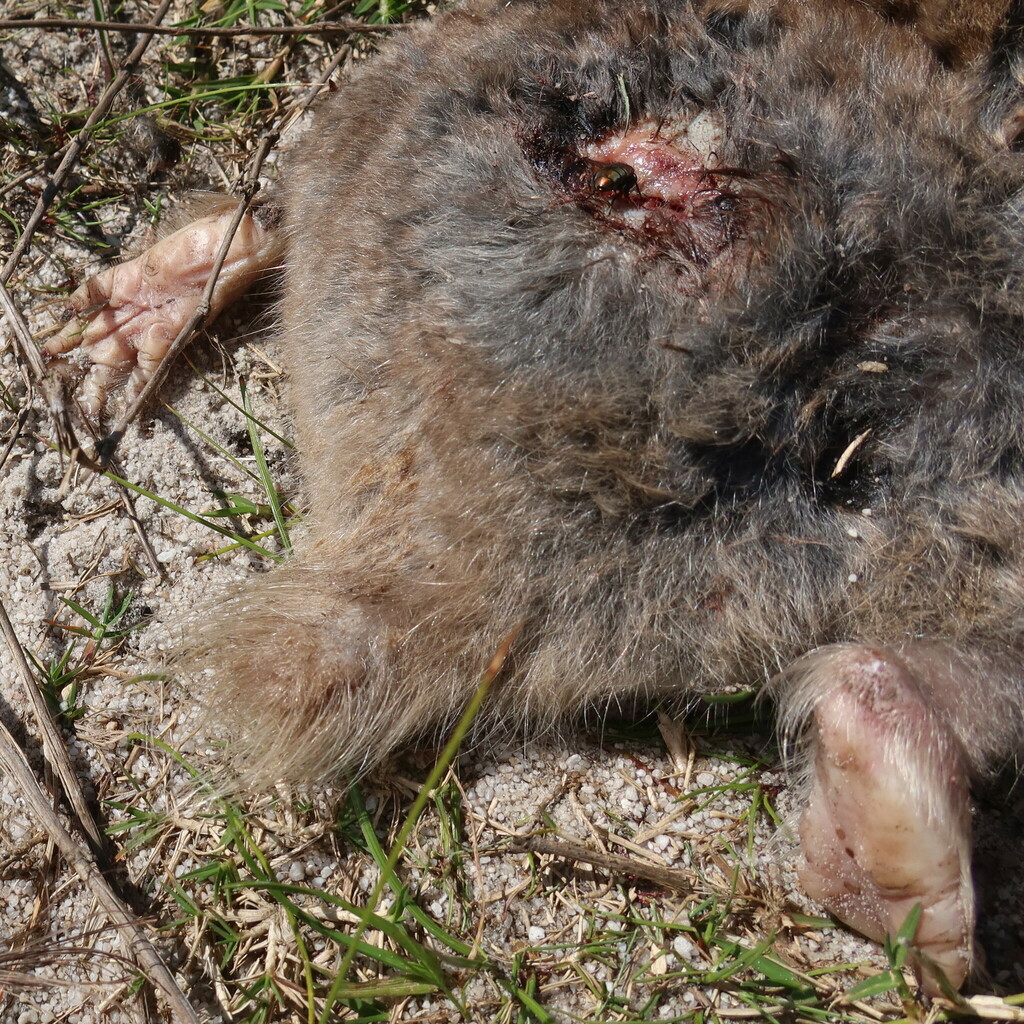
Cape Dune Mole-rat
Photo © Diana Studer
Photo © Diana Studer — CC BY 4.0 — Source: iNaturalist #241284579The Cape dune mole-rat (Bathyergus suillus) is a species of solitary burrowing rodent in the family Bathyergidae. It is endemic to South Africa and named for the Cape of Good Hope. == Description == The Cape dune mole-rat is the largest of all the blesmols, measuring 27 to 35 centimetres (11 to 14 in) in head-body length, with a short, 3 to 4 centimetres (1.2 to 1.6 in) tail. Males are generally much heavier than females, weighing anything from 570 to 1,350 grams (20 to 48 oz), compared with typical female weights of 590 to 970 grams (21 to 34 oz). Both sexes are sturdy, large-bodied rodents, with blunt snouts, cylindrical torsos and short limbs. The forefeet are heavily adapted for digging, with powerful curved claws. To enable to move more quickly through tight tunnels, the body has few visible external features; for example, there are no pinnae or scrotum, and the penis retracts into a concealed sheath. Lip-like flaps of skin are able to close behind the incisors, preventing soil from falling into the mouth. The eyes are small, but not permanently closed. Unlike its relative the naked mole-rat, the Cape dune species has a thick pelt of soft…
Garden Route National Park
George, South Africa
+353 birds+54 mammals
Sweeping across the Western Cape's coastal and mountainous terrain, this sprawling national park encompasses over five thousand square kilometers of extraordinarily diverse landscape—from coastal limestone cliffs…
VIEW NATIONAL PARKAgulhas National Park
Cape Agulhas Local Municipality, South Africa
+224 birds+13 mammals
Where the Atlantic and Indian Oceans meet at Africa's southernmost tip, Agulhas National Park stretches across 892 square kilometres of windswept coastal landscape and rugged limestone…
VIEW NATIONAL PARKNo community photos yet. Log in to add the first one.
No community observations of this species yet.