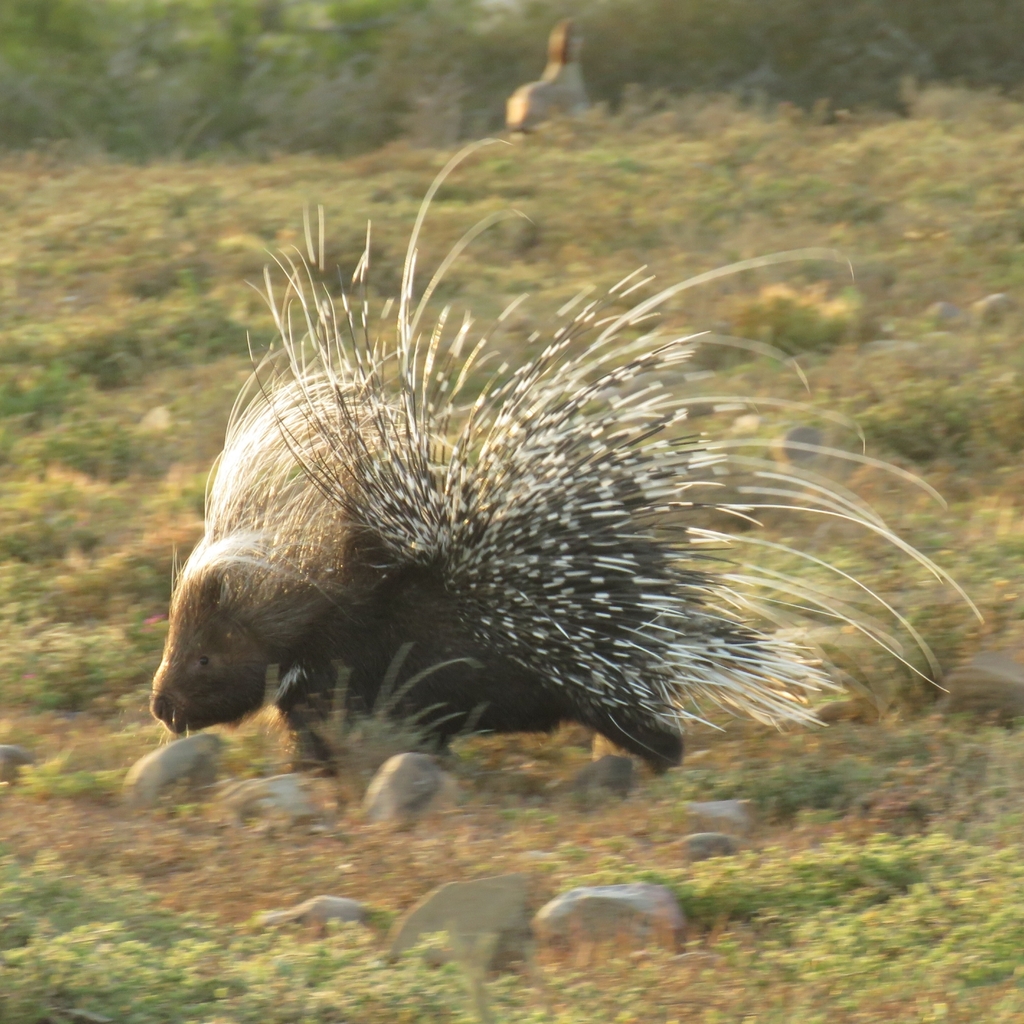
Cape Porcupine
Photo © Christiaan Viljoen
Photo © Christiaan Viljoen — CC BY 4.0 — Source: iNaturalist #141530427Identification
The Cape porcupine is one of Africa's largest rodents and among the world's biggest porcupine species. Adults measure 63–81 cm in body length with tails adding a further 11–20 cm, and weigh 10–24 kg, occasionally up to 30 kg. These heavily-built animals have stocky bodies, short limbs, and are covered in long spines up to 50 cm interspersed with sharply pointed defence quills up to 30 cm long, all banded in black and white. A distinctive erectile crest of bristly hairs runs from the head to the shoulders. Most tellingly, they bear a band of short white spines along the midline of the rump, distinguishing them from the closely related crested porcupine. The remainder of the body, including undersides, is covered in dark fur. Hollow tail spines rattle to frighten predators.
The eyes and ears are relatively small, and the feet have five clawed toes. Males and females are similar in size, each with a heavily armoured appearance that makes them unmistakable in the field.
Range & Habitat
Cape porcupines occur across central and southern Africa, ranging north to southern Kenya, Uganda, and Congo. They inhabit diverse environments from sea level to 2,000 metres elevation, thriving in savannas, grasslands, and woodlands. They are only marginally present in dense forests and the driest deserts, and are absent from swampland, making them adaptable generalists across much of sub-Saharan Africa.
Behaviour & Diet
Strictly nocturnal, Cape porcupines are monogamous, living as mated pairs that jointly defend territories ranging from 67 to 203 hectares depending on habitat and food availability. While pairs may maintain up to six burrows, they typically forage individually. Both sexes scent-mark their territory, though males do so more frequently. When threatened, they freeze; if cornered, they charge aggressively to stab attackers with their quills, or retreat into burrows exposing only their weaponry.
Cape porcupines are herbivorous, feeding on fruits, roots, tubers, bulbs, and bark, with a specialized digestive system employing hindgut fermentation to process tough plant material. They occasionally gnaw on carrion and bones. Though regarded as agricultural pests for crop damage and tree debarking, their feeding habits may benefit savanna ecosystems by preventing excessive forest densification.
Best Time & Places to See It
Since Cape porcupines are nocturnal, spotting them requires night drives or walking after dark in suitable habitat. They are most visible during the rainy season (August–March in the Southern Hemisphere) when food is abundant. Look for them in savanna reserves and woodland areas across southern and central Africa where habitat diversity supports healthy populations. Listen for the distinctive rattle of their tail spines.
Photography Tips
Photograph Cape porcupines during night drives using spotlight or infrared technology to avoid disturbing them. Their dramatic spines and bold patterning photograph well in side profile, and their distinctive crest becomes prominent when they are alert. Capture the band of white spines along the rump for a key identification feature. Wide-angle shots showing their burrow entrances with the animal emerging at dusk convey their secretive nocturnal lifestyle effectively. Exercise caution and maintain safe distances, as cornered animals will charge defensively.
Addo Elephant National Park
Agulhas National Park
Augrabies Falls National Park
Bontebok National Park
Cederberg Wilderness Area
Chobe National Park
Etosha National Park
Garden Route National Park
Kafue National Park
Nothing matches these filters.
No community photos yet. Log in to add the first one.
No community observations of this species yet.