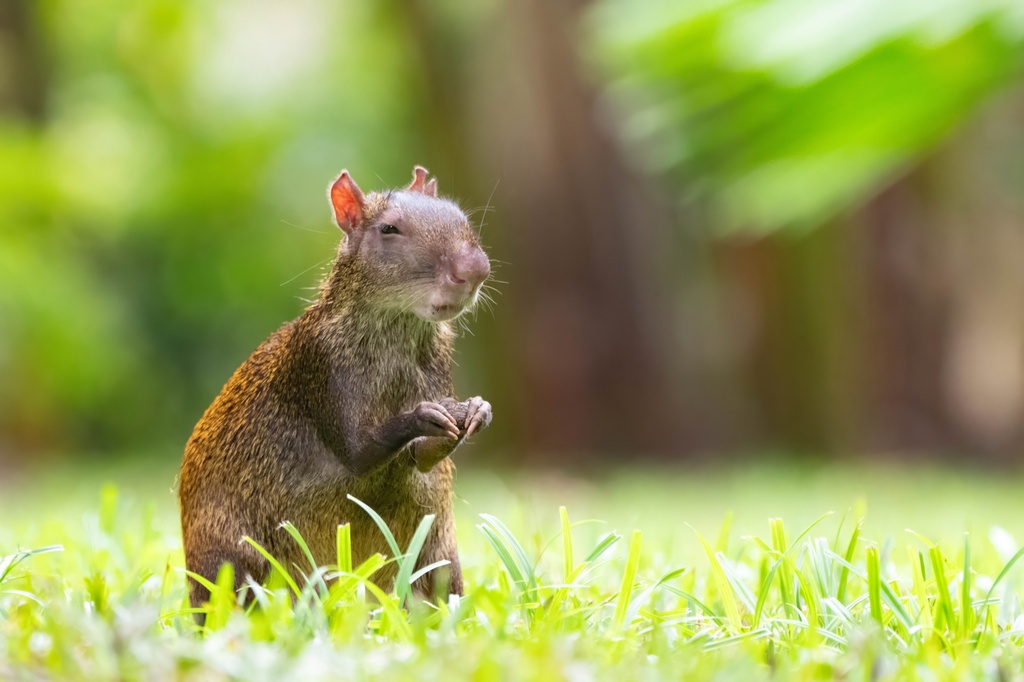
Central American Agouti
Photo © cello caruso-turiello
Photo © cello caruso-turiello — CC BY 4.0 — Source: iNaturalist photo #412425793Identification
The Central American agouti is a medium-sized rodent weighing 3–4.2 kg, with a distinctive appearance that varies across its range. In most of its distribution, the coat is reddily, orange or yellowish, heavily grizzled with black. Populations in northern Colombia, western Venezuela, and the Atlantic slopes of Costa Rica and Panama display darker foreparts (brownish or blackish grizzled with tawny), a striking orange mid-body, and black or cream rumps. Western Colombian and Ecuadorian populations show tawny foreparts with yellowish rumps. The species has a compact body, slender legs, and notably large ears. A key identifying feature is the animal's exceptional sense of smell—research ranking 240 species placed agoutis fourth for olfactory ability, surpassing dogs.
Range & Habitat
This species ranges from Chiapas and the Yucatan Peninsula in southern Mexico through Central America to northwestern Ecuador, Colombia, and far western Venezuela. A separate, disjunct population occurs in southeastern Peru, southwestern Brazil, Bolivia, western Paraguay, and northwestern Argentina; this southern population is sometimes classified as a distinct species, the brown agouti (Dasyprocta variegata). The species has also been introduced to Cuba and the Cayman Islands. Though some regional populations have declined due to hunting and habitat loss, large populations persist throughout much of the range, and the species is not considered threatened.
Behaviour & Diet
Central American agoutis are strictly diurnal (day-active) and live in monogamous pairs. Their diet centers on fruits and seeds, making them important seed dispersers in their ecosystems. These animals actively search for fruit-bearing trees and can detect falling fruit from considerable distances. When food is plentiful, they cache seeds for later consumption. Their diet is supplemented with crabs, vegetables, and other plant matter opportunistically.
Best Time & Places to See It
For the highest likelihood of encounters, visit primary and secondary forests throughout Central America, particularly in Mexico's Yucatan Peninsula and protected reserves across Guatemala, Belize, Honduras, Costa Rica, and Panama. Since agoutis are diurnal, early morning hours offer the best viewing opportunities. Look along forest floors and near fruiting trees, especially during seasons of fruit abundance. The species' wide range and stable population numbers make it relatively accessible to patient nature travelers across much of its Central American stronghold.
Photography Tips
Photograph agoutis in early morning light when they are most active and foraging on the forest floor. Their grizzled coats require careful metering to capture texture and color variation; backlighting can beautifully highlight the contrasting patches. Use a telephoto lens (200–400 mm) to maintain distance without disturbing these wary animals. Since they forage in dappled forest light, fast film speeds or higher ISO settings will help freeze motion as they move between fruiting trees. Patience near known fruiting trees increases your chances of natural, unforced behavior shots.
Nothing matches these filters.
Arenal Volcano National Park
Barra del Colorado National Wildlife Refuge
Braulio Carrillo National Park
Cahuita National Park
Carara National Park
Chagres National Park
Coiba National Park
Corcovado National Park
Curú National Wildlife Refuge
Nothing matches these filters.
No community photos yet. Log in to add the first one.
No community observations of this species yet.