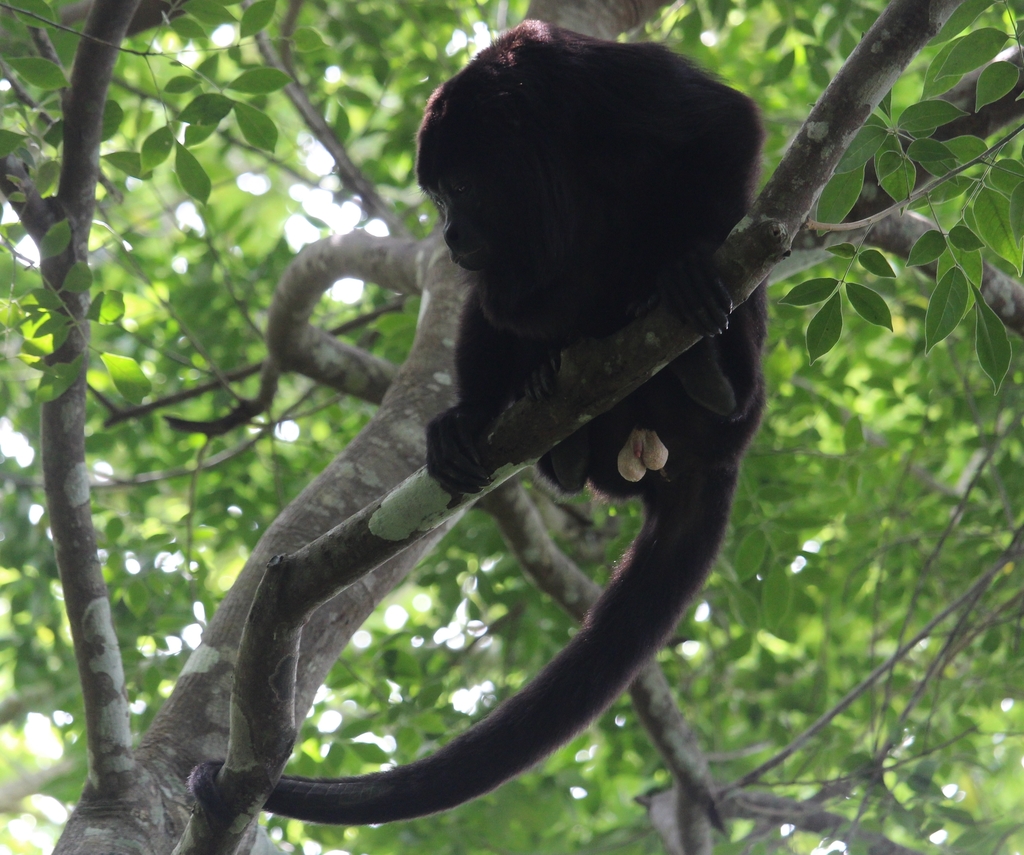
Central American Black Howler
Photo © Ricard Busquets Reverte
Photo © Ricard Busquets Reverte — CC BY 4.0 — Source: iNaturalist #96738867Identification
The Yucatán black howler is the largest howler monkey species and one of the largest New World monkeys overall. Males are substantially bigger than females, weighing around 11.4 kg compared to females at 6.4 kg. Both sexes display entirely black fur as adults, though infants are born with brown coats. They possess a distinctive prehensile tail measuring 590–690 mm, which they use for balance and climbing in the forest canopy. Males over four months old develop characteristic white scrotums. The species shares key anatomical features with other howlers: enlarged molars with high shearing crests for processing leaves, and in males, a notably enlarged hyoid bone adjacent to the vocal cords that amplifies their legendary calls.
Range & Habitat
The Yucatán black howler is endemic to Central America, found only in Belize, Guatemala, and Mexico, primarily within and around the Yucatán Peninsula. It inhabits evergreen, semideciduous, and lowland rainforest environments. The species maintains a restricted range, a consequence of historical competitive interactions with later-arriving primate species. In suitable habitat, population densities can be remarkably high—the Community Baboon Sanctuary in Belize supports over 250 individuals per square kilometer.
Behaviour & Diet
Yucatán black howlers are diurnal and entirely arboreal, living in stable family groups typically comprising 2–10 individuals, though groups of up to 16 have been documented. These groups usually contain one or two adult males and approximately 1.3 females per male. The most distinctive behavior is their spectacular dawn and dusk vocalizations—the enlarged hyoid bone produces remarkably loud calls that travel through the forest, allowing males to communicate territorial and group-locating information with minimal energy expenditure. This efficiency matters greatly since their diet consists primarily of leaves, supplemented with fruits and occasional flowers. The breadnut tree can constitute as much as 86% of their diet seasonally. Most of their day is spent resting, with eating occupying about a quarter of daylight hours, movement around 10%, and remaining time devoted to socializing.
Best Time & Places to See It
Early morning and dusk are optimal for encountering Yucatán black howlers, coinciding with their vocalization peak. The Community Baboon Sanctuary in Belize is an excellent location for observations, given its exceptionally high population density and established viewing infrastructure. Visitors exploring rainforest habitats across the Yucatán Peninsula in suitable protected areas may encounter these monkeys in their preferred evergreen and semideciduous forest zones.
Photography Tips
Photograph these monkeys from a distance using telephoto lenses to avoid disturbing them—they are wary primates in fragmented habitats. The contrast of their jet-black fur against green foliage creates striking images, particularly in dappled forest light. Early morning and late afternoon light is ideal. Position yourself low and look upward to capture dramatic silhouettes against the canopy. Record their vocalizations separately if possible; their calls are as impressive as their appearance. Exercise patience and remain still; rewarding shots come to those who give these primates space and time.
Sian Ka’an
Chunyaxché, Mexico
+350 birds+16 mammals
Where the Yucatán Peninsula dissolves into wetland and mangrove, a vast mosaic of forest, lagoon, and coastal margin creates one of Mexico's most biodiverse strongholds. Across…
VIEW BIOSPHERE RESERVEMontes Azules
Candelaria, Mexico
+395 birds+47 mammals
Where jungle-clad limestone plateaus plunge into canyon systems carved by the Usumacinta River, Mexico's most pristine rainforest reserve unfolds across the Lacandón region of Chiapas. Montes…
VIEW BIOSPHERE RESERVETikal National Park
Tikal, Guatemala
+399 birds+16 mammals
Dense rainforest canopy rises above the limestone plateau of Petén, where archaeological wonder and ecological richness merge seamlessly across one of Central America's most biodiverse landscapes.…
VIEW NATIONAL PARKLaguna del Tigre National Park
Petén, Guatemala
+399 birds+29 mammals
Where the Petén lowlands dissolve into wetland and forest, Laguna del Tigre National Park protects one of Guatemala's most ecologically vital landscapes. This sprawling reserve encompasses…
VIEW NATIONAL PARKSierra del Lacandón National Park
Petén, Guatemala
+348 birds+7 mammals
Where the Petén rainforest rises into limestone ridges and deep ravines, Sierra del Lacandón National Park protects one of Central America's most intact tropical wilderness zones.…
VIEW NATIONAL PARKNo community photos yet. Log in to add the first one.
No community observations of this species yet.