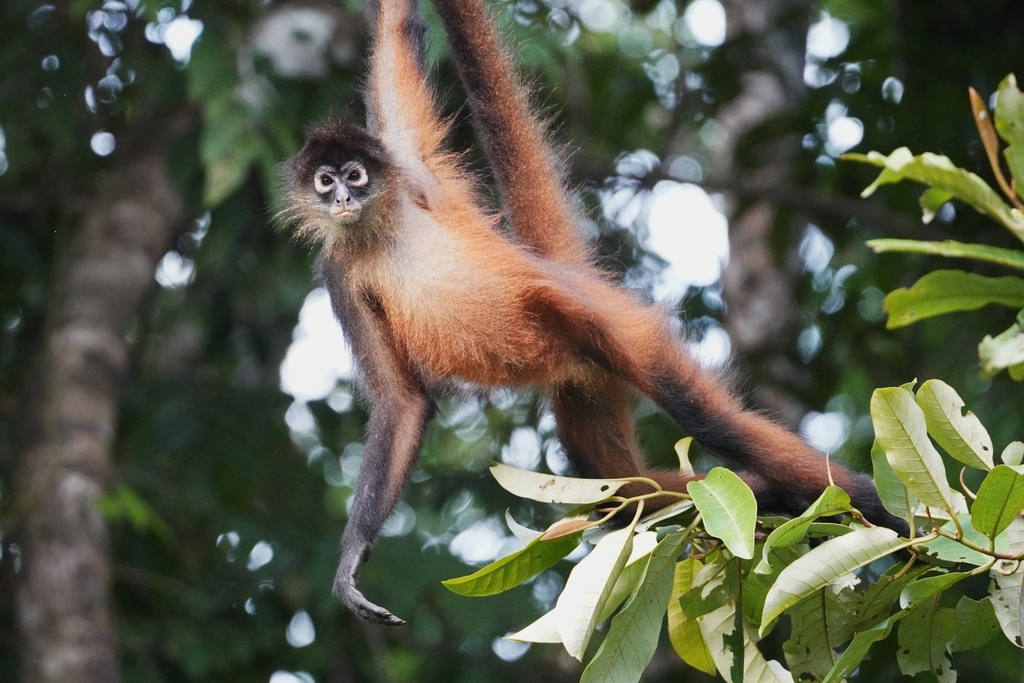
Central American Spider Monkey
Photo © relet
Photo © relet — CC0 1.0 — Source: iNaturalist photo #216610095Identification
Geoffroy's spider monkey is one of the largest New World monkeys, weighing 6–9 kg with a head-body length of 30–63 cm. Its most distinctive features are its dramatically elongated arms—about 25% longer than its legs—and its prehensile tail, which can span 63–85 cm and support the monkey's entire weight. The tail functions as a fifth limb, equipped with a sensitive palm-like pad at the tip for grasping branches and manipulating food. The hands are highly specialized for arboreal life: the thumb is reduced to a vestigial nub, while the fingers are long, strong, and deeply curved into a hook-like shape ideal for brachiating through the canopy.
Body coloration varies by subspecies and population, ranging from buff and reddish to rust, brown, or black. The hands and feet are characteristically dark or black, while the face typically displays a pale mask with bare skin around the eyes and muzzle. Males and females are approximately equal in size, though females possess an unusually prominent pendulous clitoris that can cause confusion with males in the field.
Range & habitat
Geoffroy's spider monkey is distributed across much of Central America, including Panama, Costa Rica, Nicaragua, Guatemala, Honduras, El Salvador, Belize, and southern and eastern Mexico. At least five subspecies are recognized across this range, with observations suggesting the southernmost populations may extend into Colombia near the Panama border. The species inhabits various forest types including rainforest, semideciduous forest, and mangrove forests, though higher densities are typically found in areas with extensive evergreen forest cover.
Behaviour & diet
Geoffroy's spider monkeys are highly social primates living in fission–fusion societies of 20–42 individuals, meaning group composition flexibly changes throughout the day as members split into smaller foraging parties and reunite. Their diet consists primarily of ripe fruit, and they require expansive forest tracts to sustain their nutritional needs. Their specialized anatomy makes them supremely adapted to arboreal locomotion; they move by swinging beneath branches with remarkable speed and grace, using their powerful arms and grasping tail to navigate the three-dimensional forest environment with minimal energy expenditure.
Best time & places to see it
Spider monkeys are most active during daylight hours when they forage for fruiting trees. Early morning is often the best time to locate them as they become increasingly vocal and active. Look for them in protected reserves and national parks throughout their range in Central America, particularly in regions with large tracts of undisturbed evergreen forest. Listen for their distinctive calls and watch the canopy for movement; they often travel in smaller subgroups during the day.
Photography tips
Photograph spider monkeys in early morning light when they are most active and the canopy is illuminated. Use a telephoto lens (200–400 mm) to capture detail from a distance without disturbing the animals. Focus on their remarkable anatomical features: the hook-like hands gripping branches, the tail curled around a limb, and the characteristic pale facial mask. Patience is essential; watch fruiting trees where monkeys gather to feed, and be prepared for rapid movement through the canopy. Silhouettes against the sky can create striking compositions showcasing their dynamic brachiating motion.
Corcovado National Park
Puerto Jiménez, Costa Rica
+444 birds+48 mammals
Where the Osa Peninsula juts into the Pacific, rainforest descends almost to the tide line, and Corcovado National Park protects one of Central America's most intact…
VIEW NATIONAL PARKArenal Volcano National Park
Peñas Blancas, Costa Rica
+551 birds+21 mammals
Straddling the border between Alajuela and Guanacaste in northwestern Costa Rica, this national park rises dramatically around one of Central America's most active volcanic systems. The…
VIEW NATIONAL PARKTortuguero National Park
Roxana, Costa Rica
+420 birds+23 mammals
Canals and lagoons thread through a labyrinth of lowland rainforest where the Caribbean coast of Costa Rica meets the wetland frontier. This is terrain shaped by…
VIEW NATIONAL PARKChirripó National Park
Rivas, Costa Rica
+274 birds+6 mammals
Where the volcanic spine of Costa Rica's Central Cordillera reaches its apex, Chirripó National Park encompasses a landscape that shifts dramatically with elevation, from montane cloud…
VIEW NATIONAL PARKBraulio Carrillo National Park
Las Horquetas, Costa Rica
+547 birds+18 mammals
Where the Caribbean slope descends from the central volcanic cordillera toward the humid lowlands of Heredia, Braulio Carrillo National Park preserves one of Costa Rica's most…
VIEW NATIONAL PARKPiedras Blancas National Park
Golfito, Costa Rica
+386 birds+24 mammals
Where the Golfo Dulce meets the southwestern Pacific coast of Costa Rica, Piedras Blancas National Park protects a dramatic transition zone where lowland rainforest descends toward…
VIEW NATIONAL PARKSanta Rosa National Park
Santa Elena, Costa Rica
+359 birds+30 mammals
Where Pacific-facing slopes descend from volcanic uplands toward the Guanacaste lowlands, Santa Rosa National Park unfolds across a mosaic of tropical dry forest, gallery woodland, and…
VIEW NATIONAL PARKGuanacaste National Park
Santa Elena, Costa Rica
+461 birds+17 mammals
Where the Pacific slopes of northwestern Costa Rica rise toward the Continental Divide, dry tropical forest gives way to cloud-laden peaks and misty ridges—a landscape that…
VIEW NATIONAL PARKSoberanía National Park
Cristóbal, Panama
+495 birds+34 mammals
Rainforest and riverine woodland blanket the rolling terrain of this 714-square-kilometre national park in Colón Province, where the Caribbean watershed feeds a maze of streams and…
VIEW NATIONAL PARKParque Internacional la Amistad
Teribe, Panama
+325 birds+11 mammals
Where the continental divide rises between the Caribbean and Pacific watersheds, a wilderness of extraordinary biological richness unfolds across the Talamanca Range and into lowland rainforest—a…
VIEW NATIONAL PARKArrecifes de Cozumel National Park
San Miguel de Cozumel, Mexico
+112 birds+4 mammals
Beneath the turquoise shallows of the western Caribbean, Arrecifes de Cozumel National Park protects a sprawling marine realm across 484 square kilometres off the Quintana Roo…
VIEW NATIONAL PARKMontes Azules
Candelaria, Mexico
+395 birds+47 mammals
Where jungle-clad limestone plateaus plunge into canyon systems carved by the Usumacinta River, Mexico's most pristine rainforest reserve unfolds across the Lacandón region of Chiapas. Montes…
VIEW BIOSPHERE RESERVETikal National Park
Tikal, Guatemala
+399 birds+16 mammals
Dense rainforest canopy rises above the limestone plateau of Petén, where archaeological wonder and ecological richness merge seamlessly across one of Central America's most biodiverse landscapes.…
VIEW NATIONAL PARKSierra del Lacandón National Park
Petén, Guatemala
+348 birds+7 mammals
Where the Petén rainforest rises into limestone ridges and deep ravines, Sierra del Lacandón National Park protects one of Central America's most intact tropical wilderness zones.…
VIEW NATIONAL PARKCarara National Park
Tárcoles, Costa Rica
+397 birds+19 mammals
Where the Pacific coastal plain meets transitional forest, Carara National Park straddles one of Central America's most dynamic ecological boundaries. The park's landscape encompasses lowland deciduous…
VIEW NATIONAL PARKPalo Verde National Park
Bagaces, Costa Rica
+318 birds+24 mammals
Dry forest spreads across Palo Verde's low-lying terrain in northwestern Guanacaste, where seasonal rivers and lagoons etch through deciduous woodland that sheds its canopy each winter.…
VIEW NATIONAL PARKCahuita National Park
Talamanca, Costa Rica
+359 birds+15 mammals
Where the Caribbean shoreline dissolves into mangrove creeks and coral gardens, Cahuita's mosaic of habitats unfolds across the Limón coast. The park's signature feature—a living coral…
VIEW NATIONAL PARKRincón de la Vieja National Park
Liberia, Costa Rica
+451 birds+30 mammals
Where volcanic slopes rise abruptly from the Guanacaste lowlands, Rincón de la Vieja National Park sprawls across a landscape shaped by geothermal drama and seasonal extremes.…
VIEW NATIONAL PARKTapantí Macizo de la Muerte National Park
Orosi, Costa Rica
+503 birds+18 mammals
Where montane cloud forest rises steeply from the Orosi Valley, Tapantí Macizo de la Muerte National Park enfolds a landscape of perpetual moisture and emerald complexity.…
VIEW NATIONAL PARKBarra del Colorado National Wildlife Refuge
Tortuguero, Costa Rica
+462 birds+36 mammals
Where the Caribbean's restless waters meet the Limón Province coastline, Barra del Colorado National Wildlife Sanctuary unfolds across a landscape of extraordinary ecological complexity. This equatorial…
VIEW WILDLIFE SANCTUARYNo community photos yet. Log in to add the first one.
No community observations of this species yet.