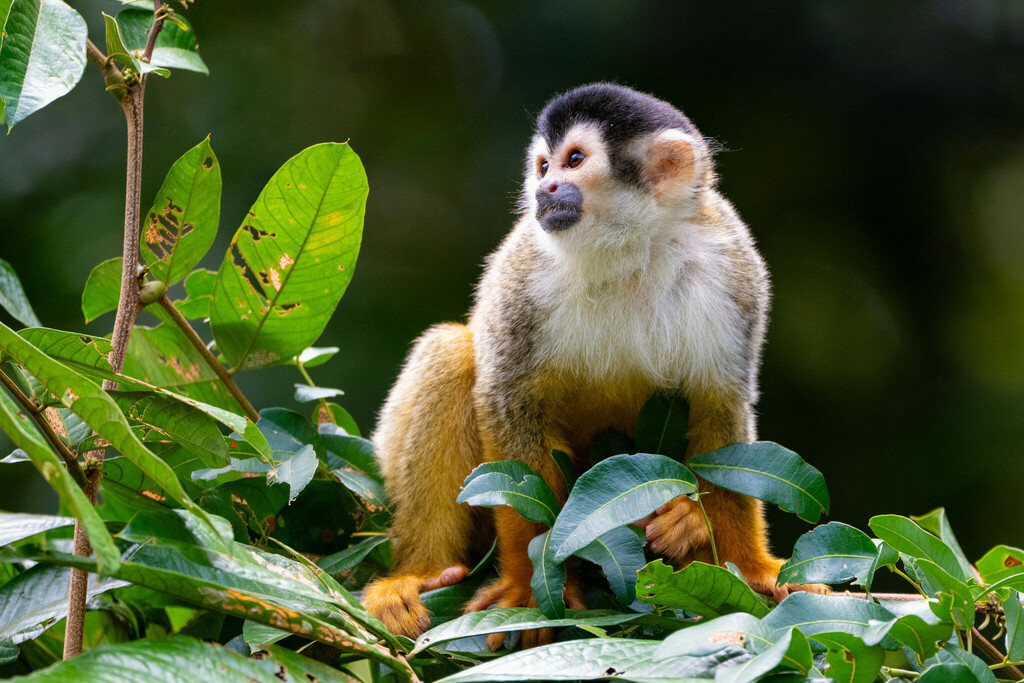
Central American Squirrel Monkey
Photo © cello caruso-turiello
Photo © cello caruso-turiello — CC BY 4.0 — Source: iNaturalist photo #411655541Identification
The Central American squirrel monkey is a striking small primate, immediately recognizable by its distinctive orange back contrasting with olive shoulders, hips and tail. Its most distinctive feature is a bold white and black facial mask, with white cheeks framed by black rims around the eyes and black markings around the nose and mouth. A black cap crowns the head, with males typically displaying lighter caps than females. The hands and feet are orange, the underparts white, and the tail—which is longer than the body—is tipped in black. Adults are diminutive, measuring between 10½ and 11½ inches in body length, with tails reaching 14¼ to 15⅜ inches, and weighing only 21 to 34 ounces, with males slightly heavier than females on average.
Two subspecies occur in the region: the black-crowned form in Panama and the Osa Peninsula of Costa Rica, and the grey-crowned form in central Pacific Costa Rica. While similar overall, they differ subtly in cap coloration and limb coloration, with the southern subspecies displaying more yellowish tones.
Range & Habitat
The Central American squirrel monkey is found exclusively on the Pacific coasts of Costa Rica and Panama, making it the only squirrel monkey species occurring outside South America. Its range is highly restricted, occurring in the northwestern tip of Panama near the Costa Rican border and along the central and southern Pacific coast of Costa Rica, with populations concentrated in Manuel Antonio and Corcovado National Parks. The species has experienced a precipitous population decline since the 1970s, primarily due to deforestation, hunting, and illegal capture for the pet trade. Conservation efforts are underway to preserve the remaining populations.
Behaviour & Diet
These arboreal and diurnal monkeys are highly social, living in groups typically containing between 20 and 75 individuals with roughly 60% more females than males. They move through the canopy on four legs and maintain home ranges of 35 to 63 hectares, traveling between 2,500 and 4,200 meters daily. Unlike many monkey species, groups remain cohesive during foraging rather than splitting into separate parties, though individual monkeys may temporarily separate from the main troop.
Central American squirrel monkeys have a remarkably egalitarian social structure. Females do not form dominance hierarchies, and males establish them only during breeding season. Females reach sexual maturity at 2½ years and typically disperse from their natal group, while males mature at 4 to 5 years and may remain with their birth group throughout their lives. The species is omnivorous, consuming fruits, plant materials, invertebrates, and small vertebrates, while facing predation from raptors, cats, and snakes. They can live for more than 15 years in the wild.
Best Time & Places to See It
Manuel Antonio and Corcovado National Parks are the premier destinations for encountering Central American squirrel monkeys. Manuel Antonio offers relatively accessible viewing in a more developed area where group ranges overlap and habituation is good, while Corcovado provides a wilder experience in one of Central America's premier rainforests. Early morning hours are optimal for observation, as these diurnal monkeys are most active at dawn and throughout the day.
Photography Tips
The species' small size and rapid, arboreal movement demand fast shutter speeds (at least 1/1000th second) and a telephoto lens of 300mm or longer. The distinctive white and black facial mask is the key identifying feature—compose to capture this striking contrast. Overcast mornings provide softer, diffused light that avoids harsh shadows in the canopy. Patience and stillness are essential; locate a group and allow them to move toward you rather than pursuing them through the forest. The orange coloration of the back provides excellent contrast against green foliage, so position yourself to maximize this visual impact.
Manuel Antonio National Park
Quepos, Costa Rica
+426 birds+22 mammals
Where tropical rainforest descends steeply to a rocky Pacific coastline, Manuel Antonio National Park distills Central American biodiversity into one of Costa Rica's most compressed and…
VIEW NATIONAL PARKPiedras Blancas National Park
Golfito, Costa Rica
+386 birds+24 mammals
Where the Golfo Dulce meets the southwestern Pacific coast of Costa Rica, Piedras Blancas National Park protects a dramatic transition zone where lowland rainforest descends toward…
VIEW NATIONAL PARKCarara National Park
Tárcoles, Costa Rica
+397 birds+19 mammals
Where the Pacific coastal plain meets transitional forest, Carara National Park straddles one of Central America's most dynamic ecological boundaries. The park's landscape encompasses lowland deciduous…
VIEW NATIONAL PARKTapantí Macizo de la Muerte National Park
Orosi, Costa Rica
+503 birds+18 mammals
Where montane cloud forest rises steeply from the Orosi Valley, Tapantí Macizo de la Muerte National Park enfolds a landscape of perpetual moisture and emerald complexity.…
VIEW NATIONAL PARKNo community photos yet. Log in to add the first one.
No community observations of this species yet.