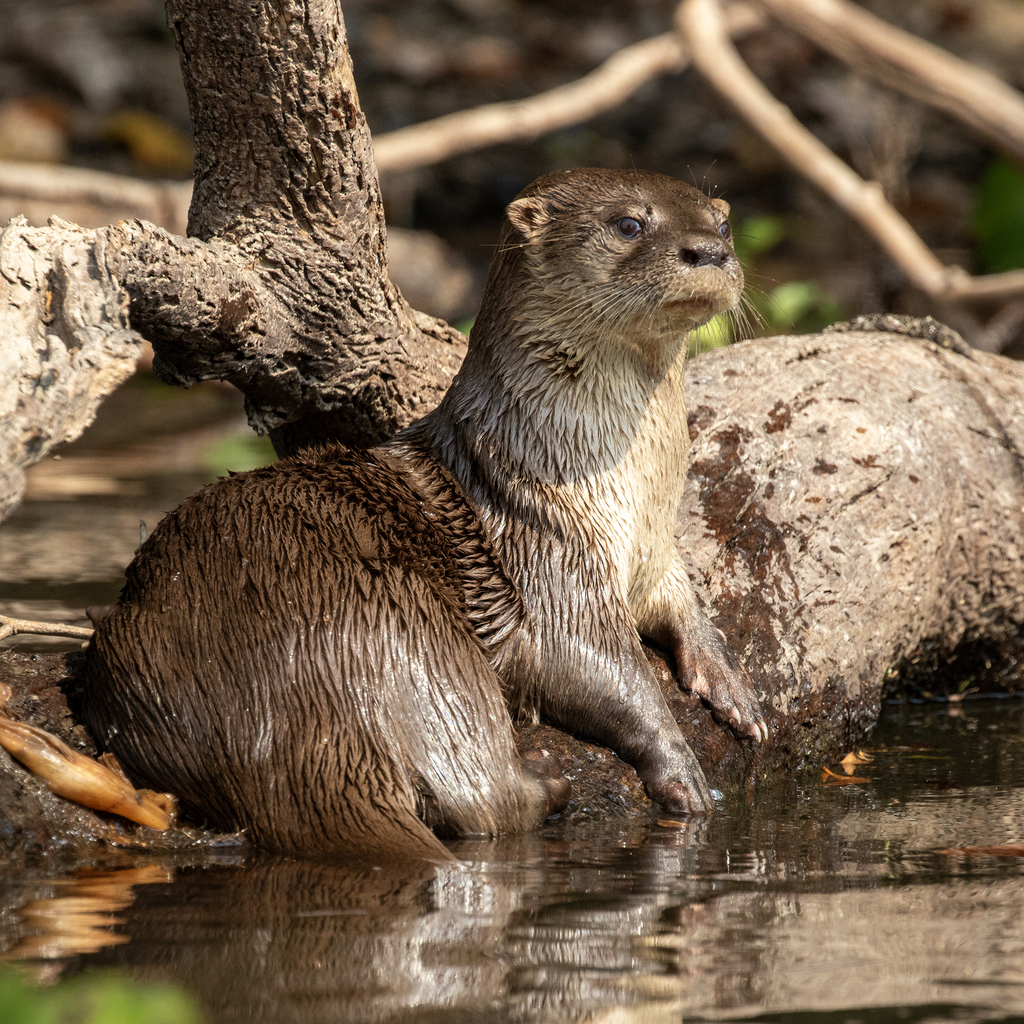
Central Neotropical River Otter
Photo © Dan Vickers
Photo © Dan Vickers — CC BY 4.0 — Source: iNaturalist photo #460766073Identification
The Central Neotropical River Otter is a sleek, medium-sized mustelid covered in short, dark grayish-brown fur that is lighter around the muzzle and throat. Head-to-body length ranges from 36–66 centimetres (14–26 inches), with a notably long tail measuring 37–84 centimetres (15–33 inches). Body weight typically falls between 5–15 kilograms (11–33 pounds), with males being approximately 25% larger than females. The species is characterized by short, stout legs, fully webbed toes, and a long, wide tail that aids in aquatic locomotion.
In the field, look for their lighter facial markings and listen for their distinctive vocalizations—they communicate through scent marking as well as whistles, hums, and screeches. These otters are notably more solitary than their larger relatives, the giant otters, making them easier to distinguish by behavior and social structure alone.
Range & Habitat
The Central Neotropical River Otter has the widest distribution of all Lontra species, ranging from northwest Mexico through Central America to central Argentina, and occurring on the island of Trinidad. They prefer clear, fast-flowing rivers and streams at elevations typically between 300–1,500 metres (980–4,900 feet), though they have been recorded at altitudes up to 3,000 metres (9,800 feet) in the Andes. They require dense riparian vegetation and abundant den sites but are remarkably versatile in exploiting diverse aquatic habitats.
Beyond pristine rivers, these highly adaptable otters inhabit wastewater treatment plants, rice paddies, sugar cane plantations, estuaries, deltas, and drainage ditches. They can survive in cold glacial lakes and streams and even venture to seashores and beaches, maintaining an almost brackish lifestyle. They actively avoid competition with giant otters by preferring smaller, faster-flowing waterways and remain relatively solitary compared to their more social congeners.
Behaviour & Diet
Unlike most otter species, the Central Neotropical River Otter is a relatively solitary animal. This independent nature sets it apart from the highly social giant otter, despite their overlapping ranges in some regions. They communicate with nearby otters through scent marking and vocalizations, establishing territories without the cohesive family groups seen in many other otter species.
Their diet consists primarily of fish (67% of intake) and crustaceans (28%), supplemented opportunistically by mollusks, small mammals, birds, and large insects. In areas where traditional prey is scarce, aquatic insects such as dobsonfly larvae become significant food sources. Otters inhabiting marine or coastal zones have notably higher proportions of crustaceans in their diets, and seasonal availability strongly influences their feeding patterns. They occasionally raid fishnets in human-dominated landscapes, creating local conflicts with fishing communities.
Best Time & Places to See It
The Central Neotropical River Otter occurs across a vast geographic range spanning tropical and temperate deciduous to evergreen forests, savannas, and specialized habitats like the llanos of Colombia and Venezuela, and the Pantanal of Bolivia, Brazil, and Paraguay. Clear, fast-flowing rivers and streams throughout this range offer the best viewing opportunities, particularly in areas with minimal giant otter presence. Their solitary nature and preference for smaller waterways make them more challenging to encounter than their larger, more conspicuous relatives.
Since these otters are near-threatened with declining populations, visiting protected areas and riparian zones managed for wildlife conservation increases your chances of observation. The timing of visits should consider local seasonal variations in prey availability and water flow, which influence otter activity patterns and distribution.
Photography Tips
Photographing solitary otters requires patience and stealth. Position yourself quietly along clear, fast-flowing streams during active feeding periods, and use a telephoto lens to maintain distance without disturbing the animal. The lighter coloration around the muzzle and throat provides good contrast for facial detail shots; capture these features during moments when the otter surfaces or emerges onto riverbanks.
Take advantage of their occasional seashore visits and diverse habitat use by exploring different ecosystems within their range. Dawn and dusk often yield the best lighting and increased otter activity. Their characteristic vocalizations and scent-marking behaviors offer unique behavioral photography opportunities that set them apart from other otter species, providing compelling storytelling potential for wildlife photographers.
Tortuguero National Park
Roxana, Costa Rica
+420 birds+23 mammals
Canals and lagoons thread through a labyrinth of lowland rainforest where the Caribbean coast of Costa Rica meets the wetland frontier. This is terrain shaped by…
VIEW NATIONAL PARKYasuní National Park
Aguarico, Ecuador
+601 birds+43 mammals
Where the western Amazon basin converges with Ecuador's Orellana Province, lowland rainforest reaches toward the horizon in an unbroken canopy of staggering botanical density. Yasuní National…
VIEW NATIONAL PARKIguaçu National Park
Brazil
+387 birds+17 mammals
Where the Paraná Plateau plunges toward the Atlantic watershed, six thousand square kilometers of subtropical rainforest cling to steep gorges and river valleys in this corner…
VIEW NATIONAL PARKEl Palmar National Park
Distrito Sexto, Argentina
+244 birds+14 mammals
Across the Paraná River floodplain in northeastern Argentina, palms rise from wetland and grassland in a landscape shaped by water and time. El Palmar National Park…
VIEW NATIONAL PARKBarra del Colorado National Wildlife Refuge
Tortuguero, Costa Rica
+462 birds+36 mammals
Where the Caribbean's restless waters meet the Limón Province coastline, Barra del Colorado National Wildlife Sanctuary unfolds across a landscape of extraordinary ecological complexity. This equatorial…
VIEW WILDLIFE SANCTUARYNo community photos yet. Log in to add the first one.
No community observations of this species yet.