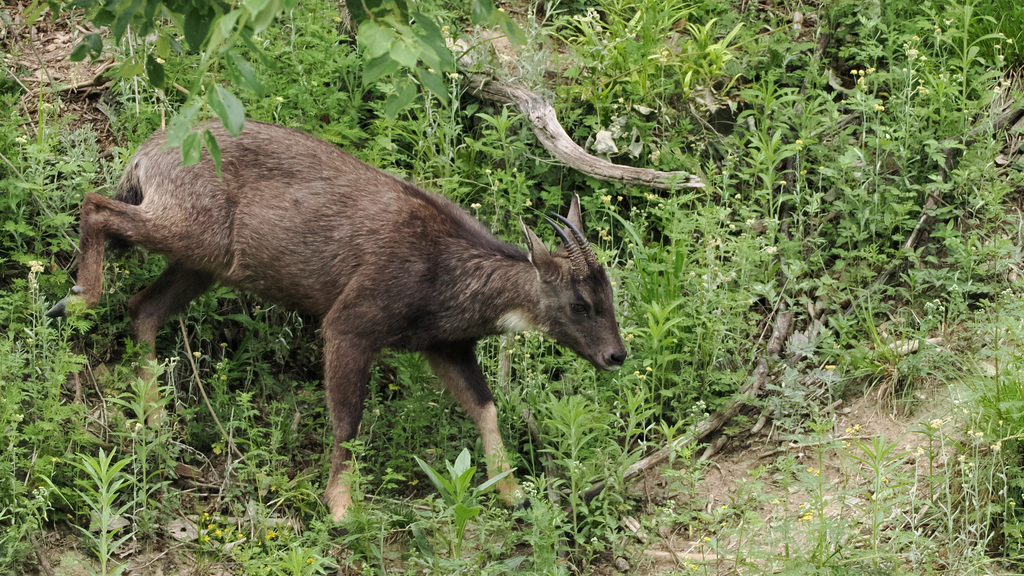
Chinese Goral
Photo © steve b
Photo © steve b — CC0 1.0 — Source: iNaturalist photo #518671398Identification
The Chinese goral is a small, stockily built ungulate that occupies a fascinating place between antelope and goat. Standing 50 to 78 cm at the shoulder and measuring 82 to 130 cm in length, it is built for life on steep terrain, with long, stout limbs and broad hooves that provide excellent grip on rocky ground. Its short, conical horns and fairly long, pointed ears are distinctive features, while an unusual characteristic—four teats rather than the two found in sheep and goats—sets it apart from similar species.
The coat consists of a dense underlayer topped with longer, coarse guard hairs that stand somewhat erect. Coloration is variable, ranging from pale grey through dark brown to reddish brown, with a characteristic dark stripe running along the back and pale coloring on the throat and underparts. This subtle patterning and stocky build make it well-adapted to its rocky mountain home.
Range & Habitat
The Chinese goral inhabits the mountainous regions of southeastern Asia, with its range extending from northeastern India, Myanmar, and northwestern Thailand through northern Vietnam, and possibly into northern Laos, reaching into much of China except the extreme north and west. This wide distribution across rugged terrain reflects the species' preference for remote, inaccessible mountain areas.
True to its name as a mountain specialist, the Chinese goral favors steep slopes, plateaus, and rocky areas where few other large herbivores venture. Though primarily restricted to these rocky zones, it sometimes ventures into nearby evergreen-deciduous forest and mixed woodland, always remaining in terrain that offers both sustenance and security from predators.
Behaviour & Diet
Chinese gorals are wary, retiring animals that live in small groups of up to 12 individuals, though older males typically become solitary. They spend much of their time on high rocky slopes, a strategy that allows them to detect and evade predators such as wolves and leopards. In response to seasonal changes, they move to lower ground during winter months when conditions in higher elevations become harsh.
The species is primarily a browser, feeding on twigs and leaves from bushes, though its diet also includes grass, nuts, and acorns. Breeding occurs in late spring, with females giving birth to one or two kids after a gestation period of approximately 215 days. The young are remarkably precocial, able to walk soon after birth, and remain with their mother through weaning in autumn and into the following winter.
Best Time & Places to See It
Encountering the Chinese goral requires patience, preparation, and access to remote mountainous terrain. The species' naturally wary and retiring nature means sightings are never guaranteed, even in suitable habitat. Protected areas within its range offer the best chances of encountering these elusive animals, though populations outside protected zones face greater pressure from hunting.
Winter movements to lower ground elevations may provide slightly improved viewing opportunities, though visitors should still expect challenging conditions. Northern Vietnam, Myanmar, and China's mountainous regions represent key areas for potential sightings, though the species' preference for inaccessible terrain means that dedicated mountaineering skills and local knowledge are typically essential for successful observation.
Photography Tips
Photographing the Chinese goral presents significant challenges due to its wariness and preference for rugged, remote terrain. Wide-angle lenses may prove more useful than telephoto equipment when working in steep, rocky country where positioning is constrained. Early morning light on rocky slopes, where the goral's coloration blends into the surrounding landscape, can provide dramatic photography opportunities if subjects can be located.
The species' variable coat color—from pale grey to reddish brown—offers interesting possibilities for capturing how individuals match their rocky habitat. Given the extremely wary nature of these animals, patient long-distance observation from concealment offers the best chance of natural behavior photography. Winter movements to lower elevations may provide more accessible opportunities than high-altitude summer habitat.
Giant Panda National Park
Mianyang, China
+447 birds+47 mammals
Where the eastern slopes of China's Sichuan plateau descend into cloud-wrapped valleys, one of Asia's most biodiverse landscapes unfolds across more than 350,000 square kilometres. This…
VIEW NATIONAL PARKJiuzhai Valley
Jiuzhaigou County, China
+226 birds+7 mammals
Where crystalline alpine streams cascade through limestone gorges and karst terrain rises in dramatic vertical walls, Jiuzhai Valley unfolds across nearly 1,300 square kilometers of southwestern…
VIEW NATURAL MONUMENTWolong National Nature Reserve
Wenchuan County, China
+333 birds+17 mammals
Where the Qingyi River cuts through the eastern flanks of the Minshan Range, a temperate montane forest cloaks steep valleys in dense canopy that thins dramatically…
VIEW NATURE RESERVENo community photos yet. Log in to add the first one.
No community observations of this species yet.