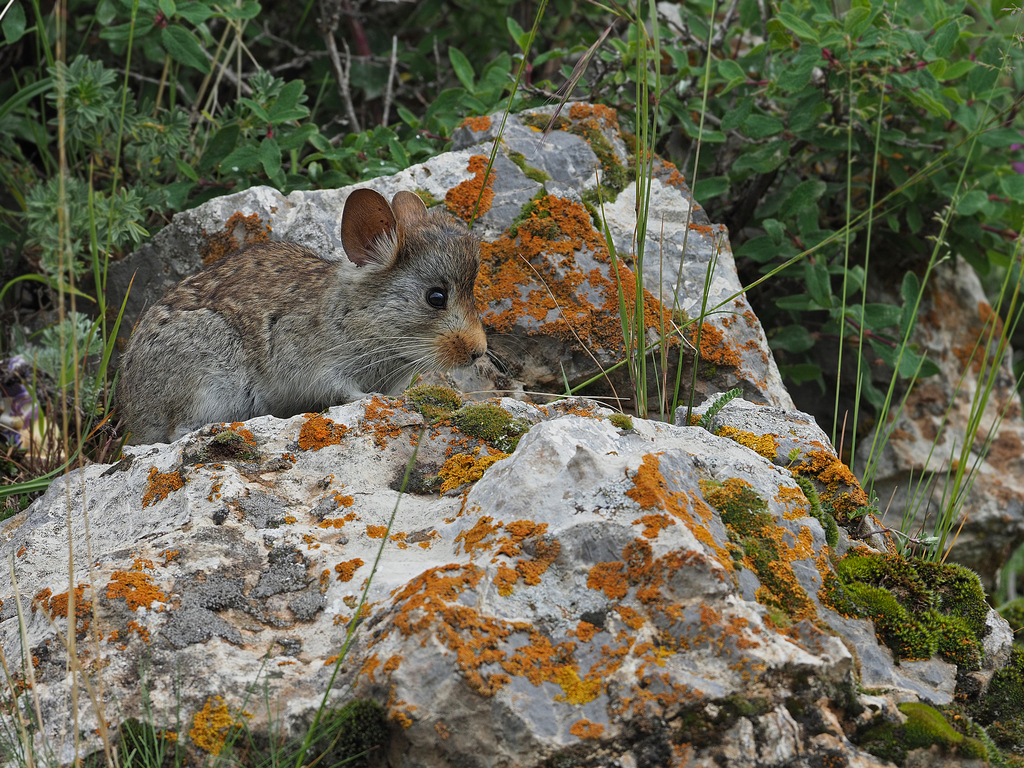
Chinese Red Pika
Photo © James Eaton
Photo © James Eaton — CC0 1.0 — Source: iNaturalist #207907584The Chinese red pika (Ochotona erythrotis) is a species of mammal in the family Ochotonidae. Typical of a pika it has short limbs, a small tail and round ears. Specific to the Chinese red pika has distinctive red color in its pelt. The Chinese pika typically lives in rocky terrain at altitudes between 600 and 1200 meters. and is endemic to the East Qinghai, West Gansu and Northern Sichuan provinces of China and Eastern Tibet. == Description == The Chinese red pika is one of the largest pika species, averaging a length of 18 to 29 cm. This pika has both a winter and summer pelt. The winter pelt is thicker for the cooler weather, and is a grey color with a slight tint of red in the ear region. In the summer, this species has a coat that is a rusty-red color at the head and chest and progressively becomes more grey at the tail end of the animal. The stomach region of O. erythrotis is a white color in both pelts. == Speciation == The Chinese red pika was formerly regarded as a subgenus of Pika, included first with Ochotona gloveri and later with Ochotona rutila until they…
Giant Panda National Park
Mianyang, China
+447 birds+47 mammals
Where the eastern slopes of China's Sichuan plateau descend into cloud-wrapped valleys, one of Asia's most biodiverse landscapes unfolds across more than 350,000 square kilometres. This…
VIEW NATIONAL PARKHuanglong Scenic and Historic Interest Area
Ngawa Tibetan and Qiang Autonomous Prefecture, China
+194 birds+7 mammals
Across the high plateau of northwestern Sichuan, a geological wonder unfolds where limestone terraces and mineral-rich springs have sculpted one of China's most distinctive natural monuments.…
VIEW NATURAL MONUMENTSanjiangyuan National Park
Nagqu, China
+187 birds+25 mammals
Where the headwaters of three great Asian rivers emerge from a high alpine plateau, the landscape unfolds in tundra and dwarf shrubland—a world of austere beauty…
VIEW NATIONAL PARKNo community photos yet. Log in to add the first one.
No community observations of this species yet.