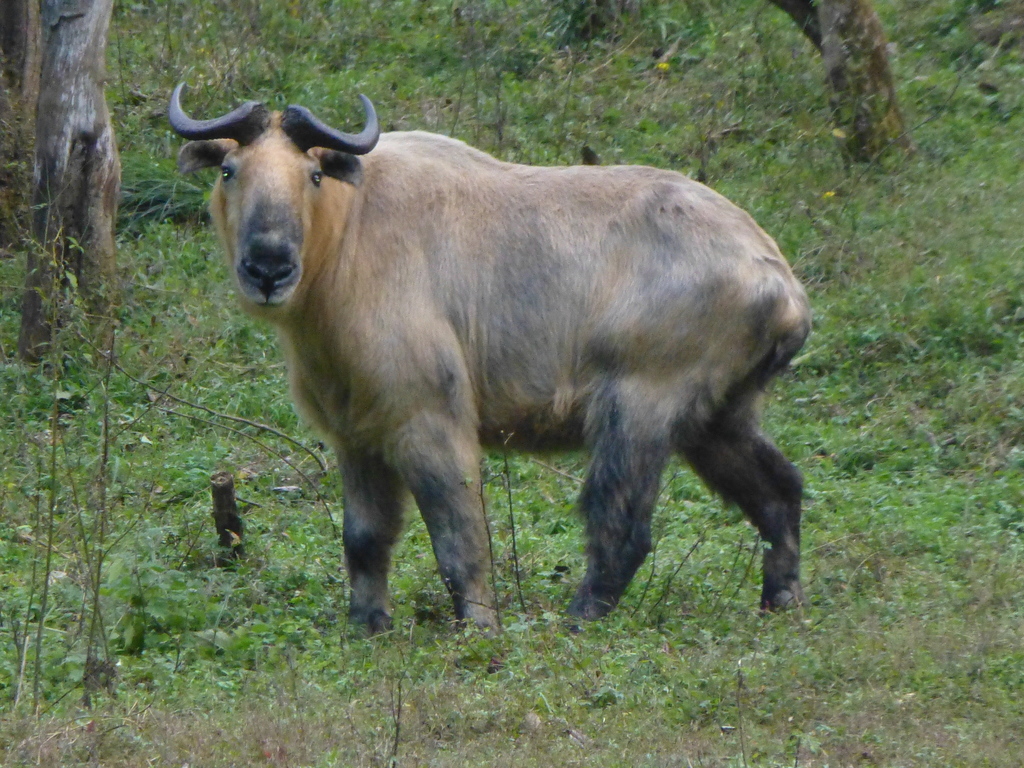
Chinese Takin
Photo © Sheelagh Halsey
Photo © Sheelagh Halsey — CC BY 4.0 — Source: iNaturalist #32698100Identification
The Chinese takin, also known as the Sichuan or Tibetan takin, is a stocky, heavily-built goat-antelope distinguished by its thick, powerful build and impressive horns. Its coat color and morphological features separate it from its closest relative, the golden takin, with which it shares the genus Budorcas. Despite superficial similarities to the Arctic muskox, DNA sequencing has revealed that takins are actually more closely related to sheep, goats, tahrs, bharal, and Barbary sheep—their resemblance to muskoxen being a result of convergent evolution rather than shared ancestry.
Perhaps the takin's most distinctive feature is its large, moose-like snout, which houses expansive sinus cavities that warm inhaled air before it reaches the lungs. Takins possess an oily skin that secretes a bitter-tasting substance, creating visible streaks where they rub against rocks and vegetation. They also emit a distinctive odor reminiscent of a combination of horse and musk. A thick secondary coat develops during winter months for additional insulation against the harsh mountain climate.
Range & Habitat
The Chinese takin is native to Tibet and the provinces of Sichuan, Gansu, and Xinjiang in China, inhabiting the same dense bamboo forests as the famous giant panda. These remarkable animals live in dense bamboo thickets and groves at altitudes above 14,000 feet, where steep, rocky terrain and challenging mountain slopes characterize their mountainous habitat. The inaccessibility of these remote regions has made gathering reliable population data and detailed ecological information difficult, though the species may have indirectly benefited from conservation protections extended to the giant panda.
Despite their large, stocky frames and relatively slow movement, takins are remarkably agile navigators of their rocky domain, capable of leaping nimbly from rock to rock across precipitous slopes. They inhabit family groups of up to 30 individuals and follow well-worn migration routes through the dense bamboo and rhododendron growth, creating distinctive paths to salt licks and grazing areas.
Behaviour & Diet
Takins are crepuscular feeders, eating during early morning and late afternoon hours before resting. They are generalist herbivores with remarkable feeding flexibility, consuming tough evergreen leaves, rhododendron foliage, oak, willow and pine bark, bamboo leaves, and various new-growth vegetation and herbs. Their ability to rear up on hind legs with front legs braced against trees allows them to access higher vegetation sources that other herbivores cannot reach.
The takin's life is governed by seasonal migration patterns. Each spring, individuals gather into herds numbering up to 300 animals and migrate upslope toward the tree line. As autumn arrives and food becomes scarce, these massive herds fragment into smaller groups of 10 to 35 animals that descend to forested valleys. Herds comprise adult females, young, subadults, and young males, while older bulls remain largely solitary except during late summer rutting season. Females give birth to a single calf in early spring; remarkably, calves can follow their mothers across difficult terrain within three days of birth.
Best Time & Places to See It
Spring and early summer offer the best opportunities to observe takins, when large herds of up to 300 animals gather together during their upslope migration. The remote, mountainous regions of Sichuan, Gansu, Tibet, and Xinjiang in western China represent the takin's primary stronghold, though the species' inaccessible habitat makes field observations challenging. Areas protecting giant pandas often overlap with takin habitat, potentially offering combined wildlife viewing opportunities.
For travellers unable to reach remote Chinese mountain regions, numerous zoos across North America maintain takin populations, including major institutions such as the San Diego Zoo, Lincoln Park Zoo, and the Cleveland Metroparks Zoo. China's Shaanxi Wild Animal Conservation Research Centre in Qinling also maintains breeding populations.
Photography Tips
Photographing wild takins requires patience and preparation for extreme mountain conditions. Spring herds offer the most photographic opportunities, with large aggregations providing numerous subjects. The takin's impressive horns, powerful build, and distinctive large snout are key features worth emphasizing. The oily secretions that create visible streaks on rocks and vegetation can add contextual interest to images documenting their behaviour and habitat use.
Photographers should be prepared for rapid movement when takins are startled—they respond quickly to danger despite their generally slow movement, either bounding across rocky terrain or gathering defensively as a herd. Capturing their characteristic alarm behavior, including the loud cough used to warn herd members of danger, would represent exceptional wildlife documentation. Zoo populations offer more accessible subjects for practicing takin photography and studying the species' morphology, behavior, and seasonal coat changes.
Giant Panda National Park
Mianyang, China
+447 birds+47 mammals
Where the eastern slopes of China's Sichuan plateau descend into cloud-wrapped valleys, one of Asia's most biodiverse landscapes unfolds across more than 350,000 square kilometres. This…
VIEW NATIONAL PARKWolong National Nature Reserve
Wenchuan County, China
+333 birds+17 mammals
Where the Qingyi River cuts through the eastern flanks of the Minshan Range, a temperate montane forest cloaks steep valleys in dense canopy that thins dramatically…
VIEW NATURE RESERVENo community photos yet. Log in to add the first one.
No community observations of this species yet.