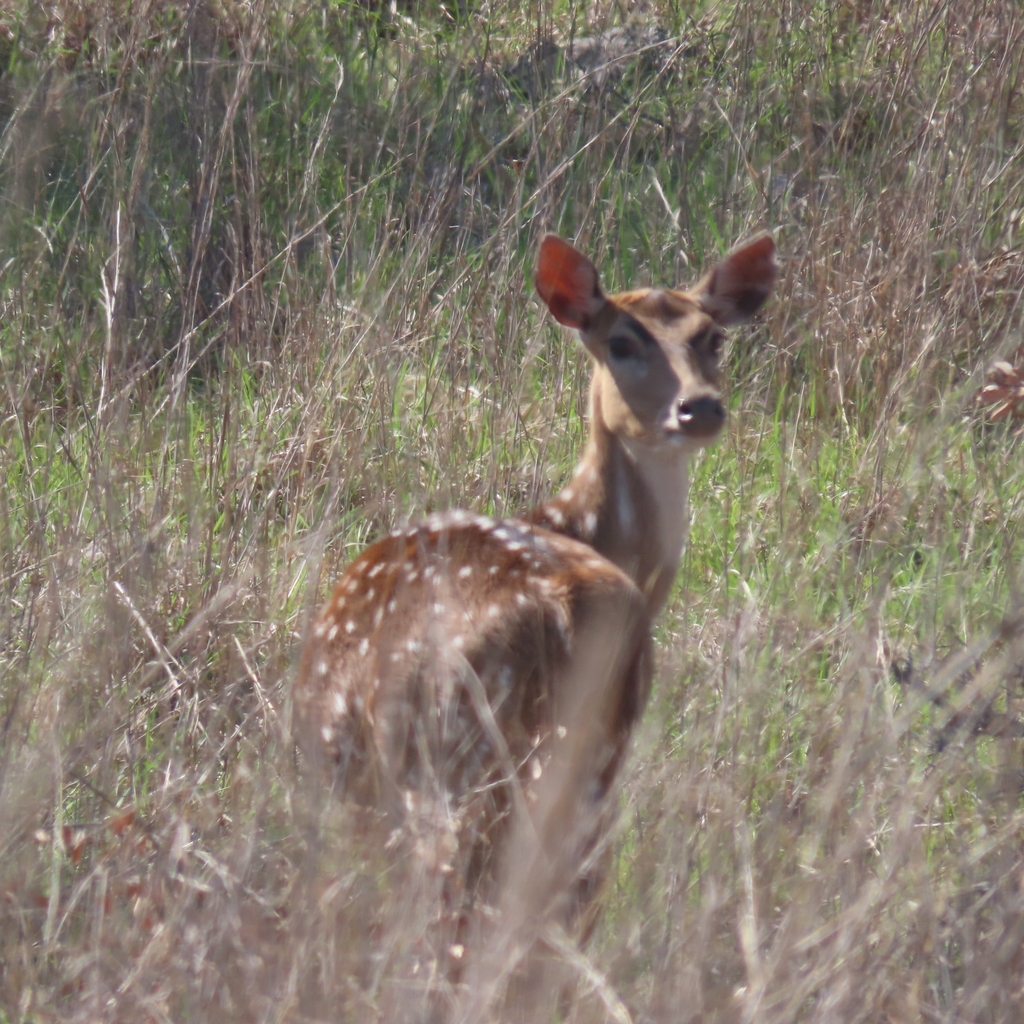
Chital
Photo © Suanne Pyle
Photo © Suanne Pyle — CC BY 4.0 — Source: iNaturalist #151751914Identification
The chital, also known as spotted deer or axis deer, is a moderately sized deer native to the Indian subcontinent. Males stand 90–100 cm at the shoulder and weigh up to 110 kg, while females are noticeably smaller at 65–75 cm and 25–45 kg. Sexual dimorphism is pronounced: only males carry antlers. The species is unmistakable in the field, with a striking golden to rufous coat completely covered in white spots. A conspicuous black stripe runs along the spine, and the abdomen, rump, throat, insides of the legs, ears, and tail are all white. The tail, marked by a dark stripe, measures around 20 cm. Males possess three-pronged antlers nearly 1 meter long, with the brow tine roughly perpendicular to the main beam. Well-developed preorbital glands near the eyes, larger in males than females, are frequently opened in response to stimuli.
Range & Habitat
The chital ranges across India, Nepal, Bhutan, Bangladesh, and Sri Lanka, roughly between 8–30°N latitude. Its western limit is eastern Rajasthan and Gujarat, while its northern distribution extends through the Terai and northern West Bengal, Sikkim, and forested valleys in Bhutan below 1,100 meters elevation. The Andaman and Nicobar Islands and Sri Lanka represent the southern extent of its range. The species inhabits deciduous and semi-evergreen forests and open grasslands throughout the Indian peninsula, though it is locally extinct in parts of central and north-eastern Bangladesh.
Behaviour & Diet
Limited specific behavioral and dietary information is provided in available sources for this species profile. As a cervid, the chital exhibits typical deer ecology, with males shedding and regrowing their antlers annually. The antlers emerge as soft velvet tissues and progressively harden into bony structures through mineralization. The species possesses a more cursorial (running-adapted) build compared to the hog deer, enabling efficient movement through its grassland and forest habitats.
Best Time & Places to See It
Chital are distributed across protected forests and grasslands throughout central and peninsular India, Nepal, Bhutan, Bangladesh, and Sri Lanka. They are particularly associated with deciduous and semi-evergreen forest habitats interspersed with open grasslands. Several eco parks around the Bay of Bengal support populations, and the species occurs in the Sundarbans. Specific seasonal information regarding optimal viewing periods is not detailed in available sources.
Photography Tips
The chital's striking spotted coat and distinctive black dorsal stripe make it highly photogenic. The white spotting against golden-rufous coloring creates excellent contrast in varied lighting conditions. For male subjects, the impressive three-pronged antlers provide dramatic focal points, particularly during velvet stage or after hardening. The white patches on the rump, throat, and ear interiors offer bright highlights that stand out against forested backgrounds. Early morning and late afternoon light will enhance the deer's warm tones and emphasize the contrast between its colored coat and white markings.
Kanha Tiger Reserve
Minneriya National Park
Bandhavgarh National Park
Bandipur National Park
Banke National Park
Bardiya National Park
Chitwan National Park
El Palmar National Park
Gir National Park
Nothing matches these filters.
No community photos yet. Log in to add the first one.