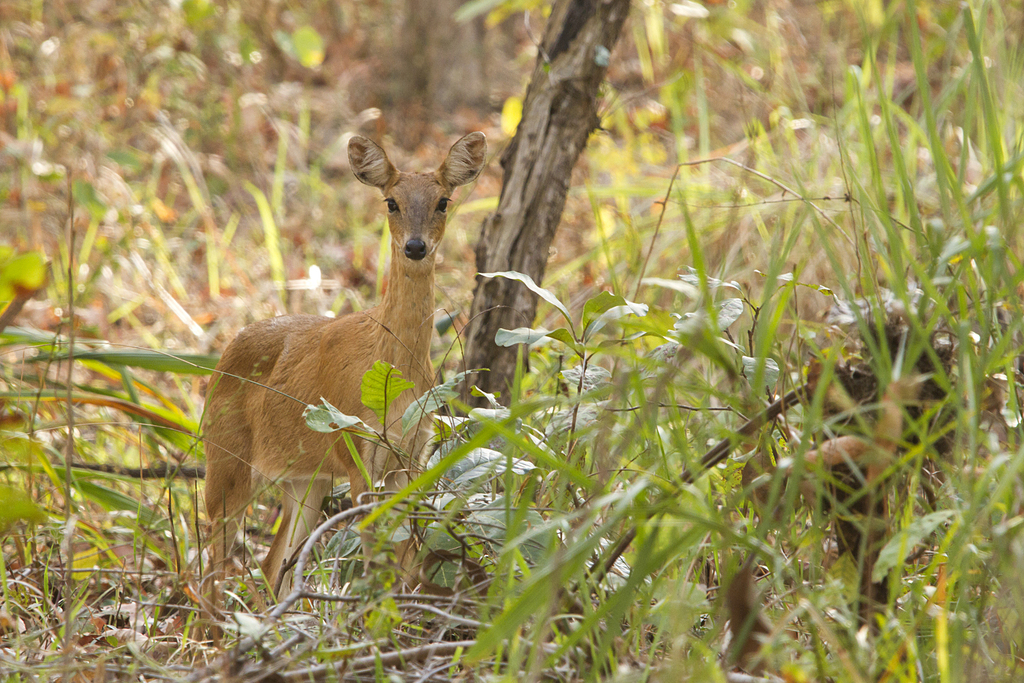
Chowsingha
Photo © Ramesh Shenai Jr.
Photo © Ramesh Shenai Jr. — CC BY 4.0 — Source: iNaturalist photo #80424707The four-horned antelope (Tetracerus quadricornis), also called chousingha, is a small bovid antelope native to central, South and Western India, along with a smaller population in Nepal. The sole member of the genus Tetracerus, the chousingha was first scientifically described in 1816 by French zoologist Henri Marie Ducrotay de Blainville. Three regional subspecies are currently recognised. The four-horned antelope has a yellowish-tan, sometimes reddish or goldenrod coat. It is slender with thin legs and a short tail. It stands nearly 55–64 cm (22–25 in) at the shoulder and weighs about 17–22 kg (37–49 lb). Its four horns are unique among antelopes and distinguish it from most other bovids. The longer pair of straight, spike-like horns is atop its head between the ears, while the other, shorter pair is on the forehead; its posterior horns are always longer than the anterior horns, which may even present as merely fur-covered "studs". While the posterior horns measure 8–12 cm (3.1–4.7 in), the anterior ones are usually 2–5 cm (0.79–1.97 in) long. The four-horned antelope is diurnal (active mainly during the day) and typically solitary by nature, though some antelope may form loose groups of three to five animals, usually one or more adults…
Kanha Tiger Reserve
Kanha Kisli F.V., India
+321 birds+23 mammals
Where sal forests give way to emerald meadows and crystalline streams carve through ancient valleys, one of India's finest wilderness reserves unfolds across the Maikal Range.…
VIEW NATIONAL PARKTadoba National Park
Palasgaon Singru, India
+270 birds+20 mammals
Where sal forests meet open grasslands and rocky outcrops rise from red laterite soil, central India's landscape unfolds in raw, untamed beauty. Ancient teak woodlands and…
VIEW NATIONAL PARKNo community photos yet. Log in to add the first one.
No community observations of this species yet.