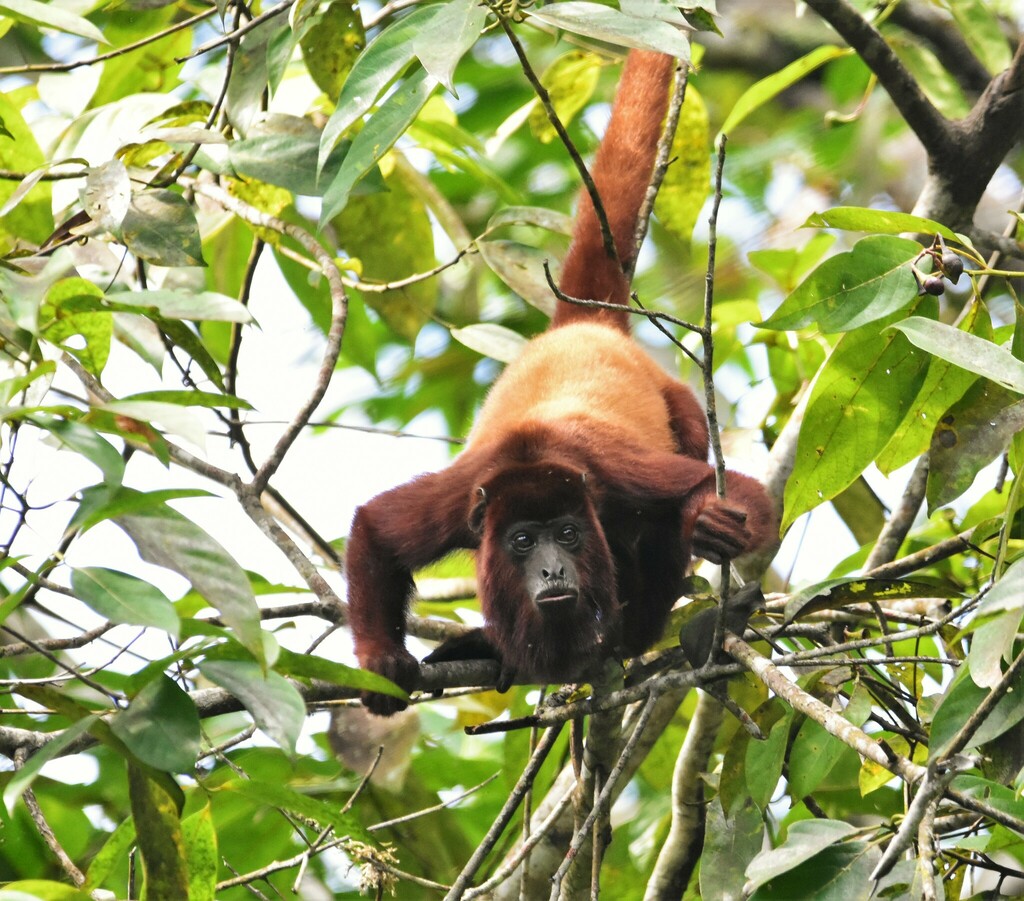
Colombian Red Howler
Photo © Zac Peterson
Photo © Zac Peterson — CC BY 4.0 — Source: iNaturalist photo #208797771Identification
The Colombian red howler is a medium-sized New World monkey with a distinctive deep reddish-brown coat that darkens with age. Males are noticeably larger than females, ranging from 49 to 72 cm in body length and weighing 5.4 to 9 kg, while females measure 46 to 57 cm and weigh 4.2 to 7 kg. Their most striking feature is a long prehensile tail measuring 49 to 75 cm, covered in fur except for the last third of the underside, which is bare and allows the animal to grip branches with extraordinary precision. The face is framed by fur with a characteristically stubby nose. Perhaps most remarkable are the anatomical adaptations for their famous vocalizations: an enlarged hyoid bone, expanded jaw, and inflated middle-ear bulla that give them exceptional acoustic capabilities.
Range & Habitat
The Colombian red howler inhabits the western Amazon Basin, with populations distributed across Venezuela, Colombia, Ecuador, Peru, and Brazil. Related populations in Bolivia and northeastern South America have been recognized as separate species. These arboreal primates spend most of their time high in the forest canopy, moving deliberately through the trees with minimal leaping. Their preferred mode of locomotion is quadrupedal walking, and their prehensile tails provide both support and active grasping ability as they navigate the three-dimensional world of the canopy.
Behaviour & Diet
Colombian red howlers live in social groups of three to nine individuals, usually five to seven, structured polygynously with one dominant alpha male who leads the group to feeding sites and defends the group's territory. Females care for the offspring. These diurnal monkeys are most active in the morning as they forage and move between feeding areas. They are folivores, subsisting primarily on leaves supplemented with nuts, seeds, fruits, flowers, and small animals. Leaves are essential—the monkeys cannot survive without them for more than a week. Specialized dentition including narrow incisors and sharp-crested molars, combined with a complex digestive system featuring a large hindgut containing specialized bacteria, enables them to process fibrous plant material efficiently.
Best Time & Places to See It
Early morning is the optimal time to locate Colombian red howlers, as groups are most active during the dawn hours when they move to new feeding spots. Listen for the famous "dawn chorus"—loud roaring and howling calls that can be heard up to 5 kilometers away and are performed primarily by males. These calls serve to establish territory and prevent confrontations between groups. Throughout the western Amazon Basin in Venezuela, Colombia, Ecuador, Peru, and Brazil, patient observers positioned in suitable forest habitat can experience these remarkable vocalizations that announce the monkeys' presence across the landscape.
Photography Tips
Photograph Colombian red howlers early in the morning when they are most active and moving through the canopy. Position yourself with clear sightlines into the canopy, ideally at or above the monkeys' level if possible. The deep reddish-brown coloration photographs well in dappled forest light, though avoid harsh midday sun which can obscure detail. Use binoculars to locate groups first, then slowly approach. Remember that males' vocalizations often precede visual sightings, so listen carefully. A telephoto lens is essential for canopy work, and fast film or higher ISO settings help compensate for the dappled light of the forest interior.
Yasuní National Park
Aguarico, Ecuador
+601 birds+43 mammals
Where the western Amazon basin converges with Ecuador's Orellana Province, lowland rainforest reaches toward the horizon in an unbroken canopy of staggering botanical density. Yasuní National…
VIEW NATIONAL PARKNatural la Paya National Park
Puerto Leguízamo, Colombia
+262 birds+4 mammals
Where the Amazon's western reaches fold into the Andes foothills, La Paya National Park sprawls across more than 8,500 square kilometers of pristine Amazonian rainforest in…
VIEW NATIONAL PARKNatural Sierra de la Macarena National Park
Vista Hermosa, Colombia
+566 birds+15 mammals
Across nearly 20,000 square kilometres of Colombia's Meta Department, the terrain rises from lowland savanna into Andean foothills through a mosaic of gallery forests, palm-fringed wetlands,…
VIEW NATIONAL PARKAmacayacu National Park
Leticia, Colombia
+567 birds+25 mammals
Where the Rio Amazonas curves through the tri-border region where Colombia, Peru, and Brazil converge, Amacayacu National Park sprawls across more than 5,250 square kilometres of…
VIEW NATIONAL PARKPacaás Novos National Park
Brazil
+279 birds+1 mammals
Across the border between Rondônia and Amazonas, vast tracts of humid tropical forest rise and fall in gentle undulations, carved by clear-flowing rivers that feed into…
VIEW NATIONAL PARKSerra do Divisor National Park
Brazil
+448 birds+10 mammals
Where the western Amazon meets the Andes foothills, Serra do Divisor National Park sprawls across one of South America's most biodiverse and least accessible frontiers. Spanning…
VIEW NATIONAL PARKManu National Park
Manu, Peru
+892 birds+26 mammals
Across the eastern slopes of the Peruvian Andes, tropical rainforest descends into the Amazon basin with a complexity that few terrestrial ecosystems match. Manu National Park…
VIEW NATIONAL PARKBahuaja Sonene National Park
San Pedro de Putina Punco, Peru
+602 birds+8 mammals
Where the Madre de Dios and Heath rivers converge in southeastern Peru rises one of South America's most biodiverse wilderness regions: a vast protected realm of…
VIEW NATIONAL PARKNo community photos yet. Log in to add the first one.
No community observations of this species yet.