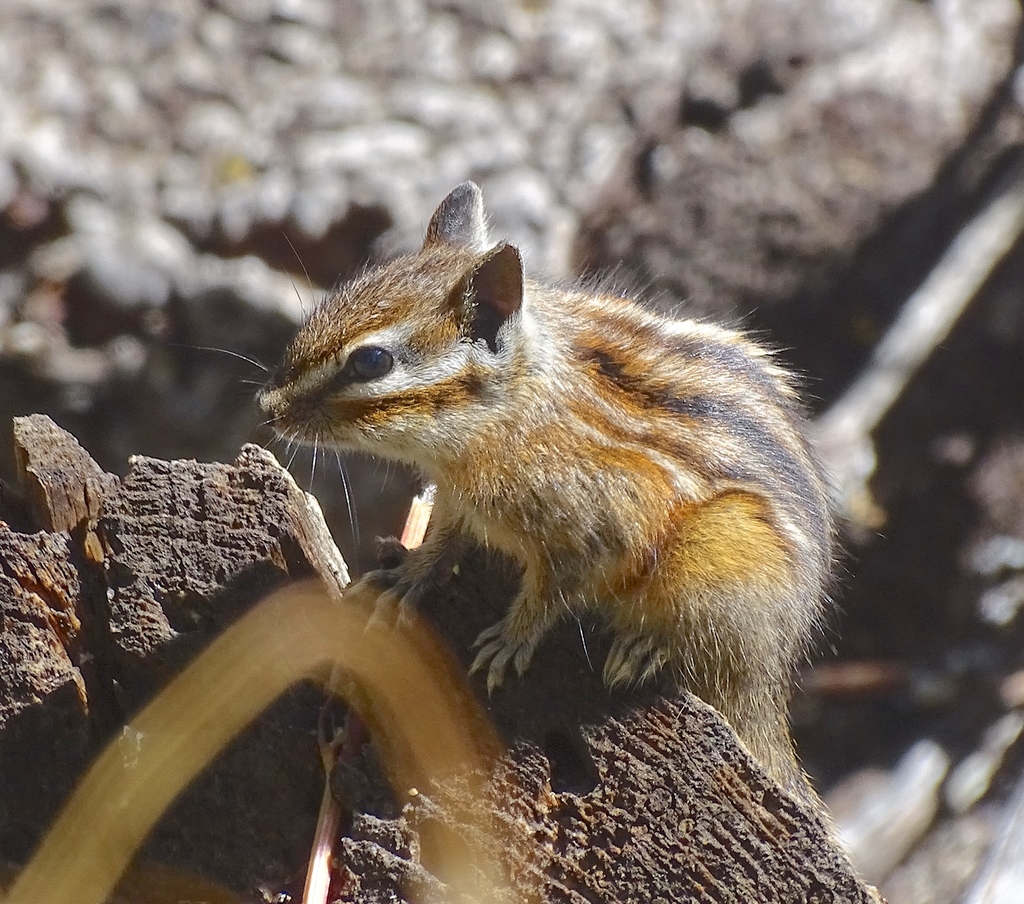
Colorado Chipmunk
Photo © Sandra Keller
Photo © Sandra Keller — CC BY 4.0 — Source: iNaturalist #98098274The Colorado chipmunk (Neotamias quadrivittatus) is a species of chipmunk in the squirrel family Sciuridae. It is endemic to Colorado, Utah, Arizona and New Mexico in the United States. == Description == This species is the largest of the three species of chipmunks found in the Colorado Front Range (which also include the least chipmunk and the Uinta chipmunk). On average it weighs about 62 grams (2.2 oz). Chipmunks are distinguished from ground squirrels in that their faces have a stripe going across under the eye. There are no dimorphic differences between males and females. Their vocalizations are essential for defending their territories. Three subspecies are recognized. N. q. australis - Organ Mountains, New Mexico N. q. oscuraensis - Oscura Mountains, New Mexico N. q. quadrivittatus - Colorado, northern New Mexico, northern Arizona, eastern Utah == Habitat == The Colorado chipmunk primarily occupies coniferous forests in the Southern Rocky Mountains. In northeastern Colorado, the Colorado chipmunk's range is strictly bounded by competition with the higher-elevation Uinta chipmunk and it predominately occurs in open woodlands between 1,500 metres (4,900 ft) and 2,100 metres (6,900 ft). In southern Colorado, where Uinta chipmunks are absent, the Colorado chipmunk occurs in montane forests and…
Mesa Verde National Park
Montezuma County, United States
+166 birds+10 mammals
Across the high desert plateau of southwestern Colorado, where sandstone mesas rise abruptly from piñon-juniper scrubland, Mesa Verde National Park preserves one of North America's most…
VIEW NATIONAL PARKGreat Sand Dunes National Park
Saguache County, United States
+193 birds+14 mammals
Where the Colorado high plains collide with one of North America's most extraordinary geological anomalies, nearly 600 square kilometres of windswept sand rise abruptly from the…
VIEW NATIONAL PARKBlack Canyon of the Gunnison National Park
Montrose County, United States
+169 birds+13 mammals
Where the Gunnison River has carved one of North America's steepest and most dramatic canyons, ancient metamorphic rock walls plunge nearly 2,000 feet in places, creating…
VIEW NATIONAL PARKRocky Mountain National Park
Larimer County, United States
+259 birds+33 mammals
Where granite peaks rise above 12,000 feet and alpine tundra gives way to subalpine forest, Rocky Mountain National Park spans the Continental Divide across nearly 1,600…
VIEW NATIONAL PARKNo community photos yet. Log in to add the first one.
No community observations of this species yet.