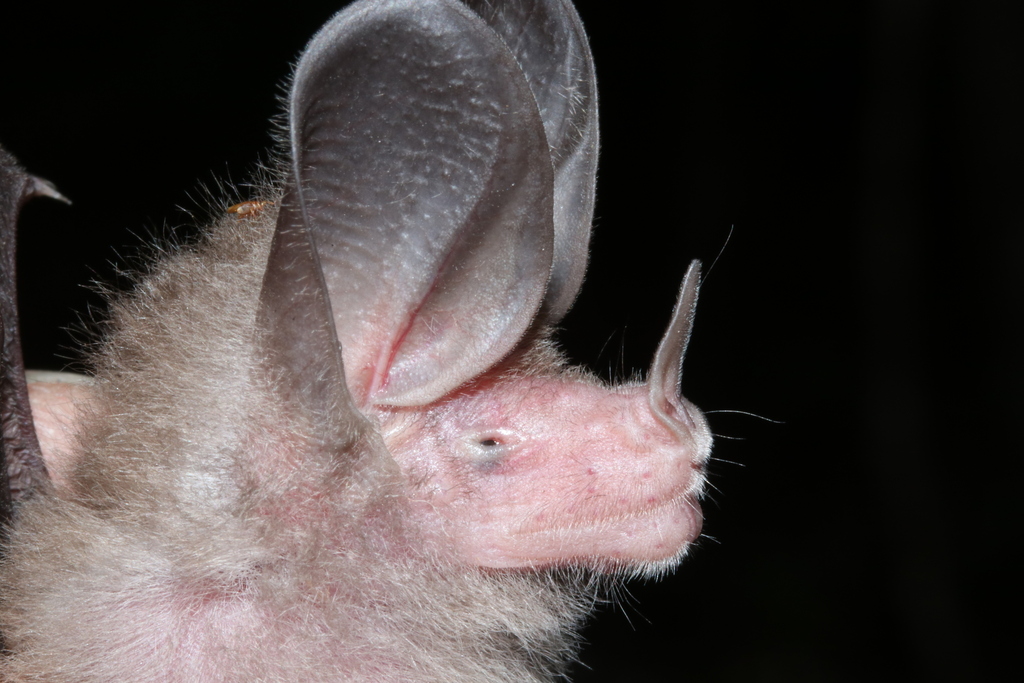
Common Big-eared Bat
Photo © Juan Cruzado Cortés
Photo © Juan Cruzado Cortés — CC BY 4.0 — Source: iNaturalist photo #343010329Identification
The common big-eared bat is a small species, weighing just 3.4–9.1 grams, with a forearm length of 32–38 mm. Its most distinctive feature is its large, rounded ears, measuring 18–23 mm long and connected by an inter-auricular membrane that spans between them. The bat's fur is brown, though the exact shade varies depending on geographic location. Like all members of the Phyllostomidae family, it possesses a characteristic leaf-nose formation used in echolocation.
Range & Habitat
This species is found across a wide range of South and Central America, occurring in Belize, Bolivia, Brazil, Colombia, Costa Rica, El Salvador, French Guiana, Guatemala, Guyana, Honduras, Mexico, Nicaragua, Panama, and Venezuela. Its broad distribution suggests it is adaptable to various tropical and subtropical habitats throughout the region.
Behaviour & Diet
The common big-eared bat possesses a remarkable and unique echolocation ability that sets it apart from most other bat species. While most echolocating bats detect prey by tracking movement—identifying glints or Doppler shifts caused by wingbeats—M. microtis can locate completely motionless prey within dense, cluttered environments. This extraordinary skill allows it to hunt with precision in extremely complex sonic landscapes where visual and acoustic clutter would overwhelm other species.
The bat's echolocation call is a broad-band multi-harmonic frequency-modulated sweep, with most energy concentrated in the second harmonic between 75 and 95 kHz. This call structure is similar to that of the long-legged bat (Macrophyllum macrophyllum), though presumably of lower intensity. Like all Phyllostomidae members, it emits its echolocation calls through its nostrils rather than its mouth. Maternal care is notably extended in this species: mothers continue to provide their pups with prey items for up to five months after weaning, suggesting complex learning of foraging techniques.
Best Time & Places to See It
The common big-eared bat's wide distribution across Central and South America means it may be encountered in suitable habitats throughout its range, from Mexico to Venezuela and Brazil. However, specific seasonal patterns and preferred microhabitats within this range are not well documented. Travellers exploring tropical forests, caves, and woodland areas in any of the thirteen countries where it occurs may encounter this species, particularly during evening foraging hours.
Photography Tips
Photographing this tiny bat presents significant challenges due to its small size and nocturnal habits. Night-vision or infrared photography equipment will be essential for capturing images in the field. The bat's large, distinctive ears and leaf-nose formation are key identifying features worth highlighting in photographs. Given the species' small size and preference for cluttered forest environments, patience and specialized macro photography techniques will yield the best results.
Sian Ka’an
Chunyaxché, Mexico
+350 birds+16 mammals
Where the Yucatán Peninsula dissolves into wetland and mangrove, a vast mosaic of forest, lagoon, and coastal margin creates one of Mexico's most biodiverse strongholds. Across…
VIEW BIOSPHERE RESERVEPalo Verde National Park
Bagaces, Costa Rica
+318 birds+24 mammals
Dry forest spreads across Palo Verde's low-lying terrain in northwestern Guanacaste, where seasonal rivers and lagoons etch through deciduous woodland that sheds its canopy each winter.…
VIEW NATIONAL PARKRincón de la Vieja National Park
Liberia, Costa Rica
+451 birds+30 mammals
Where volcanic slopes rise abruptly from the Guanacaste lowlands, Rincón de la Vieja National Park sprawls across a landscape shaped by geothermal drama and seasonal extremes.…
VIEW NATIONAL PARKNo community photos yet. Log in to add the first one.
No community observations of this species yet.