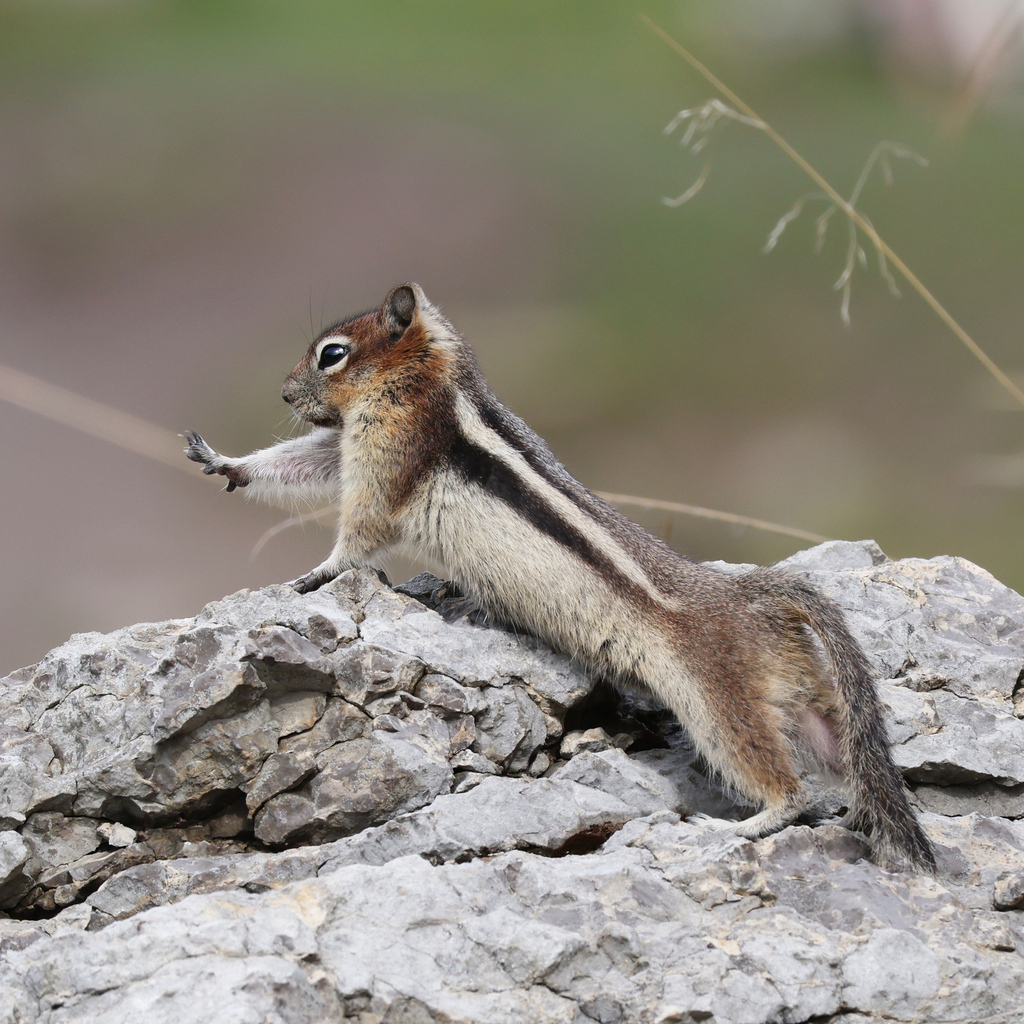
Common Golden-mantled Ground Squirrel
Photo © Huey
Photo © Huey — CC BY 4.0 — Source: iNaturalist #372611646Identification
The Common Golden-mantled Ground Squirrel is a medium-sized ground squirrel measuring 23 to 29 cm in length, with adults weighing between 120 and 394 grams. Its most distinctive features are the tawny to reddish "mantle" across its shoulders—deeper reddish in males—and the striking black-bordered white stripe running down each side of its back. The underparts are whitish or yellow-gray, while the tail is brown to black with buff edges and a yellowish to reddish underside. Pale rings encircle the eyes, giving the species a characteristic appearance. Unlike similar-looking chipmunks, this squirrel entirely lacks facial stripes, making it relatively easy to distinguish from its smaller cousins.
Range & Habitat
This species is native to western North America, with its range extending through the Rocky Mountains of British Columbia and Alberta and across much of the western United States. The Common Golden-mantled Ground Squirrel inhabits forests, chaparral, meadow margins, and sagebrush environments, showing a preference for areas with abundant rocks or forest litter that provide shelter. The species is closely associated with coniferous forests, aspen groves, and manzanita scrubland, demonstrating its adaptability to diverse montane and foothill ecosystems.
Behaviour & Diet
These omnivorous squirrels have a remarkably varied diet, feeding on pine nuts, acorns, herbs, shrubs, fungi, insects, eggs, young birds, and lizards. They opportunistically consume carrion and have learned to exploit human food sources at the wildlife-urban interface, where they are known to beg for handouts. During late summer and fall, they actively cache food near their burrows to sustain themselves through hibernation. Over winter, golden-mantled ground squirrels enter hibernation in dens that can extend up to 100 feet in length, though they are typically shallow. Breeding commences in spring following emergence from hibernation, with most broods born in July; females typically produce two to eight young per litter, averaging five.
Best Time & Places to See It
Spring through fall offers the best viewing opportunities, as these squirrels are active during warmer months and enter hibernation over winter. They are most visible during summer months when they are gaining weight in preparation for their winter dormancy. Look for them in rocky areas and meadow margins within coniferous forests, aspen stands, and sagebrush habitats throughout the Rocky Mountains and western mountain regions. Popular hiking and camping areas often provide excellent opportunities to encounter these habituated, approachable animals.
Photography Tips
The golden-mantled ground squirrel's distinctive coloration and bold markings make it a rewarding photographic subject. Position yourself near rocky outcrops or meadow edges during mid-morning or late afternoon when the squirrels are most active and lighting is favorable. The contrast between their reddish mantle and white-striped back photographs beautifully in natural light. Exercise caution at popular sites where squirrels have become habituated to humans—maintain a respectful distance and avoid feeding them, as this encourages dependency and may alter their natural behavior. Patient observation near burrows and food caching sites often yields excellent opportunities for behavioral photography.
Glacier National Park
Glacier, Canada
+162 birds+12 mammals
Where granite peaks pierce the clouds above the Columbia River valley, Glacier National Park protects one of the most dramatic mountain wilderness areas in western Canada.…
VIEW NATIONAL PARKKootenay National Park
Area G (Forster Creek/Mount Assiniboine), Canada
+181 birds+23 mammals
Where the spine of the Canadian Rockies rises above 3,000 metres, the high alpine realm around Forster Creek and Mount Assiniboine reveals one of the continent's…
VIEW NATIONAL PARKBanff National Park
Improvement District No. 9, Canada
+264 birds+33 mammals
Where the Canadian Rockies thrust skyward in a cathedral of limestone and ice, Banff National Park preserves a wilderness of astounding vertical drama. Glacier-carved valleys cradle…
VIEW NATIONAL PARKLassen Volcanic National Park
Shasta County, United States
+239 birds+18 mammals
Volcanic peaks and geothermal upheaval have sculpted 545 square kilometers of Northern California into a landscape where fire and water engage in perpetual dialogue. Lassen Peak…
VIEW NATIONAL PARKGreat Basin National Park
White Pine County, United States
+170 birds+19 mammals
Where the Great Basin's high desert plateaus rise above 10,000 feet, ancient bristlecone pines endure on moonscape ridges of limestone and quartzite, creating one of North…
VIEW NATIONAL PARKZion National Park
Washington County, United States
+244 birds+30 mammals
Towering sandstone cliffs in shades of crimson, rust, and cream rise abruptly from the Virgin River's winding canyon floor, their sculpted faces bearing witness to millions…
VIEW NATIONAL PARKGreat Sand Dunes National Park
Saguache County, United States
+193 birds+14 mammals
Where the Colorado high plains collide with one of North America's most extraordinary geological anomalies, nearly 600 square kilometres of windswept sand rise abruptly from the…
VIEW NATIONAL PARKCapitol Reef National Park
Garfield County, United States
+196 birds+22 mammals
Wrinkled ridges of crimson and gold sandstone rise from the floor of south-central Utah, their weathered faces carved by the Fremont River into one of the…
VIEW NATIONAL PARKYosemite National Park
Mariposa County, United States
+224 birds+28 mammals
Granite cliffs soar nearly a kilometer above the valley floor in this expanse of high Sierra wilderness, where glacial U-shaped valleys sculpt a landscape of dramatic…
VIEW NATIONAL PARKGrand Teton National Park
Teton County, United States
+247 birds+38 mammals
Where the Teton Range tears skyward in a dramatic escarpment above the Snake River valley, nearly 2,550 square kilometers of montane wilderness unfolds across Teton County,…
VIEW NATIONAL PARKYellowstone National Park
Park County, United States
+253 birds+43 mammals
Across nearly 11,400 square kilometres of the Rocky Mountain plateau, geothermal fury and pristine wilderness converge in one of Earth's most dynamic landscapes. Hot springs, geysers…
VIEW NATIONAL PARKCrater Lake National Park
Klamath County, United States
+174 birds+13 mammals
At 1,949 metres above sea level, a volcanic caldera of impossible clarity holds one of North America's deepest and most pristine alpine lakes, ringed by pumice-and-ash…
VIEW NATIONAL PARKBlack Canyon of the Gunnison National Park
Montrose County, United States
+169 birds+13 mammals
Where the Gunnison River has carved one of North America's steepest and most dramatic canyons, ancient metamorphic rock walls plunge nearly 2,000 feet in places, creating…
VIEW NATIONAL PARKRocky Mountain National Park
Larimer County, United States
+259 birds+33 mammals
Where granite peaks rise above 12,000 feet and alpine tundra gives way to subalpine forest, Rocky Mountain National Park spans the Continental Divide across nearly 1,600…
VIEW NATIONAL PARKSequoia National Park
Tulare County, United States
+187 birds+27 mammals
Granite peaks rising above 3,600 meters dominate the southern Sierra Nevada, where Sequoia National Park sprawls across one of North America's most vertically compressed wilderness zones.…
VIEW NATIONAL PARKKings Canyon National Park
Fresno County, United States
+186 birds+20 mammals
Where granite peaks fracture the Sierra Nevada skyline and the Kings River has carved one of North America's most dramatic canyons, a landscape of extreme relief…
VIEW NATIONAL PARKWaterton Lakes National Park
Improvement District No. 04, Canada
+252 birds+31 mammals
Where the Continental Divide plunges toward the prairies of Alberta, glacier-carved valleys and emerald lakes pierce a landscape where montane forest meets alpine tundra. Waterton Lakes…
VIEW NATIONAL PARKYoho National Park
Area A (Kicking Horse/Kinbasket Lake), Canada
+207 birds+19 mammals
Where the Canadian Rockies meet the Columbia River watershed, a vast wilderness of 2,211 square kilometres unfolds across Yoho National Park in British Columbia. The landscape…
VIEW NATIONAL PARKBryce Canyon National Park
Tropic, United States
+202 birds+20 mammals
Hoodoos rise like a forest of stone pillars from an amphitheater carved into Utah's high plateau, where the Paunsaugunt elevates the landscape to over 9,000 feet…
VIEW NATIONAL PARKGlacier National Park
United States
+246 birds+39 mammals
Where jagged peaks pierce a subarctic sky and glacial valleys carve through ancient rock, Glacier National Park spans the spine of the Northern Rockies along Montana's…
VIEW NATIONAL PARKGrand Canyon National Park
United States
+277 birds+35 mammals
A mile-deep chasm of rust-red rock and purple shadow cuts through the high desert plateau of northern Arizona, revealing nearly two billion years of geological history…
VIEW NATIONAL PARKMalheur National Wildlife Refuge
Harney County, United States
+309 birds+24 mammals
Across the high desert plateau of southeastern Oregon, where sagebrush scrubland stretches toward distant ridgelines under an enormous sky, lies a sanctuary shaped by water in…
VIEW WILDLIFE SANCTUARYKlamath Marsh National Wildlife Refuge
Klamath County, United States
+219 birds+7 mammals
Where the volcanic plateau of south-central Oregon slopes into a broad, shallow basin lies one of the Pacific Northwest's most underappreciated wetland sanctuaries. Klamath Marsh National…
VIEW WILDLIFE SANCTUARYNational Elk Refuge
Jackson, United States
+230 birds+27 mammals
Where the sagebrush flats of northwestern Wyoming rise toward the Gros Ventre Mountains, winter transforms the landscape into a realm of survival and spectacle. The National…
VIEW WILDLIFE SANCTUARYNo community photos yet. Log in to add the first one.
No community observations of this species yet.