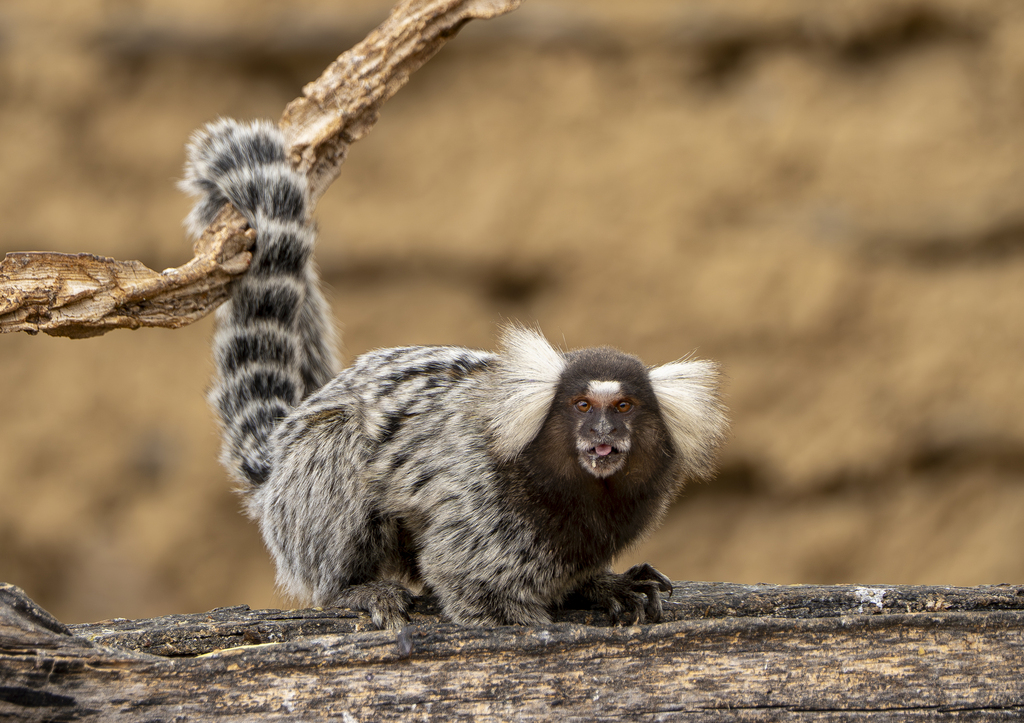
Common Marmoset
Photo © Patrícia Hanate
Photo © Patrícia Hanate — CC BY-SA 4.0 — Source: iNaturalist photo #586496800Identification
The common marmoset is a diminutive New World monkey, easily recognized by its distinctive appearance. Males average 188 mm in height and weigh around 256 g, while females are slightly smaller at 185 mm and 236 g respectively. Their most striking features are their prominent white ear tufts and banded tail, which set them apart from other small primates. The coat is multicolored, sprinkled with brown, grey, and yellow hairs, while the face displays a characteristic black patch across the nose-area skin contrasted with a white forehead blaze.
An unusual anatomical feature aids their arboreal lifestyle: claw-like nails called tegulae on most fingers, with only their big toes bearing the flat nails typical of other primates. These specialized nails, combined with their long lower incisors and chisel-shaped front teeth, reflect their unique ecological role. Young marmosets begin life with brown and yellow coats, developing their distinctive ear tufts as they mature.
Range & Habitat
Common marmosets are native to the northeastern coast of Brazil, originally inhabiting the states of Piauí, Paraíba, Ceará, Rio Grande do Norte, Pernambuco, Alagoas, and Bahia. Since the 1920s, both intentional and accidental releases of captive individuals have dramatically expanded their range into Southeast Brazil, with the first documented wild sighting in Rio de Janeiro occurring in 1929. They have also established populations in Buenos Aires, Argentina, and within Rio de Janeiro city itself.
These adaptable primates thrive in diverse forest habitats including Atlantic coastal forests, semideciduous forests, savanna forests, and riverine forests. They are particularly successful in dry secondary forests and edge habitats, demonstrating remarkable ecological flexibility that has contributed to their invasive success in regions beyond their native range.
Behaviour & Diet
Common marmosets live in stable extended family groups typically numbering around nine individuals, though groups can contain up to 15 members. These families comprise one or two breeding females, a breeding male, their offspring, and adult relatives. Social structure is hierarchical, with breeding individuals maintaining dominance through various behaviors, postures, and vocalizations. Interestingly, marmosets may delay dispersal from their natal groups until adulthood, unlike most other primates. Reproduction involves a complex mating system where monogamy is most common, though polygamy and polyandry have been observed. Non-breeding group members are behaviorally and physiologically suppressed from reproducing, ensuring they focus energy on raising related young.
The marmoset's specialized anatomy reflects an extraordinary dietary strategy: between 20 and 70 percent of their feeding behavior involves consuming plant exudates—gum, sap, latex, and resin extracted from trees using their claws and incisors. They exploit tree holes repeatedly, including those created by other animals, particularly relying on exudates from January through April when fruit is scarce. Insects comprise 24-30 percent of their diet, while they also consume fruits, seeds, flowers, fungi, nectar, snails, lizards, tree frogs, bird eggs, nestlings, and infant mammals.
Best Time & Places to See It
Your best opportunities to observe common marmosets are in their native northeastern Brazilian range, particularly within the Atlantic coastal forests and semideciduous forest habitats of states including Bahia, Pernambuco, and Ceará. They are also readily encountered in Southeast Brazil, especially in the Rio de Janeiro region and surrounding Atlantic forest fragments, where populations have become established since 1929.
These active diurnal primates are generally visible year-round, though their behavior patterns shift seasonally. Between January and April, when fruit availability declines, marmosets intensify their exudate-feeding behavior, making them particularly predictable at favorite feeding trees during these months.
Photography Tips
Photograph marmosets in early morning when family groups are most active and foraging. Their small size and rapid movements demand fast shutter speeds; aim for at least 1/500th of a second to freeze their acrobatic leaps and quadrupedal branch running. Their white ear tufts and facial markings photograph beautifully with side or backlighting that emphasizes these distinctive features against darker forest backgrounds.
Position yourself near known exudate-feeding trees during the January-April season for predictable photo opportunities. The claw-gripping behavior on vertical tree trunks and their squirrel-like locomotion provide dynamic compositional possibilities. Wide apertures help isolate individual marmosets from the busy rainforest background, while patience with family groups often rewards you with intimate behavioral shots of grooming, playing, or feeding interactions.
Tijuca National Park
Brazil
+317 birds+13 mammals
Where the Atlantic forest rises steeply from Rio de Janeiro's urban edge, Tijuca National Park encompasses a landscape of dramatic granite peaks, cascading waterfalls, and closed-canopy…
VIEW NATIONAL PARKSerra da Bocaina National Park
Brazil
+441 birds+5 mammals
Where the escarpment of the Serra da Bocaina rises sharply from the Atlantic coastal plain, tropical rainforest cloaks steep mountainsides that climb toward peaks exceeding 2,000…
VIEW NATIONAL PARKSerra do Teixeira National Park
Brazil
+160 birds+5 mammals
Rugged plateaus and deep escarpments define this 3,112-square-kilometre sweep of the Brazilian Northeast, where the crystalline bedrock of the Borborema Plateau rises abruptly from the surrounding…
VIEW NATIONAL PARKSerra da Capivara National Park
Brazil
+156 birds+6 mammals
Across the semi-arid plateaus and deeply incised canyons of northeastern Brazil, where Piauí's ancient sandstone formations rise and fall in weathered waves, Serra da Capivara National…
VIEW NATIONAL PARKCatimbau National Park
Brazil
+118 birds+6 mammals
Where sandstone plateaus rise from the semi-arid scrublands of northeastern Brazil, Catimbau National Park unfolds across more than 1,000 square kilometres of geological drama and surprising…
VIEW NATIONAL PARKNo community photos yet. Log in to add the first one.
No community observations of this species yet.