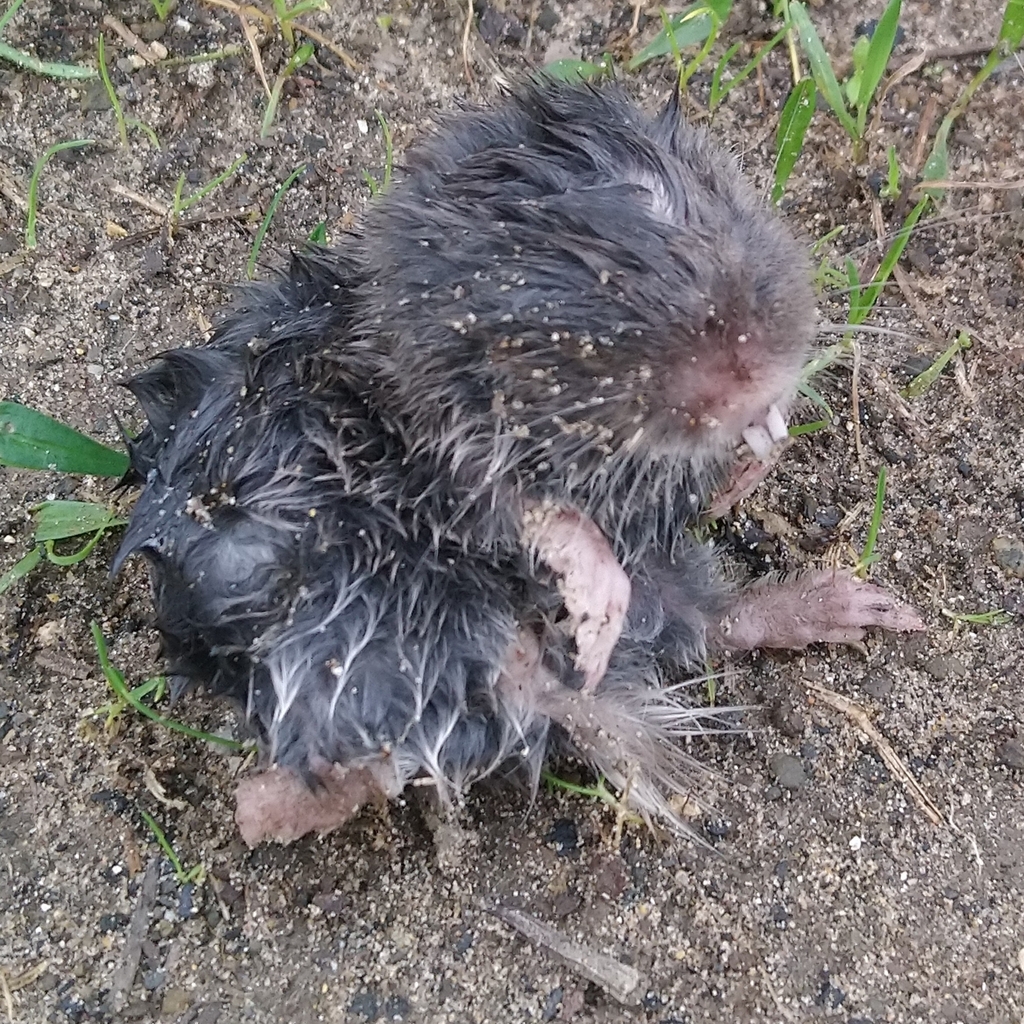
Common Mole-rat
Photo © Henry de Lange
Photo © Henry de Lange — CC BY 4.0 — Source: iNaturalist #165173035The common mole-rat, African mole-rat, or Hottentot mole-rat, (Cryptomys hottentotus) is a burrowing rodent found in Southern Africa, in particular in the Western Cape province of South Africa. It also occurs in Eswatini, Lesotho, Malawi, Mozambique, Tanzania, Zambia, and Zimbabwe. It is a species in the subfamily Bathyerginae. == Taxonomy == René Primevère Lesson was the first to describe the common mole-rat in 1826, based on an animal captured near Paarl, and called it Bathyergus hottentotus. The following year, the Dutch zoologist Anton Brants described a specimen from the eastern part of the Cape Colony which he named Bathyergus caecutiens. In 1828, Andrew Smith described Bathyergus ludwigii. Around 1900 these little mole rats were no longer considered to fit into the genus Bathyergus, and various forms were described in the genus Georychus, namely G. exenticus in 1899 by Édouard Louis Trouessart, G. jorisseni in 1909 by Henry Lyster Jameson, G. albus in 1913 and G. vandamii in 1917, both by Austin Roberts. The same Roberts described two more forms in 1924, but now under the current genus name Cryptomys, namely C. cradockensis and C. transvaalensis. However, the current combination was already made in 1906 by Oldfield Thomas and Harold Schwann…
Garden Route National Park
George, South Africa
+353 birds+54 mammals
Sweeping across the Western Cape's coastal and mountainous terrain, this sprawling national park encompasses over five thousand square kilometers of extraordinarily diverse landscape—from coastal limestone cliffs…
VIEW NATIONAL PARKTankwa-Karoo National Park
Hantam Local Municipality, South Africa
+201 birds+20 mammals
Across the semi-arid heartland of the Northern Cape, where winter rains carve ephemeral watercourses through endless ochre plains, Tankwa-Karoo National Park sprawls across more than 3,100…
VIEW NATIONAL PARKNo community photos yet. Log in to add the first one.
No community observations of this species yet.