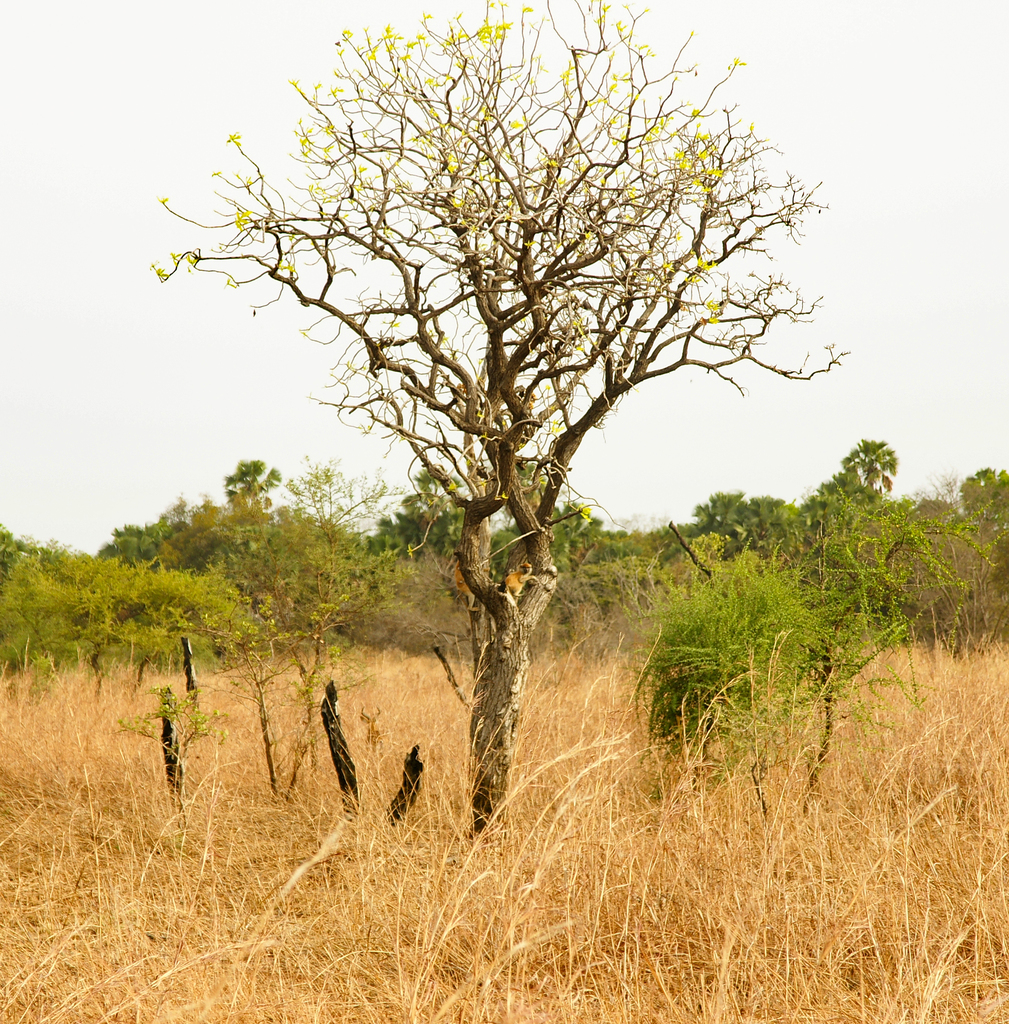
Common Patas Monkey
Photo © martin ingemansson
Photo © martin ingemansson — CC BY 4.0 — Source: iNaturalist #261152939Identification
The common patas monkey, also known as the hussar monkey, is a distinctly terrestrial primate with pronounced sexual dimorphism. Males are considerably larger, measuring 60–87 cm in body length with a 75 cm tail and weighing around 12.4 kg, while females average 49 cm in length and 6.5 kg. Males possess the longest canine teeth of all African long-tailed monkeys, which serve an important role in establishing dominance hierarchies. The species is remarkable among primates for its exceptional running ability, reaching speeds of 55 km/h, making it the fastest runner of all primates.
Range & Habitat
Common patas monkeys are distributed across semi-arid regions of West, central, and East Africa, where they inhabit dry, open woodland environments. The species has also been introduced to Puerto Rico, where it has become established as an invasive population. Their preference for open, arid habitats distinguishes them from many other African primates and reflects their ground-dwelling lifestyle.
Behaviour & Diet
Patas monkeys are highly social animals living in multi-female groups of up to 60 individuals, typically containing just one adult male for most of the year. These groups are notable for maintaining some of the longest daily travel distances and largest home ranges relative to body size among all primates. Notably, adult females initiate group movement, with the male following their lead. Outside the breeding season, excess males either form all-male groups or remain solitary; during the brief mating season lasting roughly one month annually, outside males enter groups to mate in apparent total promiscuity.
The diet of common patas monkeys is unusually specialized for their body size, consisting primarily of insects, gum, seeds, and tubers—a nutritional profile more typical of much smaller primate species. Female social structure varies across populations, likely reflecting differences in food availability. Females demonstrate recognition of matrilineal relatives and engage in reconciliation through grooming and sitting together after conflicts. Cooperation is also observed, with childless females assisting in the rearing of other infants.
Best Time & Places to See It
Mating season, occurring for roughly one month each year, offers excellent opportunities to observe diverse male behavior and competitive interactions within patas monkey groups. Look for these primates in semi-arid, open woodland habitats across West, central, and East Africa, where their ground-dwelling habits and preference for open terrain make them more accessible to observers than forest-dwelling species.
Photography Tips
The patas monkey's terrestrial lifestyle and open habitat preference make them excellent photography subjects. Their exceptional speed means fast shutter speeds are essential for capturing action shots. The dramatic sexual dimorphism between males and females provides compelling compositional opportunities. Male canines are a distinctive feature worth capturing in close-up portraits. The open woodland habitat typically offers good natural lighting. During the brief breeding season, watch for distinctive female solicitation displays—running with tail curled upward and crouching postures—which make for dynamic and behaviorally interesting images.
Kidepo Valley National Park
Uganda
+478 birds+24 mammals
Where the Narus and Kidepo rivers carve through northeastern Uganda's semi-arid lowlands, a landscape of sparse acacia woodland, grassland, and riverine thickets creates one of East…
VIEW NATIONAL PARKMurchison Falls National Park
Uganda
+608 birds+33 mammals
Where the Victoria Nile compresses through a narrow gorge and explodes across a 45-meter precipice, the landscape speaks in thunder. Murchison Falls National Park sprawls across…
VIEW NATIONAL PARKNo community photos yet. Log in to add the first one.
No community observations of this species yet.