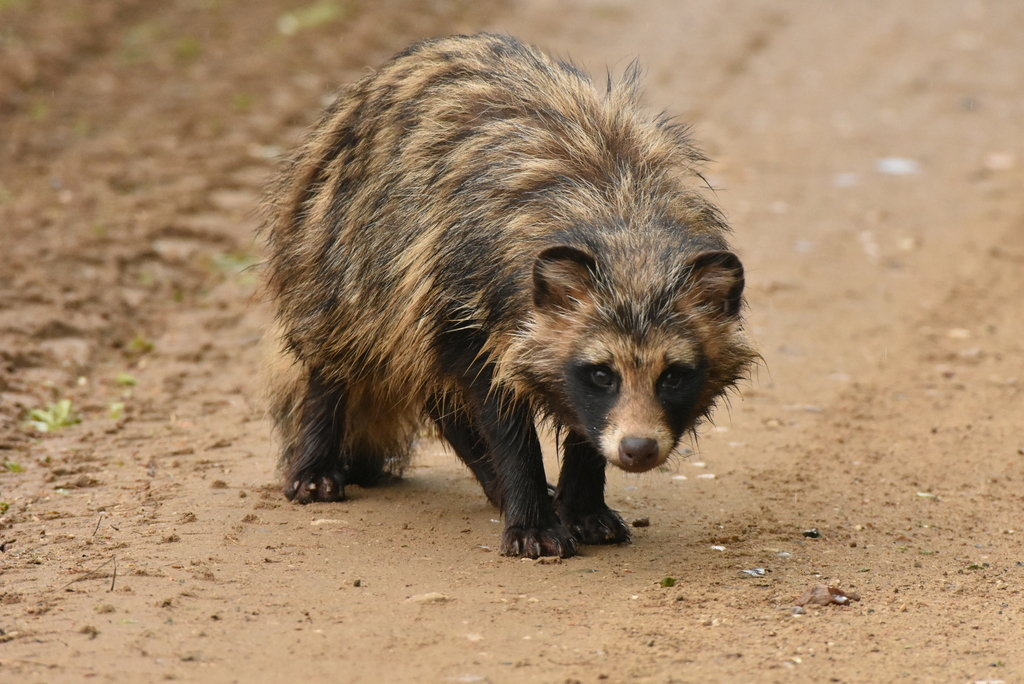
Common Raccoon Dog
Photo © Марина Садыкова
Photo © Марина Садыкова — CC BY 4.0 — Source: iNaturalist photo #379771229Identification
The common raccoon dog is a heavy-set, fox-like canid easily recognized by its distinctive raccoon-like face markings. Despite its name and appearance, it is most closely related to true foxes rather than raccoons. The animal has a long torso, short legs, and a short tail measuring 12 to 18 cm that hangs below the tarsal joints without touching the ground. Total body length ranges from 45 to 71 cm. The ears are short and protrude only slightly from the fur.
Winter fur is long and thick with dense underfur, displaying a dirty earth-brown or brownish-grey colour with black guard hairs measuring up to 120 millimetres in length. A distinctive dark stripe runs along the back, broadening at the shoulders to form a cross shape. The abdomen is yellowish-brown while the chest is dark brown or blackish. Summer fur is brighter and reddish straw-coloured. Rare colour variations including white and yellow morphs occur in China. Weight varies seasonally, from around 3 kg in March to 6.5–7 kg in males during late summer, with some individuals reaching 9–10 kg.
Range & Habitat
The common raccoon dog is native to East Asia, where it remains widespread throughout its natural range. The species has been introduced to Europe for the fur trade and is now established there as an invasive species. In Scandinavia, it is known locally as "marten-dog" (Swedish: mårdhund, Norwegian and Danish: mårhund). Since 2019, the common raccoon dog has been listed as an Invasive Alien Species of Union concern in the European Union, meaning it cannot be imported, bred, transported, commercialized, or intentionally released anywhere in EU territory.
Behaviour & Diet
Common raccoon dogs are highly adaptable omnivores with a remarkably diverse diet. They feed on insects, rodents, amphibians, birds, fish, reptiles, mollusks, crabs, sea urchins, carrion, eggs, human garbage, and plant matter including fruits, nuts, berries, and vegetables. Notably, they can eat toxic toads by producing copious amounts of saliva to dilute skin secretions. Diet varies seasonally: in late autumn and winter they focus on rodents, carrion, and feces, while spring and summer see increased consumption of fruits, insects, amphibians, and nesting birds.
Unusual among canids, common raccoon dogs hibernate during cold winters and can climb trees—an ability shared among canids only with the North American gray fox. Their omnivorous diet is reflected in their anatomy: they possess small and weak canines and carnassials, flat molars, and relatively long intestines (1.5–2.0 times longer than other canids). Wolves are their primary predators, accounting for over half of deaths in some regions, while red foxes prey on pups and occasionally adults.
Best Time & Places to See It
Common raccoon dogs are widespread throughout their native East Asian range, making them potentially observable across much of the region. However, their primarily nocturnal and crepuscular habits make sightings challenging. In their introduced European range, they have become established, particularly in Scandinavia and other northern regions where their winter adaptation allows survival. The best opportunities may come during seasonal activity peaks, particularly in spring and summer when animals are actively foraging.
Photography Tips
Photographing common raccoon dogs requires patience due to their nocturnal tendencies. Focus on capturing their distinctive facial markings and the characteristic dark cross pattern on their shoulders and back. The contrast between their winter and summer coats offers seasonal variation in subjects. Their short, stocky build and fox-like features provide excellent compositional opportunities, particularly when combined with their natural habitat. Early morning or late evening excursions will maximize chances of encounters in their active periods.
Lower Oder Valley National Park
Schwedt/Oder, Germany
+216 birds+21 mammals
Where the Oder River winds through northeastern Brandenburg, the Lower Oder Valley National Park protects one of Central Europe's most vital wetland systems. This sprawling mosaic…
VIEW NATIONAL PARKVorpommersche Boddenlandschaft National Park
Küstengewässer einschließlich Anteil am Festlandso, Germany
+230 birds+19 mammals
Where the Baltic coast dissolves into a labyrinth of shallow lagoons and coastal wetlands, Vorpommersche Boddenlandschaft National Park protects one of northern Europe's most dynamic and…
VIEW NATIONAL PARKSchleswig-Holsteinisches Wattenmeer National Park
Germany
+378 birds+49 mammals
Where the North Sea ebbs and flows across a vast expanse of exposed mud and sand, the Schleswig-Holsteinisches Wattenmeer National Park reveals one of Europe's most…
VIEW NATIONAL PARKDanube Delta Biosphere Reserve
Tulcea, Romania
+277 birds+27 mammals
Where the Danube surrenders to the Black Sea, a vast labyrinth of channels, reed beds, and freshwater lakes sprawls across nearly 13,400 square kilometers of eastern…
VIEW NATIONAL PARKSipoonkorven National Park
Sipoo, Finland
+94 birds+6 mammals
Where boreal forest meets the Baltic coast, Sipoonkorven National Park sprawls across 70 square kilometres of south-western Finland, a landscape shaped by the slow retreat of…
VIEW NATIONAL PARKPallas-Yllästunturi National Park
Muonio, Finland
+137 birds+19 mammals
Where boreal forest meets fell, across the Finnish Arctic frontier, nearly 3,650 square kilometres of pristine subarctic wilderness unfold in a landscape sculpted by glacial epochs…
VIEW NATIONAL PARKUrho Kekkonen National Park
Sodankylä, Finland
+122 birds+11 mammals
Across nearly 2,700 square miles of boreal wilderness in Lapland, where the Arctic Circle's influence shapes every ecosystem, lies a landscape dominated by dense spruce and…
VIEW NATIONAL PARKNuuksio National Park
Espoo, Finland
+135 birds+12 mammals
Across the forested plateaus and rocky shorelines of southern Finland, where granite bedrock pierces through boreal woodland just twenty kilometers northwest of Helsinki, lies a landscape…
VIEW NATIONAL PARKCévennes National Park
Vebron, France
+187 birds+63 mammals
Where granite gorges slice through the limestone plateaux of southern France, the Cévennes Cœur National Park unfolds across nearly 3,500 square kilometres of one of Europe's…
VIEW NATIONAL PARKSoomaa National Park
Viljandi County, Estonia
+172 birds+20 mammals
Across the boglands of south-central Estonia, where water dominates more than half the landscape, lies one of northern Europe's most hydrologically dynamic national parks. The terrain…
VIEW NATIONAL PARKLahemaa National Park
Lääne-Viru County, Estonia
+237 birds+25 mammals
Where the Baltic coast meets temperate forest in northwestern Estonia, Lahemaa National Park sprawls across more than 1,300 square kilometers of deeply character-filled terrain. Coastal wetlands…
VIEW NATIONAL PARKTsentralno-Lesnoy
Nelidovsky District, Russia
+76 birds+9 mammals
Where vast boreal forests sweep across the landscape of Tver Oblast, a primordial woodland realm unfolds across 419 square kilometres of largely intact taiga. Central Forest…
VIEW NATIONAL PARKPolesie National Park
Michałów, Poland
+172 birds+9 mammals
Where the Pripyat River winds through eastern Poland, Polesie National Park sprawls across 418 square kilometres of a landscape shaped by water, peat, and millennia of…
VIEW NATIONAL PARKWolin National Park
Kamień County, Poland
+232 birds+21 mammals
Where the Baltic shoreline meets vast wetland complexes and Pleistocene woodlands, Wolin National Park unfolds across nearly 440 square kilometres of northwestern Poland's most biodiverse terrain.…
VIEW NATIONAL PARKSłowiński National Park
Smołdzino, Poland
+217 birds+16 mammals
Where the Baltic shoreline surrenders to vast inland dunes and freshwater lagoons, Słowiński National Park spans nearly 610 square kilometres of one of Europe's most dynamic…
VIEW NATIONAL PARKBiebrza National Park
Goniądz, Poland
+242 birds+33 mammals
Where the Narew River sprawls across northeastern Poland's flatlands, Biebrza National Park unfolds as one of Europe's largest and most ecologically vital wetland complexes. Encompassing roughly…
VIEW NATIONAL PARKBiałowieża National Park
Bialowieza, Poland
+177 birds+23 mammals
Straddling the border between Poland and Belarus, this primordial forest landscape encompasses one of Europe's last remaining expanses of old-growth woodland, where ancient trees rise through…
VIEW NATIONAL PARKLand of the Leopard National Park
Khasansky District, Russia
+83 birds+11 mammals
Where coniferous and mixed forests sweep across the rolling terrain of Russia's Far East, Land of the Leopard National Park embraces a landscape shaped by the…
VIEW NATIONAL PARKNortheast China Tiger and Leopard National Park
Mu Dan Jiang Shi, China
+202 birds+19 mammals
Across the temperate forests of northeastern China, where winters grip the landscape in subzero silence and summers remain cool and brief, the Mudanjiang region supports a…
VIEW NATIONAL PARKYancheng National Nature Reserve
Yancheng, China
+208 birds+4 mammals
Where the East China Sea's tidal rhythms sculpt the Jiangsu coast, Yancheng National Nature Reserve sprawls across one of Asia's most dynamic wetland complexes. This vast…
VIEW NATURE RESERVENo community photos yet. Log in to add the first one.
No community observations of this species yet.