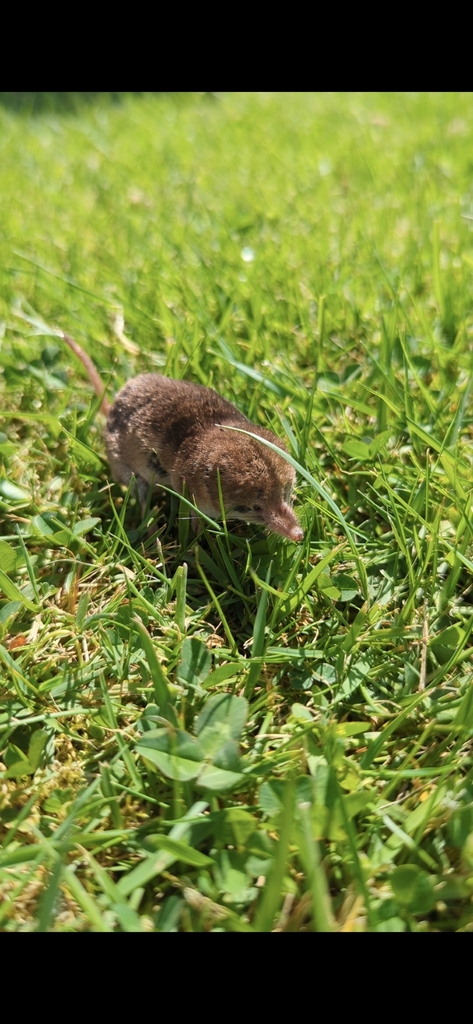
Common Shrew
Photo © Heather Morrison
Photo © Heather Morrison — CC BY 4.0 — Source: iNaturalist photo #510247000Identification
The common shrew is one of Europe's smallest mammals, measuring 55 to 82 millimetres in length and weighing just 5 to 12 grams. Despite its diminutive size, it is instantly recognizable by its velvety dark brown fur contrasting sharply with a pale underside. The species has distinctively red-tipped teeth, small eyes, and a characteristically pointed, mobile snout that constantly twitches as it hunts. Juvenile shrews are noticeably lighter in colour until their first moult. One of the most remarkable features of this tiny creature is that it is one of the rare venomous mammals, though its venom poses no threat to humans.
Range & Habitat
The common shrew, also known as the Eurasian shrew, is the most abundant shrew species throughout Northern Europe, including Great Britain, but notably absent from Ireland. It thrives in woodlands, grasslands, and hedgelands across Britain, Scandinavia, and Eastern Europe. Each individual shrew establishes and fiercely defends a home range of 370 to 630 square metres, with males expanding their territories during the breeding season to seek out females. These territorial animals construct their nests either underground or beneath dense vegetation, making them challenging to observe directly in the field.
Behaviour & Diet
Common shrews are relentless foragers, remaining active both day and night with only brief rest periods between long bursts of intense activity. Their carnivorous diet consists of insects, slugs, spiders, worms, amphibians, and small rodents. With an extraordinary metabolic requirement, these shrews must consume 200 to 300 percent of their body weight daily, necessitating feeding every 2 to 3 hours—starvation threatens if they fast longer. Compensating for their poor eyesight with exceptional senses of smell and hearing, shrews are highly efficient hunters. Remarkably, they employ echolocation via high-frequency tittering for close-range spatial orientation, a trait that represents convergent evolution with bats and dolphins. To survive winters without hibernating, common shrews undergo dramatic physiological changes: their skulls shrink by nearly 20 percent, brains by up to 30 percent, and total body mass by about 18 percent, reducing their food requirements significantly before reverting to normal size in spring.
Best Time & Places to See It
The breeding season from April to September provides the best opportunity for observation, particularly during the peak summer months when shrews are more active in seeking food and mates. Woodlands and hedgerows across Britain, Scandinavia, and Eastern Europe offer the most promising locations, where populations can reach densities of one individual per 200 square metres. Early morning or dusk when insect activity peaks may increase your chances of glimpsing this elusive creature as it hunts along vegetation edges and through leaf litter.
Photography Tips
Photographing the common shrew presents considerable challenges due to its small size, cryptic nature, and nocturnal tendencies. A macro lens is essential to capture the intricate details of its red-tipped teeth, pointed snout, and velvety fur texture. Given the shrew's preference for dense vegetation and underground habitats, patience and fieldcraft are crucial. Early morning light and high-speed film will help overcome the poor visibility in their typical haunts. Remember that shrews are protected under British law from certain killing methods, so approach with care and minimal disturbance to these remarkable but fragile creatures.
Bannau Brycheiniog National Park
Bavarian Forest National Park
Białowieża National Park
Biebrza National Park
Bieszczady National Park
Cairngorms National Park
Cévennes National Park
Cors Fochno National Nature Reserve
Dartmoor National Park
Nothing matches these filters.
No community photos yet. Log in to add the first one.
No community observations of this species yet.