Skip to content
ATLAS
Coquerel’s Sifaka

Coquerel’s Sifaka

Propithecus coquereli
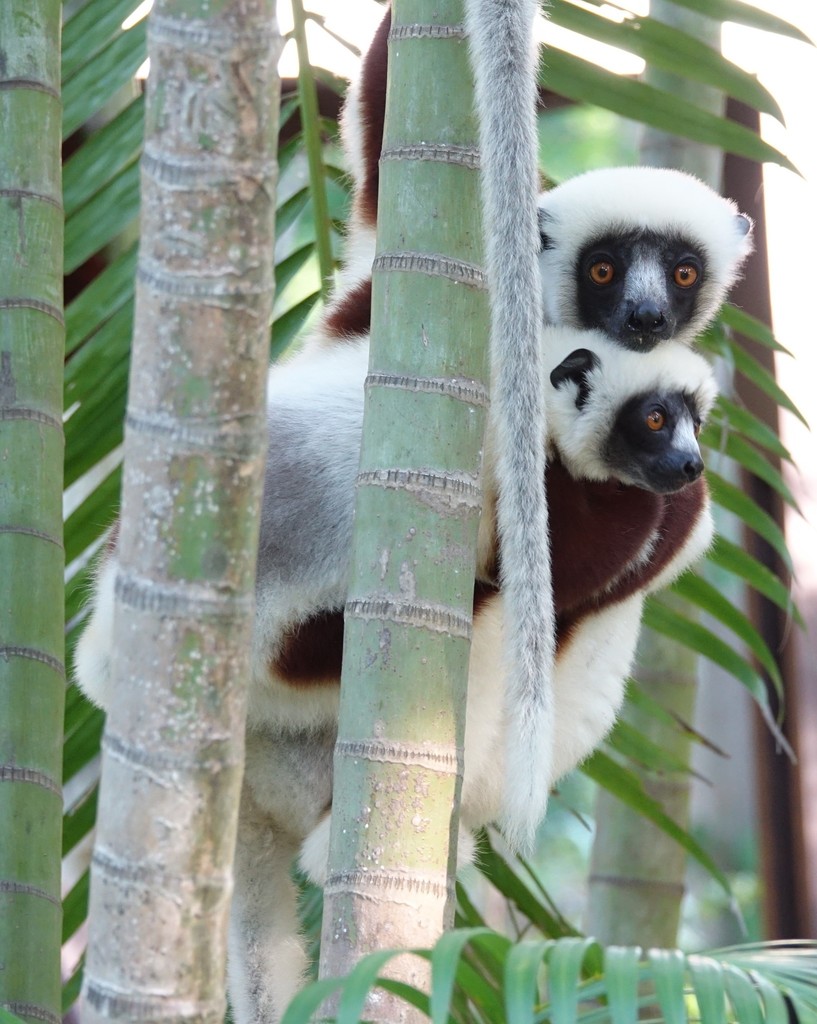
Photo © figschoolPhoto © figschool — CC BY 4.0 — Source: iNaturalist #4993986
ABOUT

Coquerel's sifaka (Propithecus coquereli) is a diurnal, medium-sized lemur of the sifaka genus Propithecus. It is native to northwest Madagascar. Coquerel's sifaka was once considered a subspecies of Verreaux's sifaka but was eventually granted full species status. It is listed as Critically Endangered on the IUCN Red List due to habitat loss and hunting. In popular culture, the title character in the children's TV show Zoboomafoo is a Coquerel's sifaka. The species was named after French entomologist Charles Coquerel. == Description == The dorsal pelage and tail of Coquerel's sifaka are white, and it has maroon patches on the chest and portions of the limbs. The coat is generally dense. Its face is bare and black except for a distinctive patch of white fur along the bridge of the nose. Its naked ears are also black, and its eyes are yellow or orange. The bottom of the lemur's hands and feet are black, while the thighs, arms, and chest are chocolate brown. Like all lemurs, Coquerel's sifaka has a toothcomb, used for grooming and sometimes scraping fruit off a pit. == Distribution == This species lives at altitudes less than 300 ft (91 m) in the dry deciduous forests of…

HOTSPOTS
Sort by
National Park

Ankarafantsika National Park

Madagascar
+137 birds+12 mammals

Nothing matches these filters.

Where to see & photograph the Coquerel’s Sifaka →
COMMUNITY
Share your photos of Coquerel’s Sifaka Inspire other photographers and contribute to the atlas.
Drag your photos here or select a file from your device JPG, PNG or WebP · Up to 10 photos of 25 MB

Your photo, your rights. Always credited to you.

Sort by

No community photos yet. Log in to add the first one.

0 Observed by
0 Hotspots reported
0 Countries

No community observations of this species yet.

Wild Atlas Guide

  • About
  • Contact
  • Privacy Policy
  • Terms of Use
  • Send Feedback

Community

  • Submit a Hotspot
  • Operators Directory
  • Add your business
  • Business Terms
© 2026 Wild Atlas Guide — Content & data compilation protected.
Privacy Policy · Cookie settings · Copyright & data use

Contact Us

We'd love to hear from you. We'll reply as soon as possible.

Send Feedback

Found an error? Have a suggestion? We read every message.

Submit a hotspot Add your business
Sign in
MENU
Sign in

or

Enter your username or email and we'll send you a link to reset your password.

or

Biological profile

Coquerel’s Sifaka

A compact view of how this species lives, moves and responds to its environment.

The species at a glance

Select a card to explore the details.

Movement
Does it remain in the same area?
It generally remains in the same region
How does it move?
Local RangingDispersal
Can its movements be anticipated?
Yes, its movements tend to repeat
Do its movements change with the seasons?
No, they are not tied to one season
Do all populations follow the same calendar?
Yes, broadly speaking
Activity
When is it active?
Mainly active by day
Does it have inactive periods?
No known inactive period
How to detect it
Is it easy to find?
It takes some patience
How can you detect it?
AcousticVisual
Does it tend to hide?
It usually remains visible
Do you need a specific technique?
Sometimes a specific technique helps
Which seasonal signs help?
None Known
Habitat
Which environment does it live in?
Terrestrial
Which places does it prefer?
ForestWoodland
Can it adapt to different habitats?
It tolerates some variety of habitats
At what level of the habitat does it move?
CanopyUnderstory
Feeding
What kind of food does it eat?
Herbivore
How does it get its food?
Browsing
Social life
Does it usually live alone or in a group?
It usually lives in family groups
Does it gather at certain times?
It does not usually gather seasonally
Reproduction
How does it breed?
Territorial
Where does it breed?
Tree
Key moments in its annual cycle
Birth · Annual Cycle Consistent
Spatial ecology
Does it defend a territory?
Yes, it defends a territory
How far does it usually travel?
Within a local area
In which major regions does it live?
Afrotropical
Environmental response
Does its calendar change from place to place?
It changes little between places
Sensitivity
Is it affected by human disturbance?
Observe it calmly and keep your distance
When does it need the most space?
None Known
Global profile. Local behaviour and timing may vary.
Discover
Book
AllBirdsMammalsCountriesHotspotsHidesExperiencesOperators

Before you choose a photo

Please confirm the photo rights and credit terms first.

Read the photo rights and credit terms

I'm the author of this photo or hold the rights to it, and I keep full ownership. I grant Wild Atlas Guide a free, non-exclusive licence to display it on the site and in Wild Atlas Guide's own channels, including social media, always credited to me by my display name or the Instagram handle I choose to provide. I confirm it does not reveal a sensitive wildlife location or a recognisable person without their permission. I can withdraw future social use for this photo or ask for it to be removed at any time.

Please accept the photo rights and credit terms to continue.

Add your photo

    Uploading…

    We use cookies to measure traffic and improve Wild Atlas Guide. You decide. Privacy policy