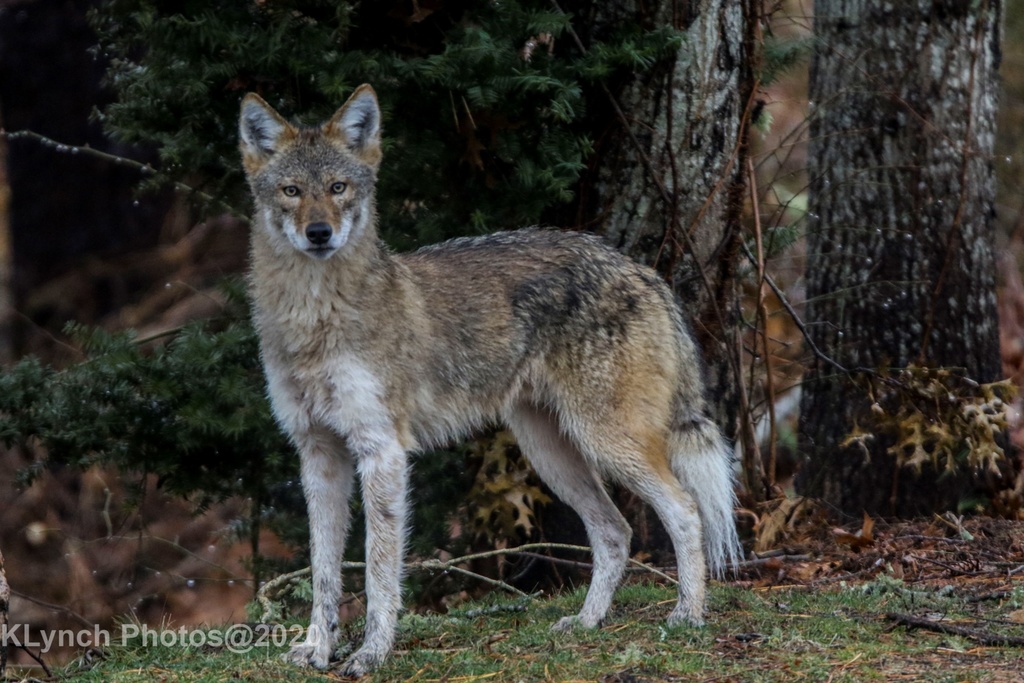
Coyote
Photo © Kevin Lynch
Photo © Kevin Lynch — CC BY 4.0 — Source: iNaturalist photo #61403730Identification
The coyote is a lean canine noticeably smaller than its close relative, the gray wolf, though slightly smaller than the eastern and red wolves. Males average 8 to 20 kg (18 to 44 lb), while females average 7 to 18 kg (15 to 40 lb), with significant geographic variation—northern subspecies tend to be larger than their southern counterparts. The largest coyote on record weighed 34 kg (75 lb). Coyotes typically measure 1.0 to 1.35 m (3 ft 3 in to 4 ft 5 in) in total length, including a distinctive tail of about 40 cm (16 in).
Their fur is predominantly light gray and red or fulvous, interspersed with black and white, though coloration varies geographically. High-elevation coyotes display more black and gray shades, while desert dwellers appear more fulvous or whitish-gray. All adults typically show a sable coat color, bushy tail, and characteristic white facial mask. Compared to wolves, coyotes have longer ears, a relatively larger braincase, and a thinner frame, face, and muzzle. A key behavioral difference: coyotes carry their tails downward when running or walking, whereas wolves hold theirs horizontally.
Range & Habitat
Native to North America, coyotes have expanded dramatically from their historical range in the western plains and arid regions. The species is listed as least concern due to its wide distribution and remarkable abundance. Coyotes are remarkably versatile, adapting readily to environments modified by humans; urban coyotes are now common in many cities across the continent. In 2013, the species reached eastern Panama, marking a significant range expansion across the Panama Canal into territory previously outside its home range.
Behaviour & Diet
Coyotes are highly flexible in their social organization, living either in family units or loosely knit packs of unrelated individuals. Primarily carnivorous, they hunt deer, rabbits, hares, rodents, birds, reptiles, amphibians, and fish, along with invertebrates. They occasionally supplement their diet with fruits and vegetables. Their characteristic vocalization is a distinctive howl that changes rapidly in tone and pitch, a sound that has become iconic across North America.
Coyotes can interbreed with eastern wolves and red wolves, producing "coywolf" hybrids, particularly in northeastern North America where larger eastern coyote subspecies have resulted from historical matings with various wolf types. While they have never been known to mate with gray wolves in the wild, genetic studies show that most North American wolves contain some level of coyote DNA.
Best Time & Places to See It
Coyotes are widely distributed across North America and increasingly accessible to wildlife observers, particularly in western open plains and arid regions where they historically thrived. Urban areas now offer reliable sighting opportunities, as coyotes have become established residents in many cities. Their adaptability means they can be encountered across diverse habitats, from deserts to forests to metropolitan neighborhoods.
Photography Tips
The coyote's variable coloration, distinctive white facial mask, and characteristic downward-held tail provide excellent identifying features for photography. Their lean build, longer ears relative to wolves, and relatively slender muzzle distinguish them from other canines. Dawn and dusk are prime times to photograph coyotes in open terrain where their silhouettes are most striking. In urban settings, early morning offers the best opportunities before human activity increases.
Manitoba Owls
Nothing matches these filters.
Tombstone Territorial Park
Acadia National Park
Alligator River National Wildlife Refuge
Arches National Park
Banff National Park
Bear River Migratory Bird Refuge
Big Bend National Park
Biscayne National Park
Bitter Lake National Wildlife Refuge
Nothing matches these filters.
No community photos yet. Log in to add the first one.
No community observations of this species yet.