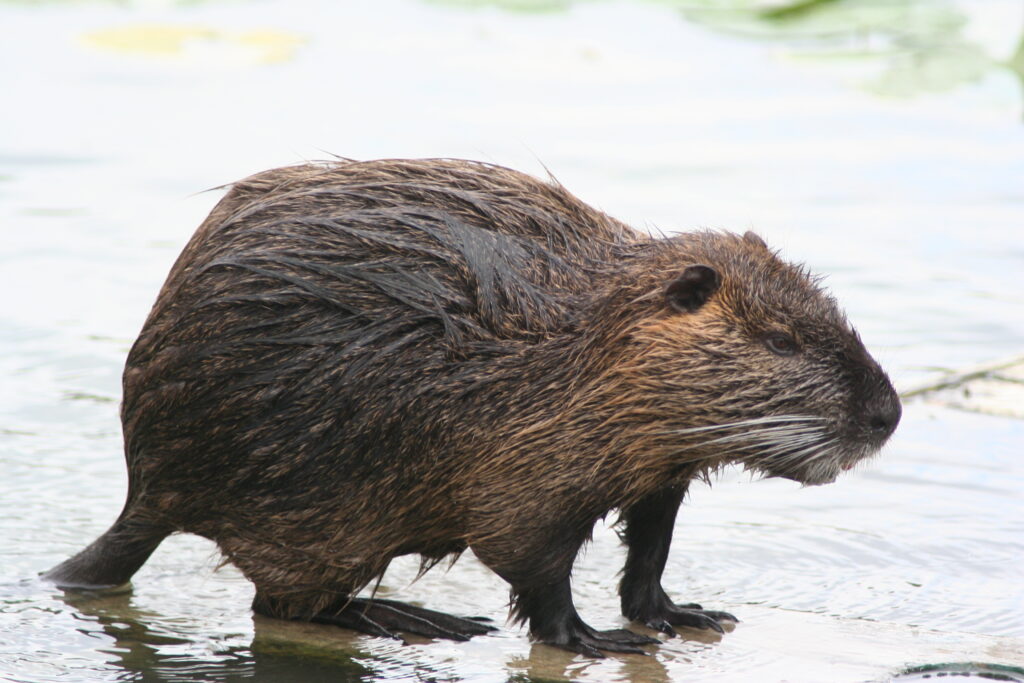
Coypu
Photo © Philippe Amelant
Photo © Philippe Amelant — CC BY-SA 4.0 — Source: Wikimedia CommonsIdentification
The coypu is a large, robust rodent that resembles a oversized rat or a beaver with a distinctive thin, hairless tail. Adults typically weigh 4–9 kg (9–20 lb) and measure 40–60 cm (16–24 in) in body length, though some individuals reach up to 16–17 kg (35–37 lb). The animal's most striking features include a white patch on the muzzle, large bright orange-yellow incisors, webbed hind feet, and prominent four-inch-long whiskers on each cheek. Coypus possess three layers of fur: long guard hairs, a coarse darkish-brown midlayer, and soft dense grey underfur. The orange discoloration of their incisors results from iron pigment in the tooth enamel.
Coypu can be confused with other semiaquatic rodents. Unlike muskrats, which are smaller and more cold-tolerant with flattened tails, coypus have round tails. Beavers, while similar in anatomy and habitat, possess distinctive flat, paddle-like tails rather than the round tail of the coypu. There is no visible distinction between male and female individuals in coloring or weight.
Range & Habitat
Native to subtropical and temperate South America, the coypu inhabits four recognized subspecies distributed across different regions. These range from northern Argentina, Bolivia, Paraguay, Uruguay, and southern Brazil, to central Chile and Patagonia, with a distinct population on Chiloé Island. The species has been widely introduced to North America, Europe, and Asia, primarily by fur farmers, and is now considered invasive in several countries.
Coypus are semiaquatic animals that live in burrows alongside stretches of water. They favour wetland habitats similar to those occupied by muskrats and beavers, making them well-adapted to riverside and marsh environments where aquatic vegetation is abundant.
Behaviour & Diet
As herbivorous rodents, coypus feed primarily on river plant stems and aquatic vegetation. Their feeding and burrowing habits can be highly destructive, often bringing them into conflict with humans. The species is still hunted and trapped for its fur in some regions, though its invasive status in many countries reflects the ecological and agricultural damage it causes.
Beyond habitat destruction, coypus pose additional threats to human and animal health, transmitting various diseases primarily through water contamination. Life expectancy in the wild is typically short, with most individuals dying within the first year and few living past three years, though they can survive up to six years in captivity.
Best Time & Places to See It
Coypus are semiaquatic and most active around waterways, making riverside habitats, marshes, and wetland areas the best locations to observe them. As they live in burrows alongside water stretches, searching along banks where aquatic vegetation grows prolifically offers the greatest chance of encounters. The species' presence in North America, Europe, and Asia means that sightings are possible across these continents, particularly in established invasive populations.
Photography Tips
The coypu's distinctive features—its white muzzle patch, bright orange incisors, webbed feet, and characteristic round tail—make excellent photographic subjects. Close-up shots of the face will capture the striking dental coloration and prominent whiskers. Since coypus are semiaquatic, photographing them in or near water showcases their natural behaviour and webbed feet. Early morning or dusk near wetland edges may offer the best opportunities, as these are active feeding periods. The contrast between the animal's dark outer fur and its pale underfur can be emphasized with careful lighting to highlight the three-layered coat structure.
Lower Saxon Wadden Sea National Park
Norderney, Germany
+193 birds+12 mammals
Where the North Sea meets the German coast, a vast expanse of tidal mudflats, salt marshes, and shallow waters creates one of Europe's most dynamic estuarine…
VIEW NATIONAL PARKSchleswig-Holsteinisches Wattenmeer National Park
Germany
+378 birds+49 mammals
Where the North Sea ebbs and flows across a vast expanse of exposed mud and sand, the Schleswig-Holsteinisches Wattenmeer National Park reveals one of Europe's most…
VIEW NATIONAL PARKCap de Creus Natural Park
Roses, Spain
+245 birds+23 mammals
Where the Pyrenees tumble into the Mediterranean, Cap de Creus Nature Park unfolds across 300 square kilometres of one of northeastern Spain's most dramatic coastal wilderness…
VIEW NATURAL PARKBig Bend National Park
Brewster County, United States
+345 birds+34 mammals
Where the Chisos Mountains rise abruptly from the Sonoran Desert floor, Big Bend National Park spans over 7,300 square kilometers of one of North America's most…
VIEW NATIONAL PARKCévennes National Park
Vebron, France
+187 birds+63 mammals
Where granite gorges slice through the limestone plateaux of southern France, the Cévennes Cœur National Park unfolds across nearly 3,500 square kilometres of one of Europe's…
VIEW NATIONAL PARKForêts National Park
Lucey, France
+140 birds+50 mammals
Across the rolling plateaux of central Burgundy, where limestone uplands give way to deep valleys carved by time and water, lies a landscape of profound ecological…
VIEW NATIONAL PARKFertő–hanság National Park
Fertőszéplak, Hungary
+246 birds+11 mammals
Where the Austro-Hungarian plains meet the foothills of Western Transdanubia, nearly 900 square kilometres of wetland, reed bed, and mixed woodland form one of Central Europe's…
VIEW NATIONAL PARKPeixe National Park Lagoon
Brazil
+293 birds+4 mammals
Where the coastal plains of Rio Grande do Sul meet the Atlantic, Peixe National Park Lagoon sprawls across nearly 2,200 square kilometres of shallow waters, reed…
VIEW NATIONAL PARKAraucárias National Park
Brazil
+231 birds+3 mammals
Where the southern Brazilian highlands rise into cool temperate forest, Araucárias National Park protects one of the Atlantic Forest's most distinctive ecosystems across 506 square kilometres…
VIEW NATIONAL PARKCamargue Regional Nature Park
Saintes-Maries-de-la-Mer, France
+378 birds+48 mammals
Where the Rhône Delta sprawls into the Mediterranean, a landscape of stark and haunting beauty emerges—vast salt marshes punctuated by shallow lagoons, reed beds, and scrubland…
VIEW NATURAL PARKRegional Park of the Catalan Pyrenees
Olette, France
+244 birds+63 mammals
Where granite peaks thrust skyward above cloud-laden valleys, a wild tapestry of Mediterranean and alpine ecosystems interweaves across the Franco-Spanish frontier. These Pyrenean slopes harbour extraordinary…
VIEW NATURE RESERVED’Armorique Regional Nature Park
Le Faou, France
+103 birds+23 mammals
Where granite ridges meet Atlantic moorland, one of Brittany's wildest regions reveals itself in layers of ecological richness. The landscape shifts dramatically from heather-clad uplands to…
VIEW NATURAL PARKChiloé National Park
Dalcahue, Chile
+122 birds+6 mammals
Temperate rainforest cloaks the Chiloé archipelago's northwestern reaches, where granite ridges thrust through dense, moisture-laden canopy and freshwater streams carve ravines toward the Pacific. Across approximately…
VIEW NATIONAL PARKVicente Pérez Rosales National Park
Puerto Varas, Chile
+109 birds+8 mammals
Where the Andes descend toward the temperate rainforests of Chile's Lake District, nearly 4,641 square kilometers of pristine wilderness unfolds across Vicente Pérez Rosales National Park.…
VIEW NATIONAL PARKEl Palmar National Park
Distrito Sexto, Argentina
+244 birds+14 mammals
Across the Paraná River floodplain in northeastern Argentina, palms rise from wetland and grassland in a landscape shaped by water and time. El Palmar National Park…
VIEW NATIONAL PARKCampos del Tuyú National Park
Argentina
+169 birds+5 mammals
Subtropical forest graces the borderlands where Misiones Province meets Paraguay, a landscape shaped by the Paraná Plateau's weathered topography and the warm, humid climate of northeastern…
VIEW NATIONAL PARKNahuel Huapi National Park
Argentina
+124 birds+11 mammals
Where the Andes descend toward Patagonia, vast glacial lakes cut through a landscape of southern beech forest and granite peaks, creating one of South America's most…
VIEW NATIONAL PARKLanín National Park
Argentina
+128 birds+7 mammals
Where the volcanic spine of the Andes plunges into Patagonian steppe, Lanín National Park sprawls across nearly 4,700 square kilometers of one of Argentina's most visually…
VIEW NATIONAL PARKLos Alerces National Park
Argentina
+84 birds+3 mammals
Where the temperate rainforests of southern Patagonia sweep down towards crystalline lakes, Los Alerces National Park unfolds across nearly 3,000 square kilometres of one of South…
VIEW NATIONAL PARKEspai d’interès natural de les Gavarres
Cruïlles, Monells i Sant Sadurní de l'Heura, Spain
+143 birds+16 mammals
Where Mediterranean scrubland rises and falls across the gentle hills of inland Catalonia, the Espai d'interès natural de les Gavarres protects one of the region's most…
VIEW NATURE RESERVECirceo National Park
Italy
+232 birds+6 mammals
Where limestone headlands plunge toward the Tyrrhenian Sea, Circeo National Park preserves a rare mosaic of Mediterranean coastal habitats that few Italian reserves can match. The…
VIEW NATIONAL PARKKerkini Lake National Park
Serres, Greece
+291 birds+18 mammals
Where the Strymon River widens into a sprawling freshwater lake hemmed by the Rhodope Mountains, Kerkini National Park unfolds across northern Greece as one of southeastern…
VIEW NATIONAL PARKPyrénées National Park
Hautes Pyrenees, France
+150 birds+35 mammals
Where alpine meadows give way to limestone cliffs and rushing torrents carve through ancient stone, the Pyrénées National Park spans a landscape of austere beauty along…
VIEW NATIONAL PARKCalanques National Park
Bouches-du-Rhône, France
+233 birds+42 mammals
Where limestone cliffs plunge dramatically into crystalline Mediterranean waters, Calanques National Park preserves one of Europe's most striking coastal landscapes. These steep-sided inlets, carved by erosion…
VIEW NATIONAL PARKYancheng National Nature Reserve
Yancheng, China
+208 birds+4 mammals
Where the East China Sea's tidal rhythms sculpt the Jiangsu coast, Yancheng National Nature Reserve sprawls across one of Asia's most dynamic wetland complexes. This vast…
VIEW NATURE RESERVESanta Ana National Wildlife Refuge
Hidalgo County, United States
+349 birds+12 mammals
Where the Rio Grande delta meets the semi-arid scrublands of South Texas, Santa Ana National Wildlife Sanctuary preserves a rare mosaic of wetland and thornforest habitat…
VIEW WILDLIFE SANCTUARYSan Luis National Wildlife Refuge
Merced County, United States
+219 birds+14 mammals
Across the floor of California's San Joaquin Valley, where semi-arid grasslands meet shallow seasonal wetlands, San Luis National Wildlife Sanctuary preserves a critical mosaic of habitats…
VIEW WILDLIFE SANCTUARYPea Island National Wildlife Refuge
Dare County, United States
+356 birds+15 mammals
Where the Outer Banks taper toward the Atlantic, a sliver of barrier island creates a microcosm of coastal ecology. Pea Island National Wildlife Sanctuary spans over…
VIEW WILDLIFE SANCTUARYAberdare National Park
Mweiga ward, Kenya
+394 birds+30 mammals
Where the central highlands of Kenya rise to their elemental grandeur, the Aberdare range unfolds across Nyeri County as a montane stronghold of cool, misty forest…
VIEW NATIONAL PARKNo community photos yet. Log in to add the first one.
No community observations of this species yet.