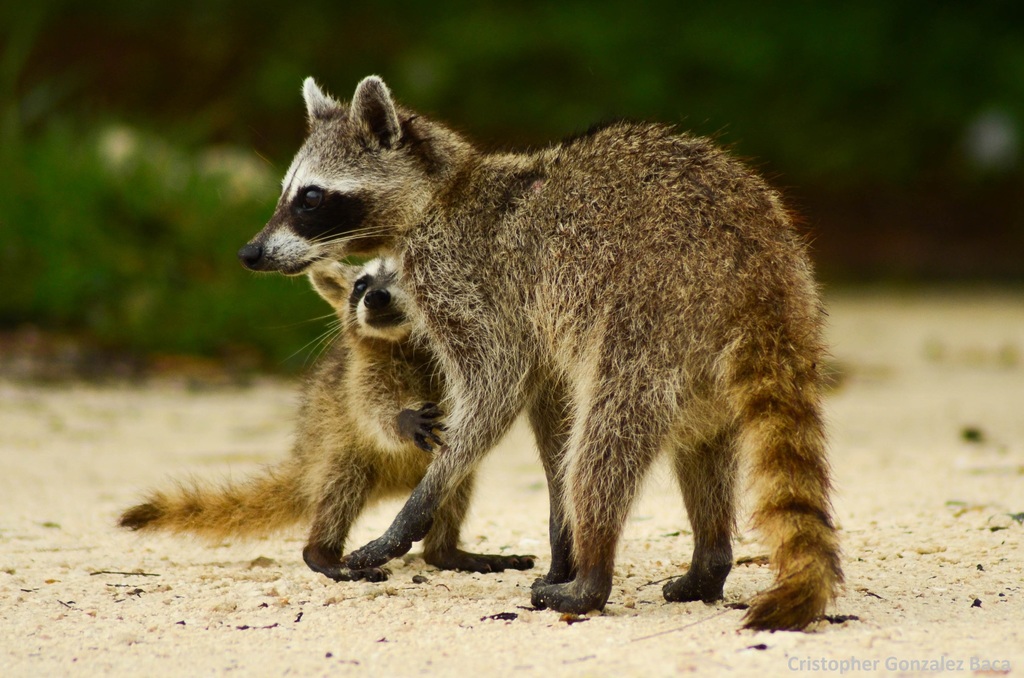
Cozumel Raccoon
Photo © CristopherGlez
Photo © CristopherGlez — CC BY-SA 4.0 — Source: iNaturalist photo #908082Identification
The Cozumel raccoon is a distinctly smaller relative of the common raccoon, representing a striking example of insular dwarfism. Adults measure 58–82 centimeters in total length and weigh only 3–4 kilograms, making them approximately 45% lighter than mainland raccoons. The species is immediately recognizable by its broad black throat band and distinctive golden-yellow tail marked with 6–7 black or brown rings. The face displays the characteristic raccoon "mask" around the eyes, with a grizzled grey head contrasting sharply with a white muzzle and chin. The upper body fur is buff-grey with occasional black hairs, while the underparts are pale buff. Males display a patch of bright orange fur on the neck scruff and are roughly 20% heavier than females.
Range & Habitat
This critically endangered species is found exclusively on Cozumel Island, a 478-square-kilometer island off the east coast of Mexico's Yucatan Peninsula. It is the only raccoon species present on the island, making it biogeographically unique. The species primarily inhabits mangrove forests and sandy wetlands concentrated in the northwest tip of the island, though individuals have also been captured in semi-evergreen forests, agricultural lands, and the Punta Sur ecological park at the island's southern end. The raccoon's distribution is notably restricted compared to its larger mainland relative, reflecting its specialized habitat requirements.
Behaviour & Diet
Cozumel raccoons are primarily solitary and nocturnal, with peak activity occurring between sunset and 4:00 AM. They occasionally form small family groups consisting of mothers and cubs, and individuals have been observed engaging in social learning behaviors, such as making and playing with rolled-paper balls within family groups. Population densities average 17–27 individuals per square kilometer, with average home ranges of approximately 67 hectares, though males maintain larger territories than females. The species is a generalist omnivore, with crabs comprising 44–50% of their diet, particularly the species Cardisoma guanhumi and Coenobita clypeatus. Other dietary staples include fruits, frogs, lizards, and insects, with seasonal availability driving significant diet variation—crabs dominate during the wet season, while fruits such as sapodilla and snowberries become more important during dry periods.
Best Time & Places to See It
Observing Cozumel raccoons requires patience and nighttime fieldwork, given their strictly nocturnal habits and peak activity between sunset and early morning. The mangrove forests and sandy wetlands of the island's northwest represent your best opportunities, though the Punta Sur ecological park at the southern end also supports populations. The wet season, when crabs are most active and abundant, may concentrate raccoons in accessible foraging areas, potentially improving sighting chances. Hiring a local guide familiar with raccoon movements and nocturnal activity patterns will significantly enhance your chances of observation.
Photography Tips
Photographing Cozumel raccoons demands specialized nocturnal equipment: use high-ISO capable cameras with fast lenses (f/2.8 or wider) and reliable artificial lighting, such as headlamps or off-camera flash, to illuminate the distinctive facial mask and throat band. Focus on capturing the characteristic broad black throat band and golden-yellow tail, as these are the raccoon's defining field marks. Patient, motionless observation in prime habitat during peak activity hours (sunset to 4:00 AM) offers the best opportunities. Given the species' relatively small home ranges and low population density, locate active areas during daylight hours and return after dark. Respect the animal's critical conservation status by minimizing disturbance and avoiding excessive light, which may disrupt natural foraging behavior.
Nothing matches these filters.
No community photos yet. Log in to add the first one.
No community observations of this species yet.