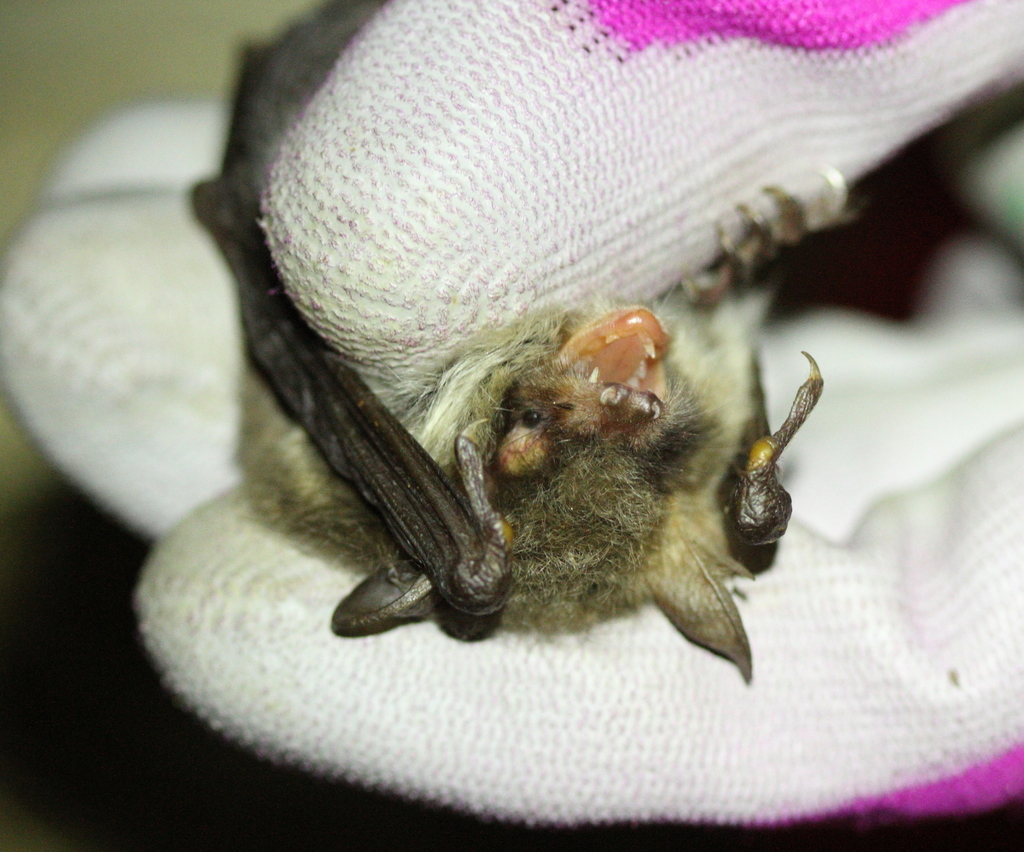
Cryptic Myotis
Photo © Julien Renoult
Photo © Julien Renoult — CC BY 4.0 — Source: iNaturalist #17056470| The cryptic myotis (Myotis crypticus) is a European vespertilionid bat. It is a member of the Natterer's bat (M. nattereri) species complex, and is also the closest living relative of M. nattereri. == Distribution and habitat == It is mostly distributed across European countries bordering the Mediterranean Sea, from Spain west to Austria, north to Switzerland, and south to most of the Italian Peninsula. Populations of similar bats in southern Italy and Sicily display significant genetic divergence from M. crypticus, and thus may represent a unique taxonomic entity that requires more study. It is found in a wide range of altitudes, from sea level to 1000 meters above. It feeds in forest and grassland habitats and roosts in tree hollows as well as man-made structures. In autumn, M. crypticus swarms with other Myotis in large numbers, and overwinters with them in underground sites such as crevices. == Food == The cryptic murine is still poorly understood as it was discovered late. However, its resemblance to the Natterer's Murin means it probably hunts in closed environments. In some areas like western Switzerland, it feeds on spiders and caterpillars.
Cévennes National Park
Vebron, France
+187 birds+63 mammals
Where granite gorges slice through the limestone plateaux of southern France, the Cévennes Cœur National Park unfolds across nearly 3,500 square kilometres of one of Europe's…
VIEW NATIONAL PARKÉcrins National Park
La Chapelle-en-Valgaudémar, France
+143 birds+36 mammals
Where granite peaks and Alpine meadows converge across nearly 2,100 square kilometres, Écrins National Park forms one of the wildest mountainous strongholds of the French Alps.…
VIEW NATIONAL PARKCalanques National Park
Bouches-du-Rhône, France
+233 birds+42 mammals
Where limestone cliffs plunge dramatically into crystalline Mediterranean waters, Calanques National Park preserves one of Europe's most striking coastal landscapes. These steep-sided inlets, carved by erosion…
VIEW NATIONAL PARKNo community photos yet. Log in to add the first one.
No community observations of this species yet.