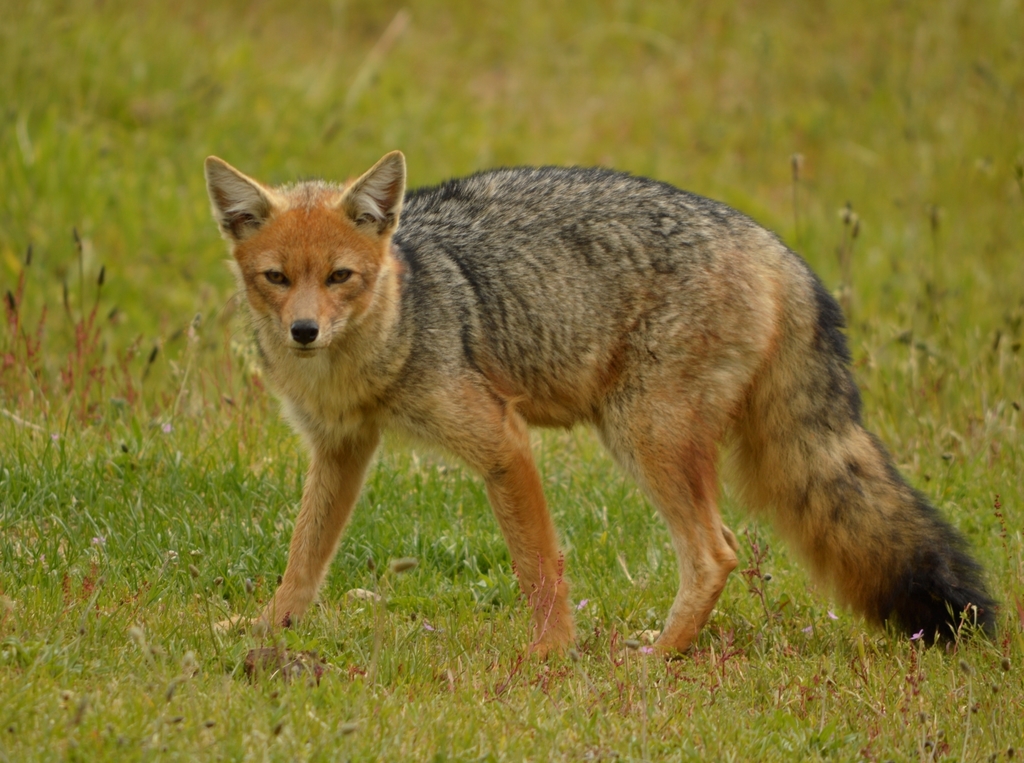
Culpeo
Photo © E Santos Ortega
Photo © E Santos Ortega — CC BY 4.0 — Source: iNaturalist photo #172989139Identification
The culpeo is a canid intermediate in size between a red fox and a coyote, and the second-largest native canid on the South American continent after the maned wolf. Males average 11.4 kg (25 lb), while females typically weigh 8.4 kg (19 lb), though the species ranges from 5 to 13.5 kg (11 to 30 lb). Total length ranges from 94 to 133 cm (37 to 52 in), including a tail of 32 to 44 cm (13 to 17 in).
The culpeo's coat has a grizzled appearance with grey and reddish fur. The neck and shoulders are often tawny to rufous, while the upper back is darker. It displays a white chin, reddish legs, and a stripe on its back that may be barely visible. The bushy tail characteristically has a black tip. Despite its fox-like appearance, the culpeo is not a true fox but more closely related to wolves and jackals, with its resemblance to foxes resulting from convergent evolution.
Range & Habitat
The culpeo's range extends from the southern regions of Patagonia and Tierra del Fuego in the south to Ecuador and Peru in the north, with some populations extending into southern Colombia. It is also found in the Sierras Grandes mountain range in Córdoba, Argentina, and is most common on the western slopes of the Andes.
This adaptable species inhabits a wide variety of habitats across western South America, including broadleaf Nothofagus temperate rainforest, sclerophyllous matorral, deserts, chaparrals, and plateaus such as the Altiplano. They are found in open country and deciduous forests, ranging up to the tree line at 4,800 metres (15,700 ft).
Behaviour & Diet
The culpeo is an opportunistic predator with a varied diet. It mainly feeds on rodents (including common degus) and lagomorphs, particularly the introduced European rabbit and European hare. The species also takes insects, birds, lizards, fruit, and carrion of llamas and vicuñas. Occasionally, culpeos prey on young guanacos and may attack farm animals including sheep, goats, and poultry, particularly lambs up to one week old.
In ecological interactions, larger culpeos dominate potential competitors including South American gray foxes, Geoffroy's cats, pampas cats, grisons, and various raptorial birds. Introduced rabbits, brought to the region in 1915, are believed to have allowed culpeos to spread from the Andean foothills across the Patagonian plain. The mating period typically occurs between August and October, with females giving birth after a 55–60 day gestation to usually between two and five pups.
Best Time & Places to See It
Travellers seeking culpeos should focus on the Andean regions and Patagonian plains of western South America, particularly the western slopes of the Andes where they are most common. The species is found across a vast latitudinal range, making it accessible in multiple countries including Argentina, Chile, Peru, Ecuador, and Colombia. They inhabit both lowland open country and montane habitats up to the tree line.
While the species is not threatened with extinction overall, it has become rare in some regions due to hunting in rural Chile and Argentina, where it is persecuted for attacks on livestock. Patience and early morning or dusk observation are typically required to encounter this elusive predator in its natural habitat.
Photography Tips
Photographing culpeos requires patience and attention to habitat. The species favours open country, matorral, and deciduous forests where they can be spotted during low-light periods at dawn and dusk. The grizzled coat with its mix of grey and reddish tones provides natural camouflage, so look for movement in open grasslands and scrubland edges typical of Andean foothills and Patagonian landscapes.
The culpeo's distinctive features—including the bushy black-tipped tail, white chin, and reddish legs—provide good identification markers and photographic subjects. When photographing, be aware that the species may be wary in areas where it is hunted. Distant, patient observation using telephoto lenses is recommended to capture natural behaviour without disturbing this increasingly rare canid.
Podocarpus National Park
Zamora, Ecuador
+496 birds+6 mammals
Where the Andes descend toward the Amazon basin, Podocarpus National Park sprawls across nearly 2,800 square kilometres of the most biodiverse terrain in Ecuador's southern highlands.…
VIEW NATIONAL PARKAntisana National Park
Quijos, Ecuador
+432 birds+21 mammals
Where the eastern Andean slopes descend into the Amazon basin, Antisana National Park sprawls across roughly 2,500 square kilometers of some of South America's most dramatic…
VIEW NATIONAL PARKCotopaxi National Park
Mulaló, Ecuador
+211 birds+6 mammals
High in Ecuador's volcanic corridor, where the páramo transitions into cloud forest along the slopes of Cotopaxi volcano, the national park unfolds across nearly 500 square…
VIEW NATIONAL PARKLlanganates National Park
Tena, Ecuador
+239 birds+8 mammals
Where the eastern slopes of the Andes plunge toward the Amazon basin, Llanganates National Park sprawls across nearly 3,500 square kilometers of montane wilderness, its terrain…
VIEW NATIONAL PARKCajas National Park
Cuenca, Ecuador
+190 birds+7 mammals
High in the Andes above Cuenca, where elevation ranges from 3,100 to 4,200 metres, the páramo landscape dominates—a windswept realm of cushion plants, alpine grasses, and…
VIEW NATIONAL PARKTorres del Paine National Park
Torres del Paine, Chile
+143 birds+10 mammals
Where granite spires pierce the Patagonian sky, Torres del Paine commands one of South America's most dramatic landscapes. Across 4,106 square kilometres of southern Chile, jagged…
VIEW NATIONAL PARKLaja National Park Lagoon
Antuco, Chile
+123 birds+1 mammals
Where the Andes descend into the Biobío Region's temperate forests, a vast lagoon fills the caldera of the extinct Antuco volcano, cradled by steep native woodland…
VIEW NATIONAL PARKPuyehue National Park
Puyehue, Chile
+110 birds+4 mammals
Across the volcanic spine of the Los Lagos Region, where the Andes descend toward temperate rainforest, Puyehue National Park encompasses nearly 2,600 square kilometers of one…
VIEW NATIONAL PARKVicente Pérez Rosales National Park
Puerto Varas, Chile
+109 birds+8 mammals
Where the Andes descend toward the temperate rainforests of Chile's Lake District, nearly 4,641 square kilometers of pristine wilderness unfolds across Vicente Pérez Rosales National Park.…
VIEW NATIONAL PARKParque Provincial Península de Magallanes
Argentina
+125 birds+4 mammals
Granite peaks and windswept steppe converge across this 415-square-kilometre peninsula jutting into the cold Atlantic waters of southern Patagonia, where the Magallanes landscape embodies the raw,…
VIEW NATIONAL PARKParque Municipal Llao Llao
San Carlos de Bariloche, Argentina
+73 birds+1 mammals
Where the Andes meet the Patagonian lakes, granite peaks rise above temperate rainforest in a landscape of startling contrasts. Parque Municipal Llao Llao, sprawling across 23…
VIEW NATIONAL PARKLos Glaciares National Park
Argentina
+121 birds+3 mammals
Where granite peaks and sprawling ice fields dominate the landscape, Los Glaciares National Park encompasses over ten thousand square kilometres of Patagonian wilderness in southern Argentina.…
VIEW NATIONAL PARKLos Cardones National Park
Argentina
+193 birds+6 mammals
Where the Andes descend into northwestern Argentina, Los Cardones National Park sprawls across nearly 1,200 square kilometres of one of South America's most distinctive high-altitude desert…
VIEW NATIONAL PARKNahuel Huapi National Park
Argentina
+124 birds+11 mammals
Where the Andes descend toward Patagonia, vast glacial lakes cut through a landscape of southern beech forest and granite peaks, creating one of South America's most…
VIEW NATIONAL PARKLanín National Park
Argentina
+128 birds+7 mammals
Where the volcanic spine of the Andes plunges into Patagonian steppe, Lanín National Park sprawls across nearly 4,700 square kilometers of one of Argentina's most visually…
VIEW NATIONAL PARKLos Alerces National Park
Argentina
+84 birds+3 mammals
Where the temperate rainforests of southern Patagonia sweep down towards crystalline lakes, Los Alerces National Park unfolds across nearly 3,000 square kilometres of one of South…
VIEW NATIONAL PARKNo community photos yet. Log in to add the first one.
No community observations of this species yet.