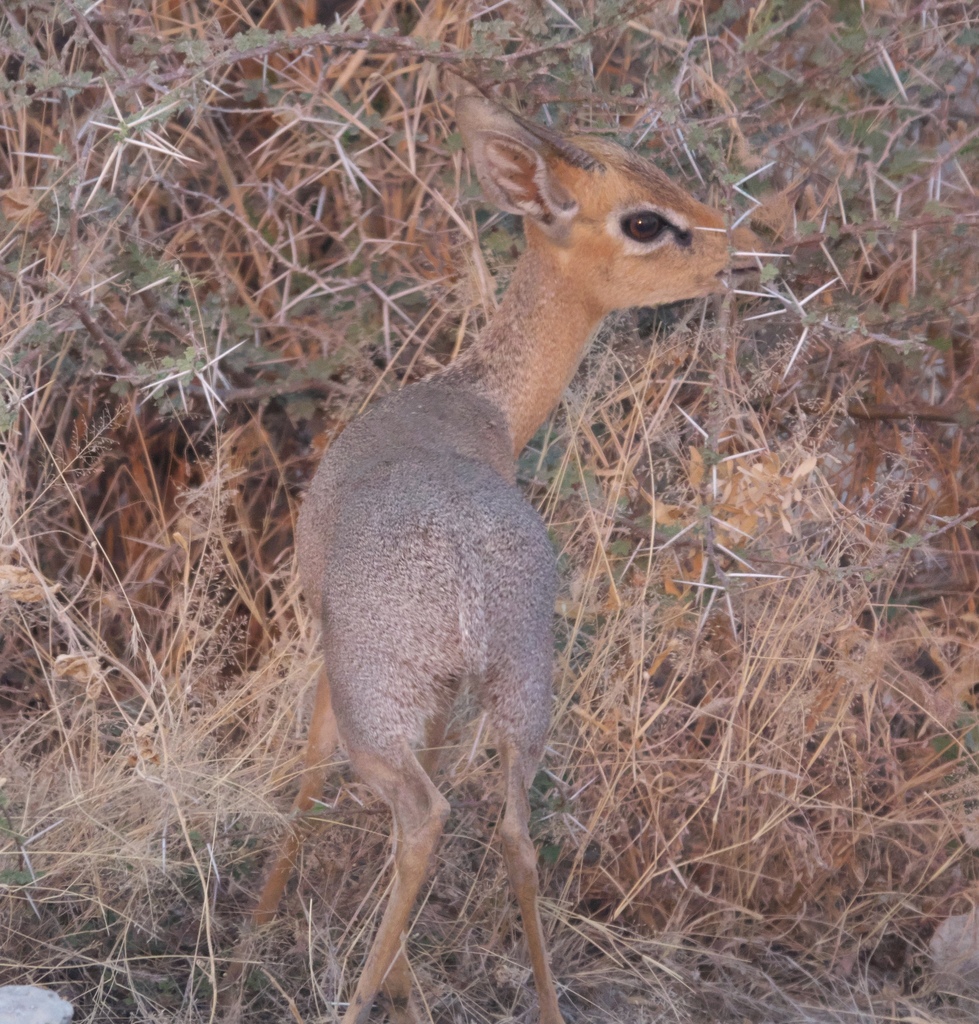
Damara Dik-dik
Photo © Robert Webster
Photo © Robert Webster — CC BY-SA 4.0 — Source: iNaturalist #317196276Identification
The Damara dik-dik is one of Africa's smallest antelope species, typically weighing less than 1.5 kg and standing only around 30–40 cm at the shoulder. Despite its diminutive size, it is instantly recognizable by its distinctive features: a compact, stocky body with relatively long, slender legs that seem almost disproportionately tall for its frame. The coat is greyish-brown to tan, often with a subtle rufous tinge on the back and flanks, while the underparts are paler. Both sexes possess small, straight horns, though the male's are noticeably longer and more prominent than the female's—an unusual characteristic among African ungulates. The dik-dik's most notable feature is its elongated, mobile snout, which overhangs the lower jaw and contains a distinctive preorbital gland. This gives the species a somewhat comical, almost endearing appearance that endears it to wildlife photographers and observers.
Range & habitat
The Damara dik-dik is endemic to southwestern Africa, with its range centered primarily in Namibia, particularly in the Damara region—from which it derives its common name. Small populations also extend into northwestern Botswana and possibly into adjacent areas of Angola. The species favors rocky, semi-arid scrubland and sparse woodland habitats, typically in areas with scattered bushes, rocky outcrops, and minimal grass cover. These diminutive antelope are highly specialized for arid conditions and rarely venture far from areas offering adequate cover and rocky terrain where they can quickly evade predators. They are notably absent from open plains and dense woodland, preferring the broken, rocky landscapes of the Damara Plateau and similar terrain.
Behaviour & diet
Damara dik-diks are strictly diurnal and solitary or found in bonded pairs, remaining within well-defined and fiercely defended territories throughout the year. They are intensely shy and cryptic, spending much of the day hidden in rocky crevices or beneath dense bush cover, emerging briefly to forage in early morning and late afternoon. When alarmed, they produce a distinctive sharp, explosive snort before bounding away in a zigzag pattern with remarkable agility across rocky ground. The species is primarily a browser, feeding on leaves, twigs, and small shrubs; they also consume available fruits and seeds. Remarkably, dik-diks obtain most of their water from their food, an adaptation essential for survival in arid regions.
Best time & places to see it
The Damara dik-dik is best sought in central Namibia, particularly in and around the Damara region and in reserves with appropriate rocky, scrubland habitat. Early morning is the optimal time for observation, when these shy creatures are most active. The species is present year-round, though the dry season (May to September) may concentrate animals around water sources. Patience and luck are essential, as their cryptic nature and preference for rocky terrain make them challenging to locate. Local guides familiar with dik-dik behavior and habitat preferences greatly improve chances of successful sightings.
Photography tips
Photographing Damara dik-diks requires patience, a fast shutter speed, and a steady hand. Use a telephoto lens (200mm or longer) to maintain distance and avoid disturbing these wary animals. Early morning light is ideal for capturing their delicate features and distinctive snout. Photograph from low angles when possible to emphasize their diminutive size relative to the rocky landscape. Remain quiet and motionless; sudden movement will send them bounding into cover. Capture behavioral shots when they emerge to forage, but be prepared for their explosive departure—a sharp snort is your only warning.
Etosha National Park
Namibia
+356 birds+58 mammals
Across northern Namibia's stark semi-arid plateau, a vast shallow depression transforms seasonally into one of Africa's most dramatic wildlife theaters. Etosha National Park, encompassing more than…
VIEW NATIONAL PARKWaterberg Plateau National Park
Okambukonde, Namibia
+198 birds+27 mammals
Where ancient sandstone cliffs rise 200 metres above the surrounding bushveld, a fortress of geology creates one of southern Africa's most compelling ecosystems. The plateau's steep…
VIEW NATIONAL PARKNo community photos yet. Log in to add the first one.
No community observations of this species yet.