Identification
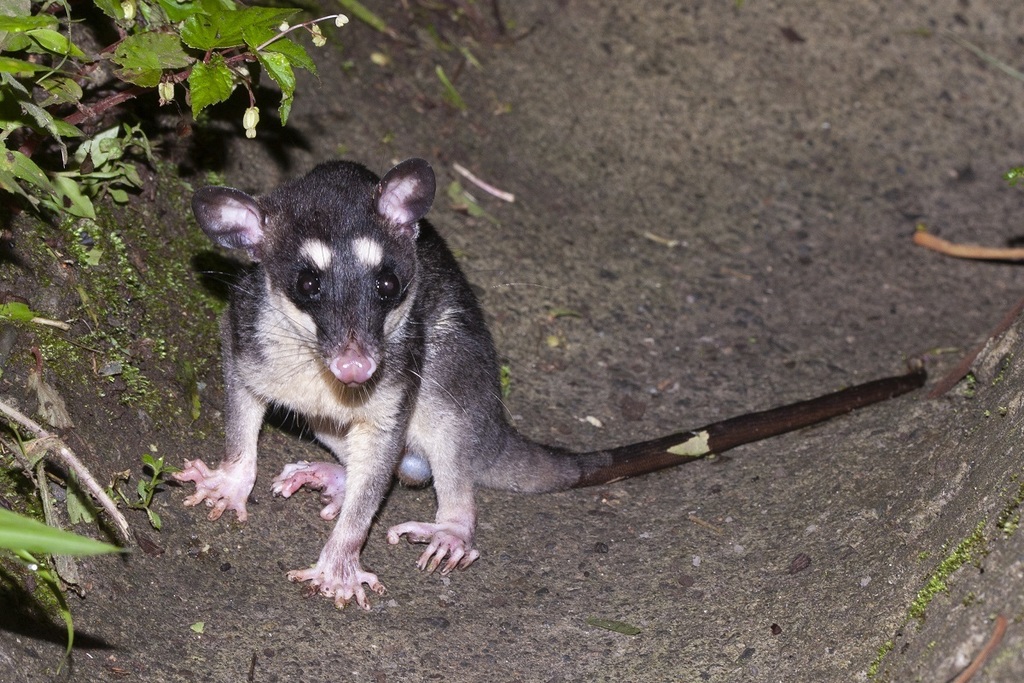
The dark four-eyed opossum is a medium-sized marsupial measuring 483–582 mm in total length, with the tail accounting for approximately 258.5 mm. The species derives its common name from distinctive light spots above the eyes that create the illusion of a second pair of eyes—a characteristic feature of the Philander genus. This opossum is notably darker than its closest relative, the gray four-eyed opossum, with dark gray to black upperparts on the head, back, rump, and limbs, often with gray-tipped hairs. The cheeks, sides, and eyebrows display a distinctive yellowish coloration, contrasting sharply with the white underside. A key identifying feature is the tail: populations in Central America typically have lighter-colored tail tips, while southern populations possess uniformly dark tails. The specific epithet "melanurus" reflects this characteristic, deriving from Greek words meaning "black" and "tail."
Range & Habitat
The dark four-eyed opossum is distributed across Central and South America, occurring west of the Andes Mountains in Ecuador, Colombia, and Panama. The species is confirmed or suspected in Guatemala, Honduras, Nicaragua, and Costa Rica, though further surveying is needed to clarify its presence in these northern regions. The range boundary between this species and Philander vossi (another four-eyed opossum) remains poorly documented, though citizen science data suggests it lies near the Nicaragua-Costa Rica border. The holotype specimen originates from Paramba, a town along the Río Mira in northern Ecuador.
Behaviour & Diet
Like other members of the Philander genus, the dark four-eyed opossum is a nocturnal marsupial, though detailed information on its specific behavioral ecology and dietary preferences remains limited in scientific literature. The species likely shares the omnivorous feeding habits typical of four-eyed opossums, though targeted research is needed to document its precise diet and ecological role within its range.
Best Time & Places to See It
Observing this species requires patience and nocturnal fieldwork in suitable habitat within its range west of the Andes. Ecuador and Colombia offer the most reliable opportunities, particularly in forest regions near the type locality of Paramba in northern Ecuador. Night surveys and live-trapping techniques are typically necessary to encounter this elusive, nocturnal marsupial. Visiting during the wet season may increase activity levels, though specific seasonal patterns for this species have not been well documented.
Photography Tips
Photographing dark four-eyed opossums presents significant challenges due to their nocturnal habits and preference for dense vegetation. Use a headlamp or red-filtered light to minimize disturbance while locating individuals at night. Fast film speeds and wide apertures are essential to capture images in low-light conditions. The distinctive eyespots and contrasting facial markings make compelling photographic subjects when adequately lit. Patience is critical—allow the animal to become accustomed to your presence before attempting photographs, and always prioritize the welfare of the animal over obtaining images.
Tortuguero National Park
Roxana, Costa Rica
+420 birds+23 mammals
Canals and lagoons thread through a labyrinth of lowland rainforest where the Caribbean coast of Costa Rica meets the wetland frontier. This is terrain shaped by…
VIEW NATIONAL PARKCaño Negro National Wildlife Refuge
Caño Negro District, Costa Rica
+486 birds+16 mammals
Where the San Juan River's seasonal floodplain opens into expansive wetlands, Caño Negro Wildlife Sanctuary sprawls across one of Central America's most productive freshwater ecosystems. This…
VIEW WILDLIFE SANCTUARYBarra del Colorado National Wildlife Refuge
Tortuguero, Costa Rica
+462 birds+36 mammals
Where the Caribbean's restless waters meet the Limón Province coastline, Barra del Colorado National Wildlife Sanctuary unfolds across a landscape of extraordinary ecological complexity. This equatorial…
VIEW WILDLIFE SANCTUARYNo community photos yet. Log in to add the first one.
No community observations of this species yet.