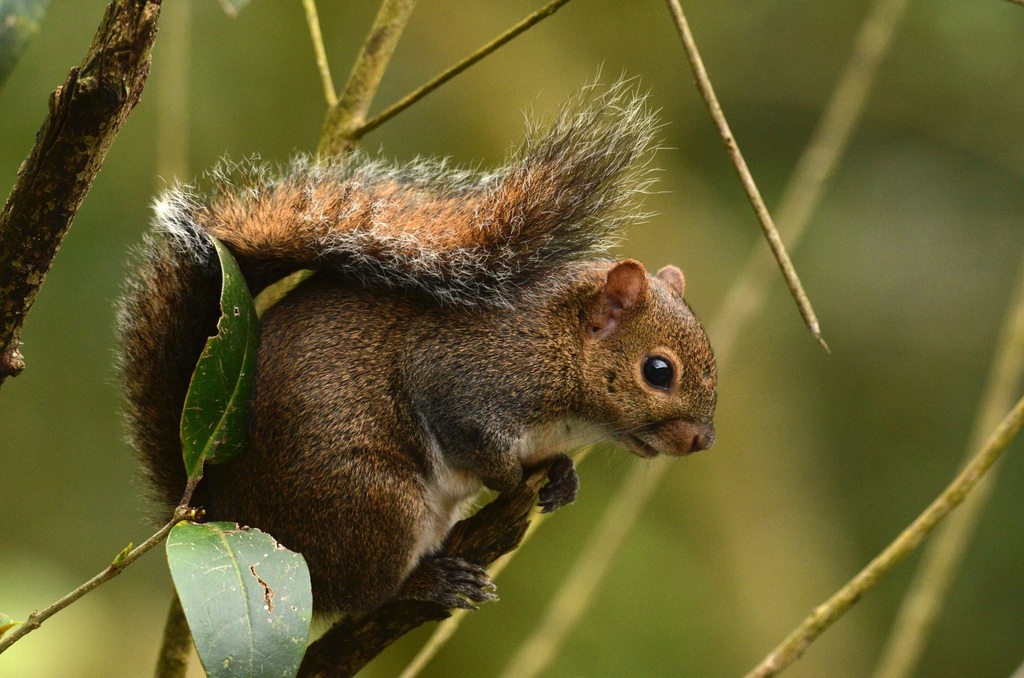
Deppe’s Squirrel
Photo © Amado Demesa Arevalo
Photo © Amado Demesa Arevalo — CC BY-SA 4.0 — Source: iNaturalist photo #1668264Identification
Deppe's squirrel is a medium-sized tree squirrel with subtle but distinctive coloring that varies between individuals. The body is typically gray to yellowish brown or rusty brown, with a gray face and dark gray or rust-colored legs. The most striking feature is the tail: the upper surface is black with white hairs mixed throughout, while the underside displays yellowish orange to rust coloring, with white hairs on the tip. Females average slightly larger than males, though both sexes are relatively similar in size. The fur pattern changes subtly with the seasons—notably, the white tail tip and patches of hair behind the ears disappear during summer months.
Range & Habitat
This Central American species is native to Belize, Costa Rica, El Salvador, Guatemala, Honduras, Mexico, and Nicaragua. Deppe's squirrels are habitat generalists, making them adaptable to various environments across their range. They show a preference for lowland tropical forests with dense vegetation and damp conditions, though the diversity of climates throughout Mesoamerica means they occupy different habitats across their distribution. Notably, populations thrive around archaeological sites such as Guatemala's Tikal National Park, where research has surprisingly shown higher densities of these squirrels near the Mayan ruins than in undisturbed control areas. The IUCN currently rates their population status as stable.
Behaviour & Diet
Deppe's squirrels are diurnal and active throughout the day, spending 30–60 percent of their foraging time on the ground despite being primarily arboreal. On the ground and in trees, they search for seeds, nuts, buds, insects, and fruits. These are not social animals and typically remain in very small groups. They are generally quiet, relying on excellent camouflage to blend with tree trunks and avoid detection by humans. When threatened by intruders, however, they emit high-pitched calls accompanied by tail flicks as alarm signals.
Best Time & Places to See It
Year-round observation is possible, though breeding activity is usually concentrated around the end of the dry season. Tikal National Park in Guatemala offers excellent opportunities to encounter Deppe's squirrels, particularly around the Mayan ruins where populations are notably abundant. Their preference for lowland tropical forests with dense vegetation means searching in such habitats across their range will increase sighting chances. Early morning when diurnal activity is highest offers the best viewing opportunities.
Photography Tips
Patience is essential when photographing Deppe's squirrels—their camouflage is remarkably effective when they are stationary, making them challenging to spot and photograph. Watch for movement in trees and on the ground to locate individuals. The distinctive tail pattern, with its contrasting black upper surface and rust-colored underside, provides an excellent photographic subject. A telephoto lens is recommended to maintain distance without disturbing these quiet, easily startled animals. Early morning light will best reveal the subtle color variations in their fur and the striking tail markings.
Sian Ka’an
Chunyaxché, Mexico
+350 birds+16 mammals
Where the Yucatán Peninsula dissolves into wetland and mangrove, a vast mosaic of forest, lagoon, and coastal margin creates one of Mexico's most biodiverse strongholds. Across…
VIEW BIOSPHERE RESERVESierra de Tamaulipas
El Porvenir, Mexico
+98 birds+19 mammals
Where limestone peaks thrust skyward through dense subtropical forest, Mexico's northeastern frontier reveals one of the continent's most biodiverse mountain ranges. Canyons carved by perennial rivers…
VIEW NATURE RESERVEMontes Azules
Candelaria, Mexico
+395 birds+47 mammals
Where jungle-clad limestone plateaus plunge into canyon systems carved by the Usumacinta River, Mexico's most pristine rainforest reserve unfolds across the Lacandón region of Chiapas. Montes…
VIEW BIOSPHERE RESERVETikal National Park
Tikal, Guatemala
+399 birds+16 mammals
Dense rainforest canopy rises above the limestone plateau of Petén, where archaeological wonder and ecological richness merge seamlessly across one of Central America's most biodiverse landscapes.…
VIEW NATIONAL PARKLaguna del Tigre National Park
Petén, Guatemala
+399 birds+29 mammals
Where the Petén lowlands dissolve into wetland and forest, Laguna del Tigre National Park protects one of Guatemala's most ecologically vital landscapes. This sprawling reserve encompasses…
VIEW NATIONAL PARKRincón de la Vieja National Park
Liberia, Costa Rica
+451 birds+30 mammals
Where volcanic slopes rise abruptly from the Guanacaste lowlands, Rincón de la Vieja National Park sprawls across a landscape shaped by geothermal drama and seasonal extremes.…
VIEW NATIONAL PARKNo community photos yet. Log in to add the first one.
No community observations of this species yet.