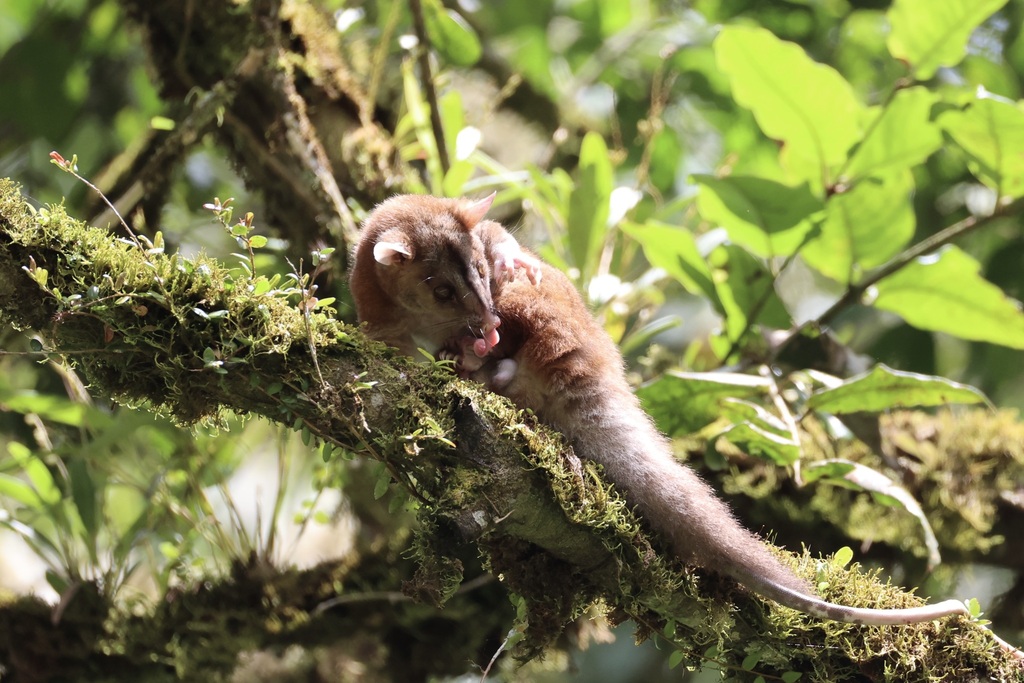
Derby’s Woolly Opossum
Photo © Andrew Holle
Photo © Andrew Holle — CC0 1.0 — Source: iNaturalist photo #449327638Identification
Derby's woolly opossum is the largest member of its genus, measuring 60–70 centimetres in total length and weighing 200–400 grams. Distinguished by its brown coat, white-buff to golden-brown underside, and characteristic white to pink ears, this arboreal marsupial is unmistakable in the field. A dark streak runs from the nose to the crown, and the prehensile tail—which comprises 58–67% of body length—is partially naked and invaluable for grasping branches. The tail's distinctive appearance and the animal's efficient climbing posture are key identification features.
Range & Habitat
This Central American species ranges from southern Mexico (Veracruz) southward through Guatemala, Honduras, Nicaragua, Costa Rica, and Panama, extending into South America to western Ecuador and the Cauca River valley of Colombia. It inhabits deciduous and moist evergreen forests, from lowland regions up to 2,600 metres elevation. Seven subspecies are recognized across this range, each showing slight geographic variation in coat colour and size.
Behaviour & Diet
Derby's woolly opossum is strictly nocturnal and solitary, spending daylight hours in nests constructed from dead leaves within tree cavities in the upper canopy. It is an exceptionally agile climber, moving with remarkable dexterity through vines and branches; the prehensile tail acts as a crucial grasping organ. When threatened, it may bite defensively or produce distress squeals. Activity levels increase when food becomes scarce and decrease when exposed to light.
The diet is omnivorous, consisting primarily of fruits from pepper vines and Cecropia species, supplemented by nectar from balsa trees and other flowering plants, as well as small invertebrates and vertebrates. After feeding, the animal meticulously grooms itself using its forepaws, cleaning the face, flanks, underbelly, and tail.
Best Time & Places to See It
As a strictly nocturnal species, Derby's woolly opossum is encountered only on night walks through suitable forest habitat. Search the upper canopy levels of deciduous and moist evergreen forests from Mexico to Colombia and Ecuador, particularly in protected reserves where forest cover remains intact. Breeding timing varies geographically, occurring during the dry season in Panama (late January–early February) but year-round in Nicaragua, though this does not significantly affect visibility. The species is classified as Least Concern with presumed large populations, though it remains challenging to locate due to its secretive, arboreal nocturnal habits.
Photography Tips
Photographing this species requires patience, night-vision capability, and a guide familiar with local populations. Use a headlamp with a red filter to minimize disturbance, as the animal's eyes glow distinctly red under light—a useful locating feature. Position yourself beneath suspected nesting cavities in large trees during night walks. A fast lens and high ISO are essential for low-light conditions. Capture the distinctive prehensile tail wrapped around branches and the animal's characteristic nose-to-crown dark streak. Wide-angle shots showing the opossum among vines and branches convey its remarkable arboreal agility and habitat preference.
Manuel Antonio National Park
Quepos, Costa Rica
+426 birds+22 mammals
Where tropical rainforest descends steeply to a rocky Pacific coastline, Manuel Antonio National Park distills Central American biodiversity into one of Costa Rica's most compressed and…
VIEW NATIONAL PARKTortuguero National Park
Roxana, Costa Rica
+420 birds+23 mammals
Canals and lagoons thread through a labyrinth of lowland rainforest where the Caribbean coast of Costa Rica meets the wetland frontier. This is terrain shaped by…
VIEW NATIONAL PARKPiedras Blancas National Park
Golfito, Costa Rica
+386 birds+24 mammals
Where the Golfo Dulce meets the southwestern Pacific coast of Costa Rica, Piedras Blancas National Park protects a dramatic transition zone where lowland rainforest descends toward…
VIEW NATIONAL PARKSanta Rosa National Park
Santa Elena, Costa Rica
+359 birds+30 mammals
Where Pacific-facing slopes descend from volcanic uplands toward the Guanacaste lowlands, Santa Rosa National Park unfolds across a mosaic of tropical dry forest, gallery woodland, and…
VIEW NATIONAL PARKSoberanía National Park
Cristóbal, Panama
+495 birds+34 mammals
Rainforest and riverine woodland blanket the rolling terrain of this 714-square-kilometre national park in Colón Province, where the Caribbean watershed feeds a maze of streams and…
VIEW NATIONAL PARKChagres National Park
Caimitillo, Panama
+486 birds+19 mammals
Where the Chagres River carves through the humid tropics of central Panama, a vast montane and lowland forest sprawls across more than 2,300 square kilometers, anchoring…
VIEW NATIONAL PARKMontes Azules
Candelaria, Mexico
+395 birds+47 mammals
Where jungle-clad limestone plateaus plunge into canyon systems carved by the Usumacinta River, Mexico's most pristine rainforest reserve unfolds across the Lacandón region of Chiapas. Montes…
VIEW BIOSPHERE RESERVETikal National Park
Tikal, Guatemala
+399 birds+16 mammals
Dense rainforest canopy rises above the limestone plateau of Petén, where archaeological wonder and ecological richness merge seamlessly across one of Central America's most biodiverse landscapes.…
VIEW NATIONAL PARKSierra del Lacandón National Park
Petén, Guatemala
+348 birds+7 mammals
Where the Petén rainforest rises into limestone ridges and deep ravines, Sierra del Lacandón National Park protects one of Central America's most intact tropical wilderness zones.…
VIEW NATIONAL PARKGandoca-Manzanillo National Wildlife Refuge
Manzanillo, Costa Rica
+394 birds+18 mammals
Where the Caribbean coastal plain surrenders to water-logged forest and mangrove tangles, Gandoca-Manzanillo Wildlife Sanctuary shelters one of Costa Rica's most biodiverse lowland wetland ecosystems. The…
VIEW WILDLIFE SANCTUARYBarra del Colorado National Wildlife Refuge
Tortuguero, Costa Rica
+462 birds+36 mammals
Where the Caribbean's restless waters meet the Limón Province coastline, Barra del Colorado National Wildlife Sanctuary unfolds across a landscape of extraordinary ecological complexity. This equatorial…
VIEW WILDLIFE SANCTUARYNo community photos yet. Log in to add the first one.
No community observations of this species yet.