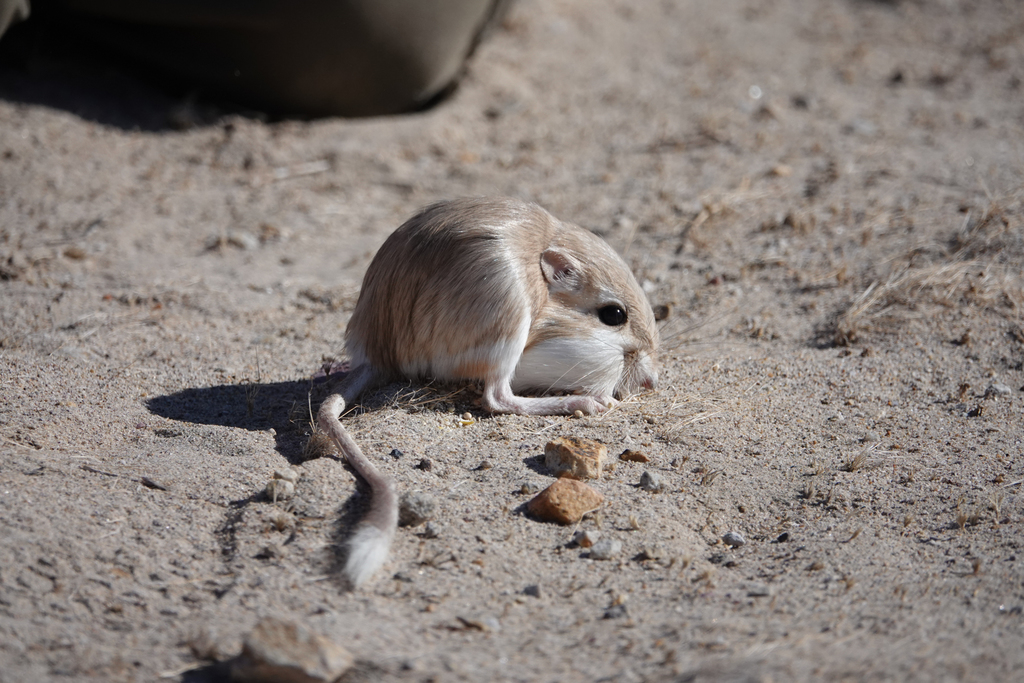
Desert Kangaroo Rat
Photo © Kyle Nessen
Photo © Kyle Nessen — CC0 1.0 — Source: iNaturalist photo #190784548Identification
The desert kangaroo rat is one of the larger members of the kangaroo rat family, with a total length greater than 12 inches (300 mm) and a mass exceeding 3.2 ounces (91 g). Like other kangaroo rats, it belongs to the family Heteromyidae and is instantly recognisable by its powerful hind legs, which it uses for both locomotion and defence. Among its distinctive anatomical features are the longest nasal cavities of any kangaroo rat species—an adaptation that aids water conservation in its harsh desert environment.
Range & Habitat
This species is found exclusively in the arid deserts of southwestern North America, including Death Valley, the Great Basin, the Mojave Desert, and portions of the Sonoran Desert. Death Valley, home to some of the most extreme desert conditions on the continent, represents a key stronghold for the species. Unlike other kangaroo rats that tolerate various soil types, the desert kangaroo rat has a strict requirement: it lives only in areas with loose sand, particularly dune terrain.
Within sandy desert landscapes, desert kangaroo rats inhabit regions with sparse vegetation dominated by creosote bush, various grasses, and cacti. They construct burrow systems beneath slight mounds of soil measuring 6–9 metres across, creating groups of 6–12 widely spaced burrows that may form loose colonies, though the species is otherwise solitary in nature.
Behaviour & Diet
The diet of desert kangaroo rats consists predominantly of seeds, with a marked preference for larger seeds than those consumed by other sympatric rodent species. When foraging in areas with varying seed sizes and densities, they preferentially select large-seed patches and show a strong preference for seeds with high carbohydrate content. Notably, unlike some kangaroo rat species, desert kangaroo rats do not consume green vegetation. Feeding occurs in discrete bouts interspersed with short movements, averaging approximately 7 metres between feeding stops.
Desert kangaroo rats are supremely adapted to water scarcity. Although they will drink available water, the vast majority of their water requirements are derived from metabolic byproducts, with water turnover times extending to 2–3 weeks. This adaptation is facilitated by remarkably elongated kidney papillae that concentrate urine with exceptional efficiency, and by nasal cavities that cool exhaled air to minimise respiratory water loss. When threatened, particularly by snakes, desert kangaroo rats respond aggressively by drumming their feet, kicking sand into the air, and using their powerful hind limbs to strike at attackers—behaviours that advertise alertness to potential predators.
Best Time & Places to See It
Desert kangaroo rats are strictly nocturnal, spending daylight hours sealed within their burrows. They are best observed during night-time surveys in their primary strongholds: Death Valley National Park, the Mojave Desert, and other loose-sand dune environments within their southwestern range. The species is most active during cooler months when foraging demands are higher, though the extreme heat of summer may reduce surface activity further.
Photography Tips
Photographing this elusive nocturnal species presents significant challenges. Night photography will be essential, requiring infrared or red-light illumination to avoid disturbing natural behaviour. Position yourself near burrow systems in loose-sand habitats and remain patient and motionless, as these solitary foragers are wary. The dramatic contrast between the animal's large hind legs and small body, along with its active sand-kicking behaviour when alarmed, offers compelling compositional opportunities. Capturing the desert landscape and dune habitat will help convey the extreme environment this remarkable rodent calls home.
No community photos yet. Log in to add the first one.
No community observations of this species yet.