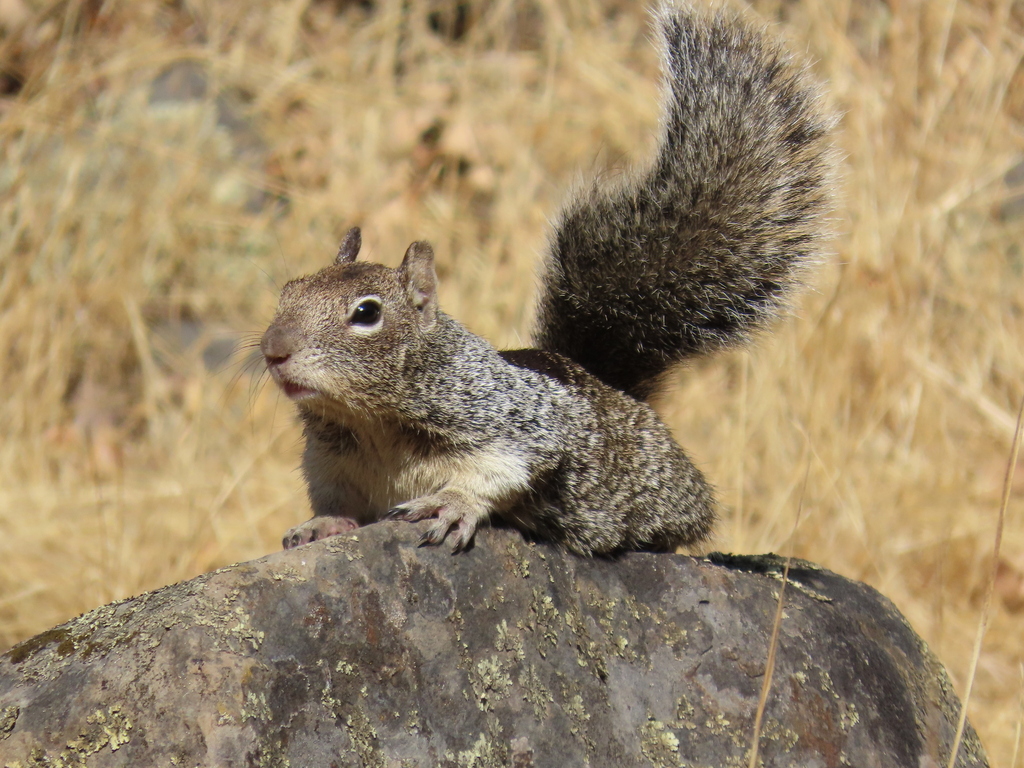
Douglas’s Ground Squirrel
Photo © John Hibbard
Photo © John Hibbard — CC BY 4.0 — Source: iNaturalist photo #432979077Douglas ground squirrel (Otospermophilus douglasii) is a rodent that has brown fur with small white spots on its head, back and flanks, with a dark patch between and behind its silvery shoulders, a lighter belly and a long, fluffy tail. It lives in colonies and makes extensive tunnels to sleep, shelter from danger, store food, and foster its newborns. It is an important prey species for snakes, birds of prey and mammalian predators. It eats seeds, and during the growing season, a variety of other parts of plants. It is regarded an agricultural pest, may cause damage to infrastructure due to its burrowing, and is considered a potential risk for human health since it harbors several infectious diseases. It can primarily be found in grasslands and open woodlands, from the coastline to the mountains, in central and southern Washington, Oregon, and northern California. In 2023, the International Union for Conservation of Nature had not yet determined the conservation assessment for this species. Douglas ground squirrel was initially described as a species, but later considered to be a subspecies of Otospermophilus beecheyi, the California ground squirrel. However, comparison of homologous DNA suggests Douglas ground squirrel should be considered as a separate…
Redwood National Park
Humboldt County, United States
+343 birds+43 mammals
Where the Pacific fog rolls deep into northern California's coastal valleys, some of the tallest trees on Earth rise from a landscape shaped by tectonic forces…
VIEW NATIONAL PARKTule Lake National Wildlife Refuge
Siskiyou County, United States
+255 birds+9 mammals
Across the high volcanic plateau of northeastern California, where summer heat scorches the alkali flats and winter winds sweep unobstructed through open water and marsh, Tule…
VIEW WILDLIFE SANCTUARYSacramento National Wildlife Refuge
Glenn County, United States
+247 birds+13 mammals
Across the flat expanse of Glenn County's Sacramento Valley, shallow pools and seasonal marshes create one of California's most vital wetland sanctuaries—a landscape shaped by water…
VIEW WILDLIFE SANCTUARYNo community photos yet. Log in to add the first one.
No community observations of this species yet.