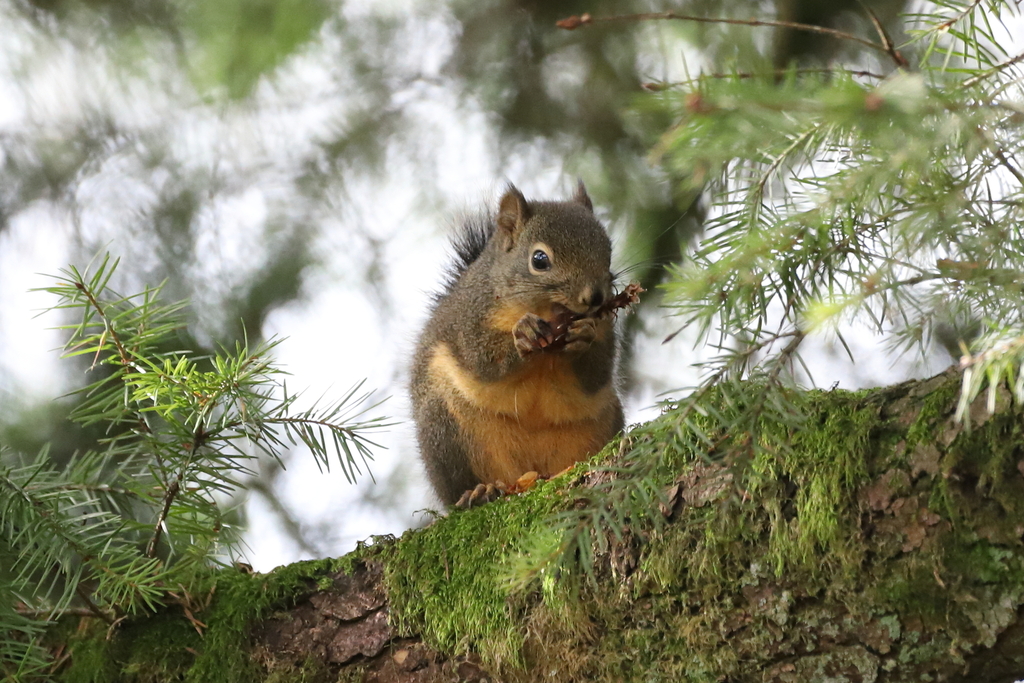
Douglas’s Squirrel
Photo © Eric Habisch
Photo © Eric Habisch — CC BY 4.0 — Source: iNaturalist photo #257543350Identification
The Douglas squirrel is a compact pine squirrel about 13 inches (33 cm) in total length, including a 5-inch tail, and weighs between 5.3 and 10.6 ounces (150–300 g). Seasonal variation is striking: summer coats display greyish or greenish-brown backs with pale orange chests and bellies, while winter fur becomes browner above and greyer below, with noticeably tuftier ears. Like many squirrels, it bears a distinctive white eye-ring. John Muir called it "by far the most interesting and influential of the California Sciuridæ."
Range & Habitat
This species inhabits coniferous forests along the Pacific Coast from California's Sierra Nevada northward to southwestern British Columbia, with an isolated subspecies (Mearns's squirrel) in northern Baja California's xeric pine forests. Douglas squirrels prefer old-growth or mature second-growth forests and are often considered dependent on these forest types. They essentially fill the ecological niche occupied by the American red squirrel elsewhere in North America, with minimal territorial overlap between the two species.
Behaviour & Diet
Highly territorial and diurnal year-round, Douglas squirrels occupy roughly 10,000 square metres individually in winter, though mated pairs defend a single territory together during breeding season. They are vocal animals, often chattering noisily at intruders. Summer nights are spent in ball-shaped tree nests; winter shelter is found in tree cavities. They breed from February onward, producing up to two litters annually in southern portions of their range, typically with four to six kits per litter.
Douglas squirrels are larder hoarders, accumulating food in middens—single storage sites where generations of squirrels have deposited cone scales, creating piles several metres across. Their diet centres on conifer seeds (Douglas fir, Sitka spruce, shore pine) and sequoia cone scales, supplemented by acorns, berries, mushrooms, bird eggs, and fruits like strawberries and plums. Predators include Pacific martens, bobcats, northern goshawks, and owls.
Best Time & Places to See It
Douglas squirrels are active throughout the year, making them accessible to observers in all seasons. Summer visits offer the best opportunity to observe family groups, as juveniles from a single litter often remain together. Look for them in coniferous forests from the Sierra Nevada and Pacific Northwest through coastal British Columbia. Listen for their characteristic loud chatter—Native Americans of Kings River named them "Pillillooeet" in imitation of this alarm call—which often betrays their presence before you spot them.
Photography Tips
The Douglas squirrel's seasonal colour changes offer excellent photographic opportunities: capture the vibrant pale-orange underside and greenish-brown back of summer individuals, or the richer brown winter coat. Their tuft-eared profile and white eye-ring are distinctive features worth emphasising. Early morning light in coniferous forests will best reveal their colouring. Watch for foraging behaviour around cone-rich trees and listen for their loud vocalizations to locate active individuals. Summer gatherings of juveniles provide opportunities for group compositions.
Lassen Volcanic National Park
Shasta County, United States
+239 birds+18 mammals
Volcanic peaks and geothermal upheaval have sculpted 545 square kilometers of Northern California into a landscape where fire and water engage in perpetual dialogue. Lassen Peak…
VIEW NATIONAL PARKYosemite National Park
Mariposa County, United States
+224 birds+28 mammals
Granite cliffs soar nearly a kilometer above the valley floor in this expanse of high Sierra wilderness, where glacial U-shaped valleys sculpt a landscape of dramatic…
VIEW NATIONAL PARKMount Rainier National Park
Pierce County, United States
+187 birds+25 mammals
A volcanic colossus dominates the Cascade Range in western Washington, its 4,392-meter summit crowned year-round with glacial ice that cascades down toward temperate rainforest and subalpine…
VIEW NATIONAL PARKCrater Lake National Park
Klamath County, United States
+174 birds+13 mammals
At 1,949 metres above sea level, a volcanic caldera of impossible clarity holds one of North America's deepest and most pristine alpine lakes, ringed by pumice-and-ash…
VIEW NATIONAL PARKRedwood National Park
Humboldt County, United States
+343 birds+43 mammals
Where the Pacific fog rolls deep into northern California's coastal valleys, some of the tallest trees on Earth rise from a landscape shaped by tectonic forces…
VIEW NATIONAL PARKSequoia National Park
Tulare County, United States
+187 birds+27 mammals
Granite peaks rising above 3,600 meters dominate the southern Sierra Nevada, where Sequoia National Park sprawls across one of North America's most vertically compressed wilderness zones.…
VIEW NATIONAL PARKKings Canyon National Park
Fresno County, United States
+186 birds+20 mammals
Where granite peaks fracture the Sierra Nevada skyline and the Kings River has carved one of North America's most dramatic canyons, a landscape of extreme relief…
VIEW NATIONAL PARKOlympic National Park
Jefferson County, United States
+263 birds+35 mammals
Where temperate rainforest meets alpine wilderness, Olympic National Park sprawls across nearly 11,000 square kilometers of the Pacific Northwest's most pristine landscape. The park's three distinct…
VIEW NATIONAL PARKNorth Cascades National Park
Whatcom County, United States
+120 birds+18 mammals
Jagged peaks rise abruptly from the western foothills of Washington's Cascade Range, where glaciers cling to elevations above 10,000 feet and meltwater feeds a landscape of…
VIEW NATIONAL PARKNo community photos yet. Log in to add the first one.
No community observations of this species yet.