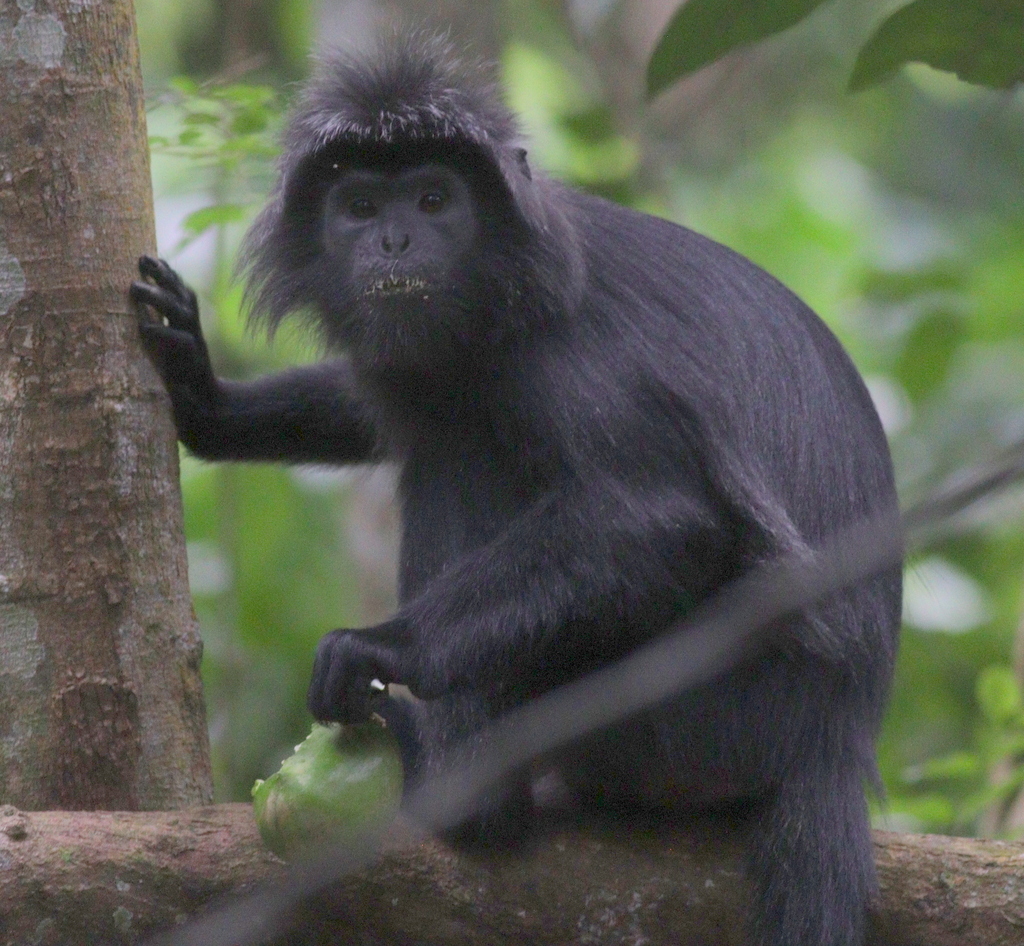
East Javan Langur
Photo © Jan Ebr & Ivana Ebrová
Photo © Jan Ebr & Ivana Ebrová — CC BY 4.0 — Source: iNaturalist #156547270The East Javan langur (Trachypithecus auratus), also known as the ebony lutung, Javan langur or Javan lutung, is an Old World monkey from the Colobinae subfamily. It is most commonly glossy black with a brownish tinge to its legs, sides, and "sideburns". It is found on the island of Java, as well as on several of the surrounding Indonesian islands. The Latin word auratus in its scientific name means "golden" and refers to a less common color variant. The common name golden langur refers to a different species. == Description == Like all langurs, this species' tail is noticeably long, measuring up to 98 cm in length while the body is only around 55 cm long. The two subspecies of this monkey are fairly similar in appearance and are geographically separated; males and females are both usually glossy black, although the females pale, yellowish-white patch around the pubic area. Juveniles of both subspecies are orange in color. The nominate subspecies Trachypithecus auratus auratus has a rare morph that does not lose its juvenile coloration when it matures, instead, the coloration darkens slightly, with yellow tinges on its sides, limbs, and around its ears, and a black tinge on its back.…
Taman Nasional Baluran
Situbondo, Indonesia
+189 birds+9 mammals
Across the northeastern tip of East Java, where monsoon winds sweep down from the Bali Strait, a landscape of contrasts unfolds within 374 square kilometres of…
VIEW NATIONAL PARKWest Bali National Park
Gerokgak, Indonesia
+240 birds+8 mammals
Across West Bali's northwestern reaches, where the Indian Ocean meets volcanic slopes and limestone cliffs plunge toward turquoise shallows, sprawls a protected realm of roughly 325…
VIEW NATIONAL PARKGunung Merbabu National Park
Magelang, Indonesia
+61 birds+2 mammals
Where volcanic slopes rise sharply from the plateau of Central Java, Gunung Merbabu National Park encompasses nearly 200 square kilometers of montane forest that transitions through…
VIEW NATIONAL PARKNo community photos yet. Log in to add the first one.
No community observations of this species yet.