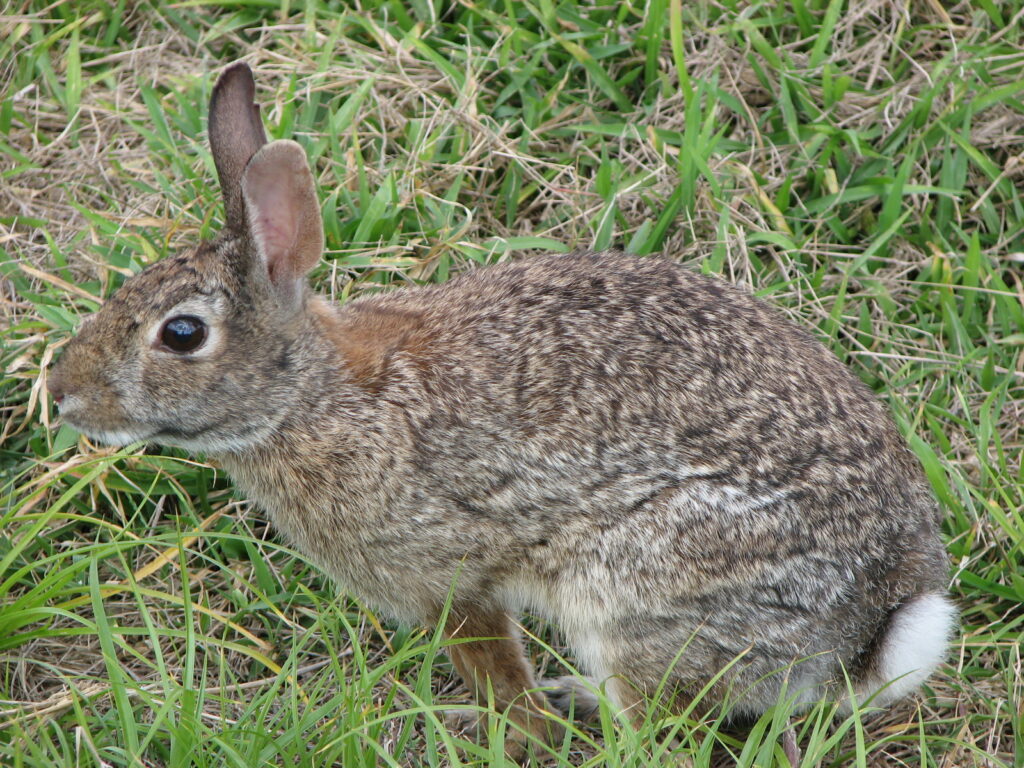
Eastern Cottontail
Photo © Dori at English Wikipedia
Photo © Dori at English Wikipedia — CC0 1.0 — Source: Wikimedia CommonsIdentification
The eastern cottontail is a medium-sized rabbit measuring 36–48 cm in total length, with adults typically weighing between 1.8 and 4.4 lb. Its most distinctive feature is the short, fluffy white tail that resembles a cotton ball—the source of its common name. The fur ranges from reddish-brown to grayish-brown on the upperparts, becoming more gray during winter months, while the underside is white with a characteristic rusty patch near the tail. Young kits are born with a white blaze down their forehead that fades as they mature.
Other identifying characteristics include large brown eyes, long ears adapted for detecting predators, and large hind feet. The species also displays a distinctive white spot on its forehead when young. Females tend to be slightly heavier than males, though the sexes broadly overlap in size. There is also notable geographic variation, with northern populations generally larger than their southern counterparts.
Range & Habitat
The eastern cottontail is the most widespread and abundant rabbit species in North America, with a range extending from southern Canada throughout most of the United States and into parts of Mexico, Central America, and the northern regions of South America. It is especially abundant across the North American Midwest. Originally absent from New England, the species has since been introduced there, and its range has also expanded to parts of Oregon, Washington, and British Columbia. The species was introduced to France, Italy, and Cuba, where it has become established.
Optimal habitat consists of open grassy areas, clearings, and old fields with abundant green vegetation, interspersed with shrubs or hedgerows providing escape cover. The species is highly adaptable and thrives in meadows, edge habitats, pastures, and grasslands. This adaptability to human-altered landscapes such as suburban and agricultural areas has been crucial to its success and stable population levels.
Behaviour & Diet
The eastern cottontail is a primarily herbivorous, crepuscular mammal, meaning it is most active during dawn and dusk. It feeds on grasses, herbs, twigs, and bark, adjusting its diet seasonally based on vegetation availability. The species plays an important ecological role as prey for a variety of predators including foxes, hawks, and owls.
The eastern cottontail is renowned for its high reproductive rate, with females capable of producing multiple large litters annually. This prolific breeding strategy contributes significantly to its widespread presence and population resilience, ensuring that despite heavy predation pressure, populations remain stable across its range.
Best Time & Places to See It
Eastern cottontails are most active during early morning and late afternoon hours, making these the optimal times for observation and photography. Look for them in open fields, meadows, old pastures, and brushy areas where they can easily find both food and cover. Edge habitats—the boundaries between open grassland and shrubby vegetation—are particularly productive locations, as these provide the combination of foraging areas and escape cover the species requires.
Given the species' wide distribution across North America and its adaptability to suburban and agricultural landscapes, eastern cottontails can be encountered throughout much of the eastern and central United States, the Midwest, and into southern Canada. Their abundance makes them relatively reliable subjects for nature travellers and photographers across this broad range.
Photography Tips
Photograph eastern cottontails during their active periods at dawn and dusk when light is soft and they are most likely to be foraging in the open. Position yourself near field edges where shrubs meet grassland, as cottontails habitually use these transition zones for feeding while remaining close to cover. A telephoto lens is essential to maintain distance and avoid disturbing these alert animals, which rely on their large ears and keen eyesight to detect threats.
The species' distinctive fluffy white tail is a key identifying feature worth emphasizing in photographs. When cottontails flee, they raise their white tails conspicuously, creating a striking photographic moment. Patience and stillness are crucial; move slowly and allow the rabbits to become accustomed to your presence. Early season photography in meadows and old fields will yield the most reliable encounters with this abundant but naturally cautious species.
Gulf Islands National Park Reserve
Southern Gulf Islands Electoral Area, Canada
+268 birds+26 mammals
Scattered across the Salish Sea in British Columbia's southwestern corner, this national park reserve stitches together a fragmented archipelago of forested islands and rocky outcrops where…
VIEW NATIONAL PARKMont-Saint-Bruno National Park
Saint-Bruno-de-Montarville, Canada
+200 birds+13 mammals
Hardwood forests rise steeply from the suburbs of Montreal to crown a distinctive peak in the Monterégian Hills, their ancient geology pushing through mixed deciduous woodland…
VIEW NATIONAL PARKNew River Gorge National Park
Fayette County, United States
+183 birds+13 mammals
Where the New River carves its ancient path through the Appalachian plateau, a landscape of towering sandstone cliffs and dense deciduous forest creates one of the…
VIEW NATIONAL PARKMammoth Cave National Park
Edmonson County, United States
+179 birds+13 mammals
Beneath the rolling hills of central Kentucky lies one of North America's most extensive cave systems, where limestone passages descend through a landscape shaped by water…
VIEW NATIONAL PARKIndiana Dunes National Park
Porter, United States
+304 birds+15 mammals
Along the southern shore of Lake Michigan, where glacial geology meets temperate woodland and open water, sprawls a landscape of extraordinary ecological complexity. The dunes themselves—massive…
VIEW NATIONAL PARKGreat Smoky Mountains National Park
Sevier County, United States
+244 birds+40 mammals
Where the southern Appalachian ridgeline reaches its most densely forested expression, over 4,200 square kilometres of temperate woodland rise and fall across Tennessee and North Carolina,…
VIEW NATIONAL PARKPoint Pelee National Park
Leamington, Canada
+296 birds+14 mammals
Where Lake Erie's shallow waters meet the Ontario shoreline, a slender sandy peninsula juts into the Great Lakes like a natural funnel for migrating wildlife. This…
VIEW NATIONAL PARKParque Nacional Benito Juárez
San Andrés Huayápam, Mexico
+128 birds+4 mammals
High in the Sierra Madre del Sur of Oaxaca, where cloud forest mingles with pine woodland and the terrain climbs steeply through ravines carved by mountain…
VIEW NATIONAL PARKMontes Azules
Candelaria, Mexico
+395 birds+47 mammals
Where jungle-clad limestone plateaus plunge into canyon systems carved by the Usumacinta River, Mexico's most pristine rainforest reserve unfolds across the Lacandón region of Chiapas. Montes…
VIEW BIOSPHERE RESERVEBadlands National Park
Wall, United States
+200 birds+14 mammals
Eroded badlands rise in jagged formations across northwestern South Dakota, where the White River has carved deep canyons through layers of sedimentary rock spanning millions of…
VIEW NATIONAL PARKCongaree National Park
Richland County, United States
+205 birds+12 mammals
Where the Congaree River winds through the lowlands of South Carolina, an old-growth bottomland forest of extraordinary character rises from a landscape shaped by seasonal floods…
VIEW NATIONAL PARKCuyahoga Valley National Park
Brecksville, United States
+255 birds+27 mammals
Where the Cuyahoga River carves through a glaciated landscape of Ohio, the valley reveals a temperate deciduous forest ecosystem shaped by four distinct seasons and reliable…
VIEW NATIONAL PARKShenandoah National Park
Page County, United States
+243 birds+31 mammals
Ridges of ancient quartzite rise above the Shenandoah Valley floor, their slopes dressed in a mosaic of oak and hickory forest that yields to cove hardwoods…
VIEW NATIONAL PARKWind Cave National Park
Custer County, United States
+175 birds+13 mammals
Beneath the rolling prairie of the Black Hills, a network of passages carved through limestone creates one of North America's most extensive cave systems. Wind Cave…
VIEW NATIONAL PARKMerritt Island National Wildlife Refuge
Brevard County, United States
+341 birds+19 mammals
Brackish marshes and palmetto scrub define this wildlife sanctuary spanning the coastal lowlands of central Florida, where the Atlantic tide meets freshwater systems in a dynamic…
VIEW WILDLIFE SANCTUARYOkefenokee National Wildlife Refuge
Charlton County, United States
+206 birds+14 mammals
Vast wetlands of cypress and blackwater creeks define this wildlife sanctuary straddling the Georgia–Florida border, where the landscape shifts between open marsh, dense swamp forest, and…
VIEW WILDLIFE SANCTUARYChincoteague National Wildlife Refuge
Chincoteague, United States
+362 birds+16 mammals
Across the barrier islands and salt marshes of Virginia's Eastern Shore, where Atlantic tides sculpt an intricate mosaic of sandy spits and tidal flats, lies one…
VIEW WILDLIFE SANCTUARYWichita Mountains National Wildlife Refuge
Medicine Park, United States
+256 birds+17 mammals
Granite peaks rise abruptly from rolling prairie in southwestern Oklahoma, where the Wichita Mountains National Wildlife Refuge protects a rare collision of ecosystems. This sanctuary encompasses…
VIEW WILDLIFE SANCTUARYLaguna Atascosa National Wildlife Refuge
Cameron County, United States
+365 birds+19 mammals
Where coastal prairie meets shallow lagoon along the southernmost tip of Texas, Laguna Atascosa National Wildlife Sanctuary sprawls across a landscape sculpted by salt spray and…
VIEW WILDLIFE SANCTUARYSanta Ana National Wildlife Refuge
Hidalgo County, United States
+349 birds+12 mammals
Where the Rio Grande delta meets the semi-arid scrublands of South Texas, Santa Ana National Wildlife Sanctuary preserves a rare mosaic of wetland and thornforest habitat…
VIEW WILDLIFE SANCTUARYWheeler National Wildlife Refuge
Triana, United States
+268 birds+10 mammals
Shallow impoundments and meandering channels spread across northern Alabama's humid subtropical landscape, where Wheeler National Wildlife Sanctuary anchors a critical junction of wetland and woodland habitat.…
VIEW WILDLIFE SANCTUARYBombay Hook National Wildlife Refuge
Kent County, United States
+323 birds+15 mammals
Tidal marshes and brackish shallows define this sanctuary on Delaware's Atlantic coast, where the meeting of freshwater and salt creates some of the Mid-Atlantic's most dynamic…
VIEW WILDLIFE SANCTUARYBlackwater National Wildlife Refuge
Fishing Creek, United States
+293 birds+15 mammals
Tidal marshes and brackish waterways define this wildlife sanctuary where the Chesapeake Bay's influence reshapes the landscape with every rise and fall of the water. Shallow…
VIEW WILDLIFE SANCTUARYPea Island National Wildlife Refuge
Dare County, United States
+356 birds+15 mammals
Where the Outer Banks taper toward the Atlantic, a sliver of barrier island creates a microcosm of coastal ecology. Pea Island National Wildlife Sanctuary spans over…
VIEW WILDLIFE SANCTUARYPelican Island National Wildlife Refuge
Windsor, United States
+265 birds+4 mammals
Where Florida's Indian River widens into a brackish estuary, a small island sanctuary commands the attention of waterbirds across the Atlantic Flyway. Pelican Island National Wildlife…
VIEW WILDLIFE SANCTUARYSt. Marks National Wildlife Refuge
Saint Marks, United States
+324 birds+16 mammals
Where the Apalachee Bay begins to define the Florida coastline, salt marshes and freshwater impoundments merge into one of the southeastern United States' most productive wildlife…
VIEW WILDLIFE SANCTUARYChassahowitzka National Wildlife Refuge
Homosassa, United States
+299 birds+14 mammals
Where the Gulf of Mexico's coastal marshes dissolve into brackish tidal flats and mangrove thickets, the Chassahowitzka National Wildlife Sanctuary near Homosassa represents one of Florida's…
VIEW WILDLIFE SANCTUARYPalo Verde National Park
Bagaces, Costa Rica
+318 birds+24 mammals
Dry forest spreads across Palo Verde's low-lying terrain in northwestern Guanacaste, where seasonal rivers and lagoons etch through deciduous woodland that sheds its canopy each winter.…
VIEW NATIONAL PARKRincón de la Vieja National Park
Liberia, Costa Rica
+451 birds+30 mammals
Where volcanic slopes rise abruptly from the Guanacaste lowlands, Rincón de la Vieja National Park sprawls across a landscape shaped by geothermal drama and seasonal extremes.…
VIEW NATIONAL PARKNo community photos yet. Log in to add the first one.
No community observations of this species yet.