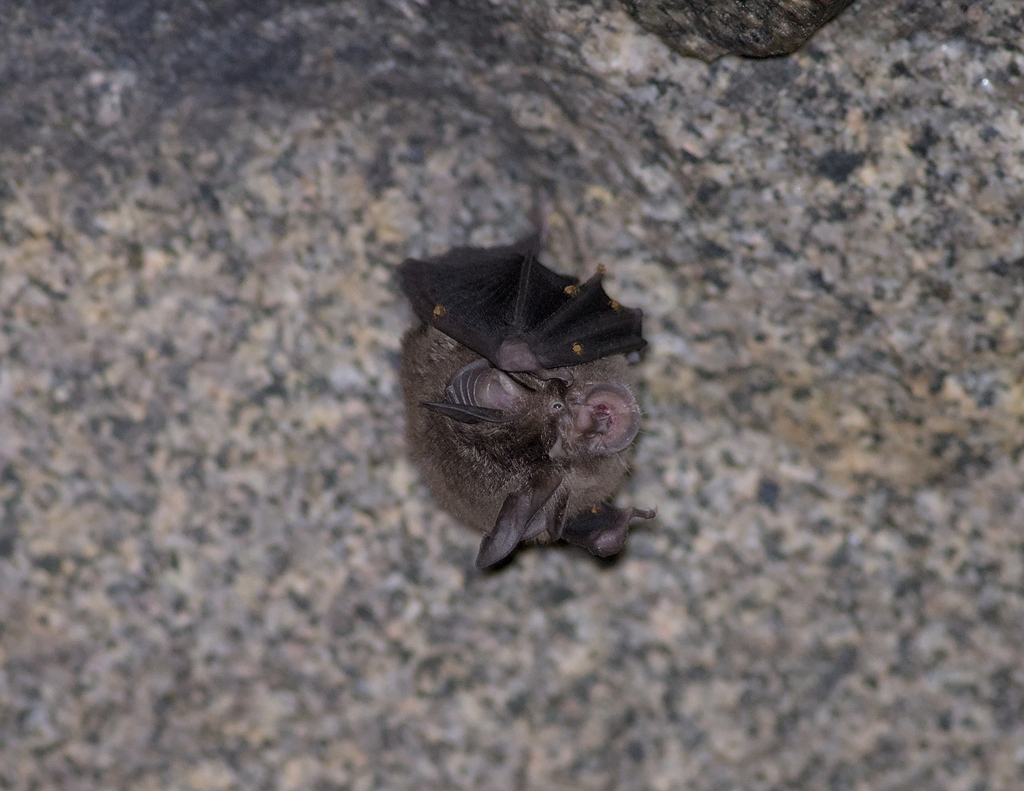
Eastern Horseshoe Bat
Photo © brandon_hewitt
Photo © brandon_hewitt — CC BY 4.0 — Source: iNaturalist #197884657Identification
The Eastern Horseshoe Bat is a small rhinolophid bat with a combined head and body length of 44–53 millimetres and a forearm measuring approximately 44–52 mm, weighing just 7 to 13 grams. Despite their diminutive size, they possess simple but large ears measuring 12–21 millimetres from base to finely pointed tip, and notably tiny eyes. The most distinctive feature is their pink nose-leaf—a fleshy structure characteristic of the genus Rhinolophus and essential for echolocation. The nose-leaf displays ridging on its upper surface aligned to a triangular point, with a structure emerging at its mid-point above the horseshoe-like protuberance at the base. This relatively simple nose-leaf is edged with grey.
Fur colour varies geographically, typically appearing as grey-brown above with paler undersides, though specimens from Queensland display rufous to orange coloration. They are readily distinguished from the similar large-eared horseshoe bat by their smaller ears (less than 25 mm) and simpler nose-leaf structure. In the southern parts of their range, their ultrasonic calls are easily distinguishable from other bat species, though geographic variation in vocalisation has not been thoroughly determined.
Range & Habitat
The Eastern Horseshoe Bat is found across eastern Australia and Papua New Guinea, with the species regarded as geographically isolated to these eastern regions. In Australia, their range extends from the tropical regions of Cape York Peninsula along the entire east coast and inland to the Great Dividing Range, reaching as far south as the temperate regions of Victoria. They inhabit altitudes up to 1,600 metres above sea level. Notably, their range extended westward in Victoria during the twentieth century, aided by colonisation of abandoned mine adits.
These bats favour caves and similar sheltered sites that provide adequate warmth and high humidity. Local populations are dependent on the availability of suitable daytime refuges and maternity roosts. Colonies can number up to two thousand individuals, though more typically comprise between five and fifty bats. Separate maternity sites are occupied for breeding, with females arriving in September or October to give birth and rear young, then departing to rejoin males for mating in March or April.
Behaviour & Diet
Eastern Horseshoe Bats display a distinctive fluttery flight pattern that allows them to make slow, agile manoeuvres while foraging within the forest. They glean insects close to surfaces at all levels of the forest canopy and frequently catch prey whilst in flight. Rather than clinging to walls, they hang from cave ceilings at their roosts, often cloaking their bodies with their wings and roosting apart from their neighbours.
Their diet is highly variable and selective, consisting mostly of Lepidoptera (butterflies and moths) and Coleoptera (beetles), though dietary choices are not consistent with seasonal targeting of particular taxa at any given location. Foraging behaviour remains consistent across their Australian range, with perch-waiting and gleaning of non-flying insects being infrequently recorded.
Best Time & Places to See It
Eastern Horseshoe Bats are common throughout suitable habitat across eastern Australia. Cave systems and abandoned mine shafts along the east coast and Great Dividing Range offer the best opportunities for observation. Cape York Peninsula represents the northern extent of their range, while Victoria marks their southern limit. The species is active year-round in Australian locations.
Maternity roosts become active from September through October when females gather for breeding and rearing young. These sites are abandoned in March or April when populations rejoin for mating, making these seasonal movements notable for tracking populations. Their presence in protected areas and their adaptation to abandoned mines means suitable habitat may be found across a wide geographic range.
Photography Tips
Photographing Eastern Horseshoe Bats presents challenges due to their small size, preference for cave habitats, and nocturnal behaviour. Cave systems and abandoned mine adits offer controlled environments where lighting can be carefully managed. Infrared or low-light photography techniques are essential, as traditional flash may disturb roosting colonies. The bats' characteristic hanging posture from cave ceilings and their habit of cloaking their bodies with wings creates distinctive silhouettes worth capturing.
The distinctive pink nose-leaf and large ears are key identifying features to highlight in close-up photography. Early morning or late evening sessions may offer opportunities to photograph bats in flight as they emerge or return to roosts. Exercise caution and respect when photographing in caves; minimise disturbance to colonies, particularly during maternity seasons (September through April) when females are caring for young. Always obtain necessary permits and follow local guidelines for cave access and wildlife photography.
Daintree National Park
Dedin, Australia
+362 birds+37 mammals
Daintree National Park is one of the world’s oldest and most biologically diverse tropical rainforests, protecting an extraordinary landscape where ancient forests meet the Great Barrier…
VIEW NATIONAL PARKSpringbrook National Park
Australia
+195 birds+25 mammals
Subtropical rainforest meets open eucalypt woodland across a mountainous terrain where the McPherson Range rises sharply from the Queensland coast, creating a patchwork of microclimates and…
VIEW NATIONAL PARKRoyal National Park
Sydney, Australia
+296 birds+46 mammals
Where sandstone ridges plunge toward the Tasman Sea, Royal National Park unfolds across 343 square kilometres of southeastern Australian coastal wilderness. The park's defining character emerges…
VIEW NATIONAL PARKMorton National Park
Australia
+253 birds+57 mammals
Across nearly 4,800 square kilometers of New South Wales's Southern Tablelands, rugged sandstone plateaus rise above sheltered valleys where cool-climate eucalypt woodland meets grassy heath and…
VIEW NATIONAL PARKGreat Sandy National Park
Australia
+306 birds+40 mammals
Where coastal dunes rise inland from the Queensland coastline, Great Sandy National Park encompasses a landscape of remarkable ecological diversity shaped by subtropical humid conditions year-round.…
VIEW NATIONAL PARKWooroonooran National Park
Australia
+240 birds+28 mammals
Where the Great Dividing Range rises sharply inland from Queensland's tropical coast, Wooroonooran National Park encompasses a landscape of steep, forested gorges and cascading waterways carved…
VIEW NATIONAL PARKBlue Mountains National Park
Australia
+220 birds+43 mammals
Dramatic sandstone cliffs rise in tiers across this mountainous plateau west of Sydney, their rust-coloured faces weathered into amphitheatres and gorges where eucalyptus forest clings to…
VIEW NATIONAL PARKKosciuszko National Park
Australia
+211 birds+52 mammals
Where the Great Dividing Range reaches its highest peaks in southeastern Australia, Kosciuszko National Park encompasses a landscape of windswept plateaus, rocky ridges, and deep river…
VIEW NATIONAL PARKBouddi National Park
Gosford, Australia
+147 birds+17 mammals
Sandstone ridges rise sharply from the Tasman Sea along the central New South Wales coast, their weathered faces etched by millennia of salt spray and storm…
VIEW NATIONAL PARKKu-ring-gai Chase National Park
Sydney, Australia
+216 birds+39 mammals
Where Hawkesbury sandstone cliffs plunge toward sheltered bays and creeks, Ku-ring-gai Chase National Park unfolds across rugged terrain just north of Sydney, a mosaic of eucalyptus…
VIEW NATIONAL PARKBarrington Tops National Park
Australia
+175 birds+47 mammals
Where the New England Plateau rises above the Hunter Valley, temperate rainforest cloaks the highest reaches of Barrington Tops, its dense canopy fed by year-round precipitation…
VIEW NATIONAL PARKNew England National Park
Australia
+169 birds+35 mammals
Temperate eucalypt woodlands and cool rainforest pockets define this upland reserve where granite peaks rise above the New England Plateau in northeastern New South Wales. Here,…
VIEW NATIONAL PARKBudawang National Park
Australia
+80 birds+17 mammals
Rugged sandstone ridges rise dramatically across the New South Wales Southern Tablelands, their weathered faces sculpted by millennia of wind and water into a landscape of…
VIEW NATIONAL PARKNo community photos yet. Log in to add the first one.
No community observations of this species yet.