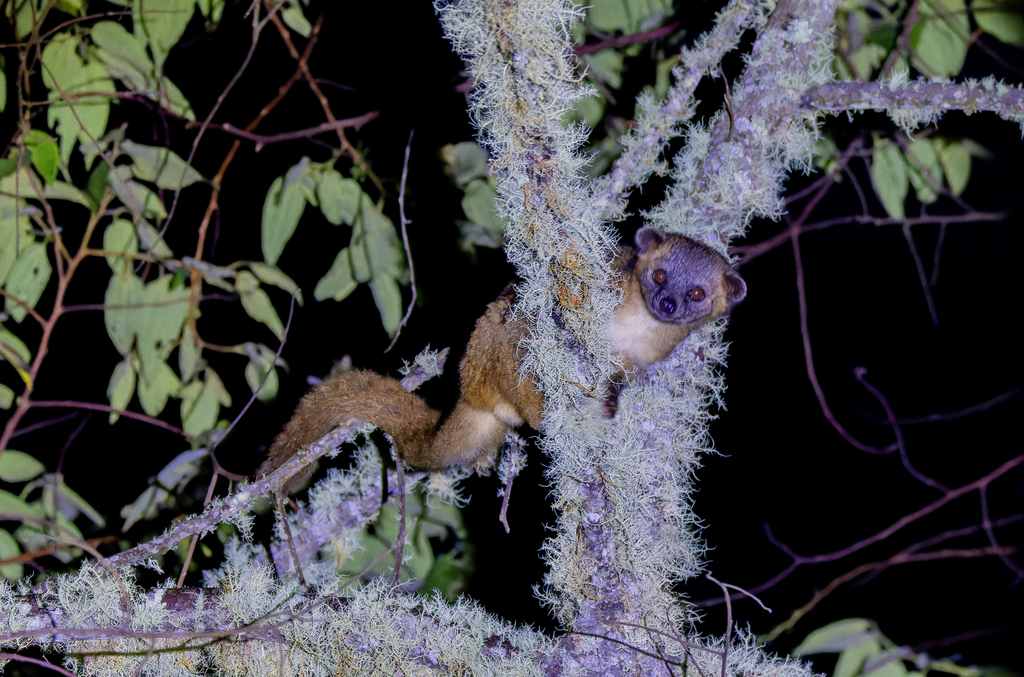
Eastern Lowland Olingo
Photo © David F. Belmonte
Photo © David F. Belmonte — CC BY 4.0 — Source: iNaturalist photo #456717097The eastern lowland olingo (Bassaricyon alleni) is a species of olingo from South America. The species is named after Joel Asaph Allen, the American zoologist who first described the genus. It is classified as Least Concern in the IUCN Red List. == Taxonomy == The eastern lowland olingo is a species in the genus Bassaricyon, within the family Procyonidae, which also includes raccoons, coatis, and kinkajous. The species is named after American zoologist Joel Asaph Allen, who first described the genus. The species itself was described by Oldfield Thomas in 1880. == Distribution and habitat == The olingo occurs across most of South America from the lowlands east of the Andes in Bolivia, Brazil, Colombia, Ecuador, Guyana, Peru and Venezuela. It is the only olingo species found east of the Andes. The closest relative of the eastern lowland olingo is the Western lowland olingo, from which it diverged about 1.3 million years ago. It is classified as Least Concern in the IUCN Red List. == Description and behavior == The eastern lowland olingo is smaller than the northern olingo, but is larger than the little olingo, the most montane member of the genus. It is larger than the western lowland…
Sumaco Napo-Galeras National Park
Loreto, Ecuador
+563 birds+4 mammals
Where Ecuador's Amazon transitions into cloud forest, a massive shield volcano rises from the emerald lowlands of Orellana Province, anchoring one of the continent's most biodiverse…
VIEW NATIONAL PARKNatural Serranía de los Yariguíes National Park
El Carmen de Chucurí, Colombia
+320 birds+3 mammals
Where the northern cordilleras of Colombia rise toward cloud forest, the Serranía de los Yariguíes unfolds across nearly 1,820 square kilometers of some of the most…
VIEW NATIONAL PARKSerra do Divisor National Park
Brazil
+448 birds+10 mammals
Where the western Amazon meets the Andes foothills, Serra do Divisor National Park sprawls across one of South America's most biodiverse and least accessible frontiers. Spanning…
VIEW NATIONAL PARKNo community photos yet. Log in to add the first one.
No community observations of this species yet.